Thank you for visiting SNEWPapers!
Sign up free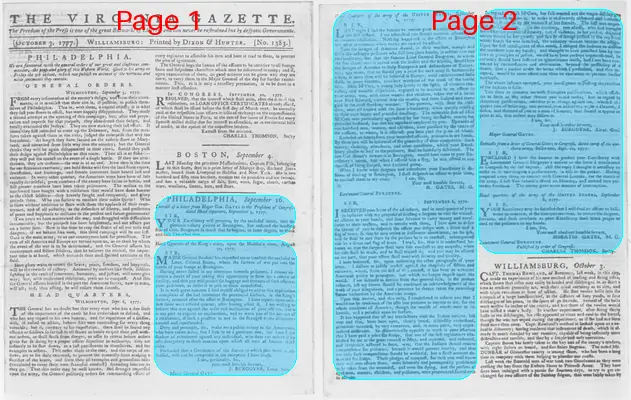
The Virginia Gazette
Richmond, Williamsburg, Richmond County, Virginia
What is this article about?
Correspondence between American Gen. Gates and British Gen. Burgoyne in September 1777, addressing the Bennington victory, prisoner mistreatment claims, and atrocities by Native allies, including the scalping of Miss McCrea. Arrangements for prisoner care are made amid mutual accusations.
Merged-components note: These components form a single coherent story detailing the exchange of letters between Generals Gates and Burgoyne regarding the Battle of Bennington and related events; the label is changed from domestic_news for the third component to story as it is a narrative article.
Clippings
1 of 2
OCR Quality
Full Text
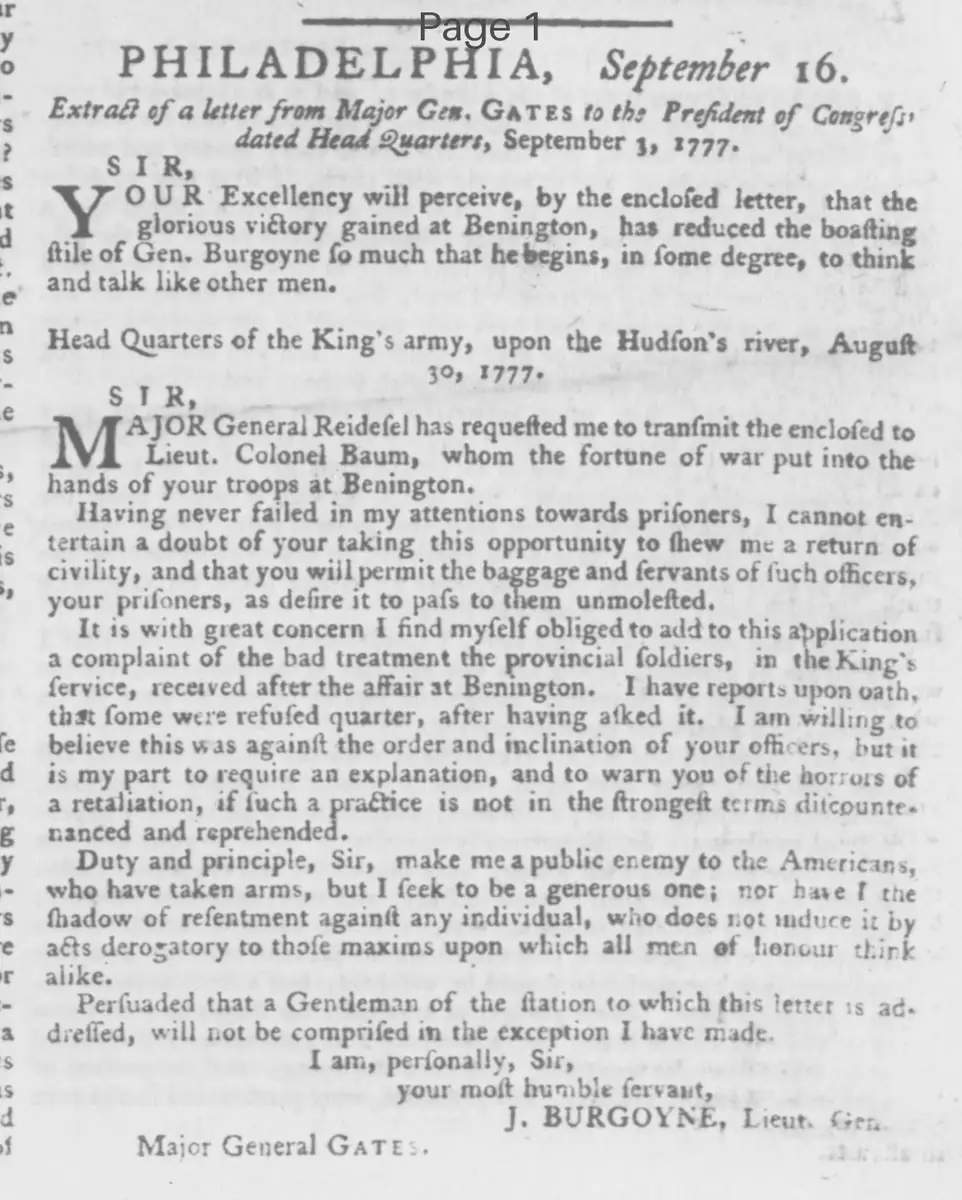
Extract of a letter from Major Gen. GATES to the President of Congress, dated Head Quarters, September 1, 1777:
SIR,
OUR Excellency will perceive, by the enclosed letter, that the glorious victory gained at Bennington, has reduced the boasting stile of Gen. Burgoyne so much that he begins, in some degree, to think and talk like other men.
Head Quarters of the King's army, upon the Hudson's river, August 30, 1777.
SIR,
MAJOR General Reidefel has requested me to transmit the enclosed to Lieut. Colonel Baum, whom the fortune of war put into the hands of your troops at Bennington.
Having never failed in my attentions towards prisoners, I cannot entertain doubt of your taking this opportunity to shew me a return of civility, and that you will permit the baggage and servants of such officers, your prisoners, as desire it to pass to them unmolested.
It is with great concern I find myself obliged to add to this application a complaint of the bad treatment the provincial soldiers, in the King's service, received after the affair at Bennington.
I have reports upon oath, that some were refused quarter, after having asked it. I am willing to believe this was against the order and inclination of your officers, but it is my part to require an explanation, and to warn you of the horrors of a retaliation, if such a practice is not in the strongest terms discountenanced and reprehended.
Duty and principle, Sir, make me a public enemy to the Americans, who have taken arms, but I seek to be a generous one; nor have I the shadow of resentment against any individual, who does not induce it by acts derogatory to those maxims upon which all men of honour think alike.
Persuaded that a Gentleman of the station to which this letter is addressed, will not be comprised in the exception I have made.
I am, personally, Sir,
your most humble servant,
J. BURGOYNE, Lieut. Gen.
Major General Gates.
Head Quarters of the army of the United States,
September 1777.
SIR,
Last night I had the honour to receive your Excellency's letter of the first instant. I am astonished you should mention inhumanity, or threaten retaliation. Nothing happened in the action at Bennington but what is common when works are carried by assault. That the savages of America should, in their warfare, mangle and scalp the unhappy prisoners who fall into their hands, is neither new nor extraordinary, but that the famous Lieut. General Burgoyne, in whom the fine Gentleman is united with the soldier and the scholar, should hire the savages of America to scalp Europeans and descendants of Europeans, is more than will be believed in Europe, until authenticated facts shall, in every Gazette, convince mankind of the truth of the horrid tale. Miss McCrea, a young lady lovely to the sight, of virtuous character, and amiable disposition, engaged to be married to an officer in your army, was, with other women and children, taken out of a house near Fort Edward, carried into the woods, and there scalped and mangled in the most shocking manner. Two parents, with their six children, were all treated with the same inhumanity, while quietly residing in their once happy and peaceful dwelling. The miserable fate of Miss McCrea was particularly aggravated by her being dressed to receive her promised husband, but met her murderer employed by you. Upwards of one hundred men, women, and children, have perished by the hands of the ruthless, to whom, it is asserted, you have paid the price of blood. By them you will be informed of the generosity of their conquerors. Such barbarous and blood-thirsty allies you have, Sir, to assist you in your projects of conquest and devastation.
Enclosed are letters from your wounded officers, prisoners in my hands. The money, clothing, attendants, and other necessaries, which your Excellency pleases to send to the prisoners, shall be faithfully delivered. The late Col. Baum's servant is at Bennington, would have come to your Excellency's camp, but when I offered him a flag, he was afraid to run the risk of being scalped, and declined going.
When I know what surgeon and attendants your Excellency is desirous of sending to Bennington, I shall despatch an officer to your lines, to conduct them to my camp.
I am, Sir,
Your most humble servant,
H. GATES, M. G.
Lieutenant General Burgoyne,
SIR,
September 6, 1777.
I RECEIVED your letter of the 2d instant, and in consequence of your compliance with my proposal of sending a surgeon to visit the wounded officers in your hands, and some servants to carry money and necessaries to their masters, and to remain with them, I have now to desire the favour of you to despatch the officer you design with a drum and a flag of truce, so that he may arrive at Stillwater about noon, on the 9th, and he shall be met there by the persons he is to conduct, accompanied also by a drum and flag of truce. I trust, Sir, that it is understood between us that the surgeon shall have a safe conduct to my outposts, when his visit shall be made, and he shall request it; and you may be assured on my part, that your officer shall meet with security and civility.
I have hesitated, Sir, upon answering the other paragraphs of your letter. I disdain to justify myself against the rhapsody of fiction and calumny, which, from the first of this contest, has been an unvaried American policy to propagate, but which no longer impose upon the world. I am induced to deviate from this general rule, in the present instance, lest my silence should be construed an acknowledgment of the truth of your allegations, and a pretence be thence taken for exercising future barbarities by the American troops.
Upon this motive, and this only, I condescend to inform you that I would not be conscious of the acts you presume to impute to me, for the whole continent of America, though the wealth of worlds were in its bowels, and a paradise upon its surface.
It has happened that all my transactions with the Indian nations, last year and this, have been open, clearly heard, distinctly understood, accurately minuted, by very numerous, and, in many parts, very unprejudiced audiences. So diametrically opposite to truth is your assertion that I have paid a price for scalps, that one of the first regulations established by me at the great council in May, and repeated, and enforced, and invariably adhered to since, was, that the Indians should receive compensation for prisoners, because it would prevent cruelty, and that not only such compensation should be withheld, but a strict account demanded for scalps. These pledges of conquest, for such you well know the will ever esteem them, were solemnly and peremptorily prohibited to be taken from the wounded, and even the dying, and the persons of aged men, women, children, and prisoners, were pronounced sacred even in assaults.
In regard to Miss McCrea, her fall wanted not the tragic display you have laboured to give it, to make it as sincerely abhorred and lamented by me as it can be by the tenderest of her friends. The fact was no premeditated barbarity. On the contrary, two chiefs, who had brought her off for the purpose of security, not of violence, to her person, disputed which should be her guard; and in a fit of savage passion, in the one from whose hands she was snatched, the unhappy woman became the victim. Upon the first intelligence of this event, I obliged the Indians to deliver the murderer into my hands; and though to have punished him by our laws or principles of justice, would have been perhaps unprecedented, he certainly should have suffered an ignominious death, had I not been convinced by circumstances and observation, beyond the possibility of a doubt, that a pardon under the terms which I prescribed, and they accepted, would be more efficacious than an execution to prevent similar mischiefs.
The above instance excepted, your intelligence respecting the cruelties of the Indians is false.
You seem to threaten me with European publications, which affects me as little as any other threats you could make; but in regard to American publications, whether your charge against me, which acquaints you of believing, was penned from a Gazette, or for a Gazette, I desire, and demand of you as a man of honour, that should it appear in print at all, this answer may follow it.
I am, Sir,
Your most humble servant,
J.
BURGOYNE, Lieut. Gen.
Major General Gates.
Extracts from a letter of General Gates to Congress, dated camp of the northern army, Stillwater, Sept. 10, 1777.
SIR.
Enclosed Lieutenant General Burgoyne's answer to the letter I transmitted to Congress by the last express. All the reply I thought it necessary to make to so extravagant a performance, is also in the packet.
Having prepared everything in concert with General Lincoln, for the march of the army, I left Van Schack's Island on Monday, and arrived here yesterday forenoon. The enemy gave us no manner of interruption.
Head quarters of the army of the UNITED STATES,
September 8, 1777.
SIR,
The surgeon will wait on you to-morrow at the time you mention to receive the servants and such comforts as your Excellency shall think proper to send to the prisoners in my hands.
I am, Sir,
Your most obedient humble servant,
HORATIO GATES, M. G.
Lieutenant General Burgoyne.
Published by order of Congress.
CHARLES THOMSON, Secy.
What sub-type of article is it?
What themes does it cover?
What keywords are associated?
What entities or persons were involved?
Where did it happen?
Story Details
Key Persons
Location
Head Quarters On Hudson's River, Bennington, Fort Edward, Stillwater, Van Schack's Island
Event Date
August 30, 1777 To September 10, 1777
Story Details
Exchange of letters between Burgoyne and Gates following the American victory at Bennington. Burgoyne requests return of prisoner baggage and complains of mistreatment of his troops. Gates accuses Burgoyne of employing Native Americans who committed atrocities, including the scalping of Miss McCrea and others. Burgoyne denies hiring savages for scalping, explains regulations against it, and details the circumstances of Miss McCrea's death. Further correspondence arranges for surgeons and servants to visit wounded prisoners.