Thank you for visiting SNEWPapers!
Sign up free
Twin City Observer
Minneapolis, Saint Paul, Hennepin County, Ramsey County, Minnesota
What is this article about?
Biography of Francis Ellis Rivers, a self-made Black man who rose from a meat market owner and postal worker to become New York City's first Negro judge in 1943, despite racial obstacles in education, career, and bar association membership.
Merged-components note: Headline, story, and continuation on life of Judge Rivers from page 1 to page 5; spatial adjacency for headline and story.
Clippings
1 of 2
OCR Quality
Full Text
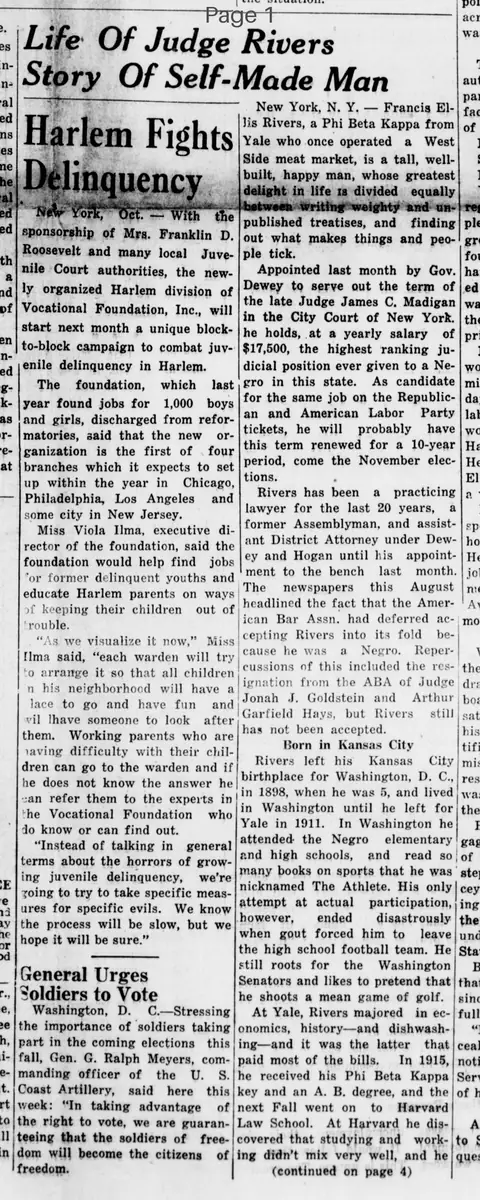
Story Of Self-Made Man
New York. N. Y. - Francis Ellis Rivers, a Phi Beta Kappa from Yale who once operated a West Side meat market, is a tall, well-built, happy man, whose greatest delight in life is divided equally between writing weighty and unpublished treatises, and finding out what makes things and people tick.
Appointed last month by Gov. Dewey to serve out the term of the late Judge James C. Madigan in the City Court of New York, he holds, at a yearly salary of $17,500, the highest ranking judicial position ever given to a Negro in this state. As candidate for the same job on the Republican and American Labor Party tickets, he will probably have this term renewed for a 10-year period, come the November elections.
Rivers has been a practicing lawyer for the last 20 years, a former Assemblyman, and assistant District Attorney under Dewey and Hogan until his appointment to the bench last month.
The newspapers this August headlined the fact that the American Bar Assn. had deferred accepting Rivers into its fold because he was a Negro. Repercussions of this included the resignation from the ABA of Judge Jonah J. Goldstein and Arthur Garfield Hays, but Rivers still has not been accepted.
Born in Kansas City Rivers left his Kansas City birthplace for Washington, D. C. in 1898, when he was 5, and lived in Washington until he left for Yale in 1911. In Washington he attended the Negro elementary and high schools, and read so many books on sports that he was nicknamed The Athlete. His only attempt at actual participation, however, ended disastrously when gout forced him to leave the high school football team. He still roots for the Washington Senators and likes to pretend that he shoots a mean game of golf.
At Yale, Rivers majored in economics, history-and dishwashing-and it was the latter that paid most of the bills. In 1915, he received his Phi Beta Kappa key and an A. B. degree, and the next Fall went on to Harvard Law School. At Harvard he discovered that studying and working didn't mix very well, and he left after the first year for a job as an inspector at the Winchester firearms plant, hoping to make enough money so that he might return to his studies. That was in 1917, however, and in June he entered Officers' Training School at Des Moines instead.
Opened Meat Market
On May 27, 1918, the young lieutenant married Lucy Ellen Miller, whom he had met just four months before, and nine days later sailed for France. Overseas he fought through many campaigns, including the Meuse-Argonne offensive, and returned to New York in May of 1919.
Temporarily giving up the idea of returning to his law work, Rivers, with two of his World War buddies, opened the Roosevelt Meat Market, at 142d St. and Seventh Ave., and ran it for about six months.
"We just decided it wasn't such hot idea." Rivers says with a grin, "and we sold it. We got back most of our money, but I guess I still don't know how to slice a steak."
With his meat market behind him, Rivers decided to look for a banking or insurance job, and made up a list of 60 firms he would like to work for. But, because he was a Negro, he was not accepted by one.
"It just didn't work out." Rivers says, "so I just went into the Post Office. I want to call it I did the best job of separation of mail ever."
Elected to Assembly
In 1921, Rivers entered Columbia Law School, and that June received his L.L.B. It was the same Judge Jonah J. Goldstein who is now fighting for his admittance to the ABA who gave Rivers his first chance as a lawyer, and Rivers worked in his office until he set up his own in 1925.
From there on things went smoothly for the young lawyer. Always a Republican, he was elected in 1929 to the Assembly, where he introduced legislation forcing landlords to repair building violations, and also setting up the 10th Municipal Court and adding two judges to that court as well as six judges to courts in other sections of Manhattan.
When, in 1930, he ran for the job he had created, however, he found himself defeated by 700 votes out of 30,000. In 1938 he was appointed Assistant DA by District Attorney Dewey.
A very young 50, Rivers is tall, conservatively dressed man whose impish grin and hearty laugh belie the dignity given him by his aquiline features, bronze skin and silvery hair. On the bench his analytical mind and strong curiosity lead him to probe each case carefully, and his judgments are never hasty. People are his hobby, and more than anything else he wants to know what makes them run. As an interviewee he is difficult, because within five minutes he is doing all the asking and the interviewer is doing all the answering.
Off the bench Rivers is pretty much of a homebody. He is particularly fond of the movies. He analyzes them, too, and likes mysteries, where he can try his own hand at sleuthing. He reads widely, but sees to it that his selection includes a liberal sprinkling of detective novels. He still is enormously fond of sports, and plays golf whenever he has a chance to.
From 140 to 99
"I've been able to shoot as high as 140 and as low as 99," he says, "but no one can tell you how to play golf better than I can."
He likes to swim, too, but hesitates to analyze his stroke.
"Like all my other sports," he says, "I learned how out of a book, and I think I must have gotten the pages a little mixed up."
A lot of his spare time, Rivers says, is spent writing articles, mostly about the war and its causes. His most recent is "Challenge of the Axis," which he calls analysis of the German war machine.
"Of course, they've never been published," he admits, "They're so heavy they put even my best friends to sleep. But they're all great writings," he adds, with a wink.
Although he takes a kid's delight in joshing himself, Rivers takes his work seriously. His ambition is not for power, but rather for the opportunity to do his job well.
"What I want is to be a fair and impartial judge—a learned and a human judge," he says.
What sub-type of article is it?
What themes does it cover?
What keywords are associated?
What entities or persons were involved?
Where did it happen?
Story Details
Key Persons
Location
New York City, Washington D.C., Kansas City
Event Date
1893 1943
Story Details
Francis Ellis Rivers, a Black Yale graduate and Phi Beta Kappa, overcame racial barriers to become a lawyer, assemblyman, and in 1943, the first Negro appointed to New York City's highest judicial position, serving out Judge Madigan's term.