Thank you for visiting SNEWPapers!
Sign up free
The Enquirer
Richmond, Henrico County, Virginia
What is this article about?
In the Virginia House of Delegates on January 18, debate on a judiciary bill to reorganize chancery courts and assign chancery duties to general court judges faced strong constitutional objections from Messrs. Smyth and Semple, citing past rulings like Kamper vs. Hawkins. The bill and related motions were defeated; a postponement of constitutional convention recommendation passed 99-58.
Merged-components note: Report on House of Delegates judiciary debate and related motions; relabeling 'story' components to 'domestic_news' for consistency.
Clippings
1 of 2
OCR Quality
Full Text
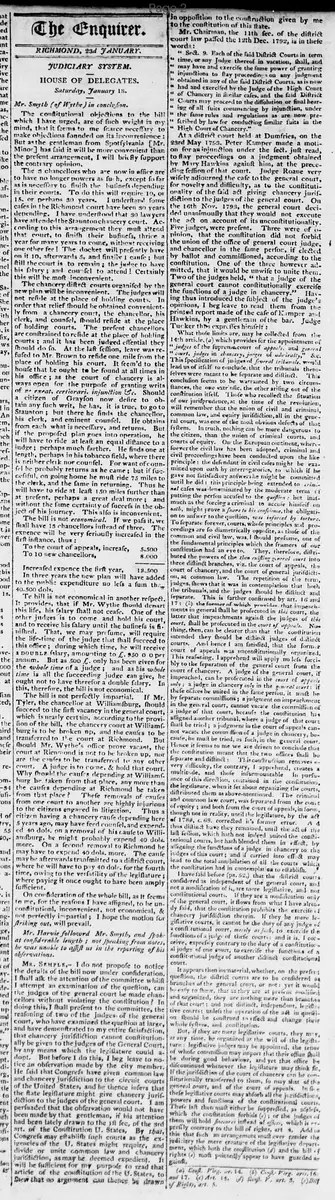
RICHMOND, 23d JANUARY.
JUDICIARY SYSTEM.
HOUSE OF DELEGATES.
Saturday, January 18.
Mr. Smyth (of Wythe) in conclusion.
The constitutional objections to the bill which I have urged, are of such weight in my mind, that it seems to me scarce necessary to make objections founded on its inconvenience: But as the gentleman from Spottsylvania [Mr. Minor] has said it will be more convenient than the present arrangement, I will briefly support the contrary opinion.
The 3 chancellors who are now in office are to have no longer powers as such, except so far as is necessary to finish the business depending in their courts. To do this will require 10, or 15, or perhaps 30 years. I understand some cases in the Richmond court have been 20 years depending. I have understood that 20 lawyers have attended the Staunton chancery court. According to this arrangement they must attend that court, to finish their business, thrice a year for many years to come, without receiving one other fee! The docket will presently have on it 10, afterwards 5, and finally 1 cause; but still the court is to remain: the judge to have his salary; and counsel to attend! Certainly this will be most inconvenient.
The chancery district courts organised by the new plan will be inconvenient. The judges will not reside at the place of holding courts. In order that relief should be obtained conveniently from a chancery court, the chancellor, his clerk, and counsel, should reside at the place of holding courts. The present chancellors are constrained to reside at the place of holding courts: and it has been judged essential they should do so. At the last session, leave was refused to Mr. Brown to reside one mile from the place of holding his court. It seemed to the house that he ought to be found at all times in his office; as the court of chancery is always open for the purpose of granting writs of ne exeat, certiorari, injunction &c. Should a citizen of Grayson now desire to obtain any such writ, he has, it is true, to go to Staunton; but there he finds the chancellor, his clerk, and eminent counsel. He obtains from each what is necessary, and returns. But if the proposed plan goes into operation, he will have to ride at least an equal distance to a judge; perhaps much farther. He finds one at length, perhaps in his tobacco field, where there is neither clerk nor counsel. For want of counsel he probably returns as he came: but if successful, on going home he must ride 75 miles to the clerk, and the same in returning. Thus he will have to ride at least 150 miles further than at present, perhaps a great deal more; and without the same certainty of success in the object of his journey. This also is inconvenient.
The bill is not economical. If we pass it, we shall have 15 chancellors instead of three. The expense will be very seriously increased in the first instance, thus:
To the court of appeals, increase, 5,500
To 10 new chancellors, 8,000
Increased expense the first year, 13,500
In three years the new plan will have added to the public expenditure no less a sum than 40,500 dols.
The bill is not economical in another respect. It provides, that if Mr. Wythe should depart this life, his Salary shall not cease. One of the other judges is to come and hold his court and to receive his salary until the business is finished. That, we may presume, will require the life-time of the judge that shall succeed to this office; during which time, he will receive a double salary, amounting to £. 950 0 0 per annum. But as £. 500 only has been given for the whole time of a judge; and as his whole time is all the succeeding judge can give, he ought not to have therefor a double salary. In this, therefore, the bill is not economical.
The bill is not perfectly impartial. If Mr. Tyler, the chancellor at Williamsburg, should succeed to the first vacancy in the general court, which is nearly certain, according to the provision of the bill, the chancery court at Williamsburg is to be broken up, and the causes to be transferred to the court at Richmond. But should Mr. Wythe's office prove vacant, the court at Richmond is not to be broken up, nor are the causes to be transferred to any other court. A judge is to come, & hold that court. Why should the causes depending at Williamsburg be taken from that place, any more than the causes depending at Richmond be taken from that place? These removals of causes from one court to another are highly injurious to the citizens engaged in litigation. Thus a citizen having a chancery cause depending here 5 years ago, may have fee'd counsel, and expended 40 dols. on a removal of his cause to Williamsburg, he might probably expend 40 dols. more. On a second removal to Richmond he may have to expend 40 dols. more. The cause may be afterwards transmitted to a district court, where he will have to pay 40 dols. for the fourth time, owing to the versatility of the legislature; where paying it once ought to have been amply sufficient.
On consideration of the whole bill, as it seems to me, for the reasons I have assigned, to be unconstitutional, inconvenient, not economical, & not perfectly impartial; I hope the motion for striking out, will prevail.
Mr. Harvie followed Mr. Smyth, and spoke at considerable length; not speaking from notes, he was unable to assist us in the reporting of his observations.
MR. SEMPLE,— I do not propose to notice the details of the bill now under consideration. I shall ask the attention of the committee whilst I attempt an examination of the question, can the judges of the general court be made chancellors without violating the constitution? In doing this, I shall present to the committee, the reasoning of two of the judges of the general court, who have examined the question at large, and have demonstrated to my entire satisfaction, that chancery jurisdiction cannot constitutionally be given to the judges of the General Court, by any means which the legislature could adopt. But before I do this, I beg leave to notice an observation made by the city member. He said that Congress have given common law and chancery jurisdiction to the circuit courts of the United States, and he thence infers that the State legislature might give chancery jurisdiction to the judges of the general court. I am persuaded that the observation would not have been made by that gentleman, if his attention had been lately drawn to the 1st sec. of the 3rd art. of the Constitution U. States. By that, Congress may establish such courts as the exigencies of the U. States might require, and divide or unite common law and chancery jurisdiction, as may be deemed expedient. It will be sufficient for my purpose to read that article of the constitution of the U. States, to show that no argument can thence be drawn in opposition to the construction given by me to the constitution of this State.
Mr. Chairman, the 11th sec. of the district court law passed the 12th Dec. 1792, is in these words:
"Sec. 9. Each of the said District Courts in term time, or any Judge thereof in vacation, shall, and may have and exercise the same power of granting injunctions to stay proceedings on any judgment obtained in any of the said District Courts, as is now had and exercised by the Judge of the High Court of Chancery in similar cases, and the said District Courts may proceed to the dissolution or final hearing of all suits commencing by injunction, under the same rules and regulations as are now prescribed by law for conducting similar suits in the High Court of Chancery."
At a district court held at Dumfries, on the grand May 1793, Peter Kamper made a motion for an injunction under the sec. just read, to stay proceedings on a judgment obtained by Mary Hawkins against him, at the preceding session of that court. Judge Roane very wisely adjourned the case to the general court, for novelty and difficulty, as to the constitutionality of the said act giving chancery jurisdiction to the judges of the general court. On the 16th Nov. 1793, the general court decided unanimously that they would not execute the act on account of its unconstitutionality. Five judges, were present. Three were of opinion, that the constitution did not forbid the union of the office of general court judge, and chancellor in the same person, if elected by ballot and commissioned, according to the constitution. One of the three however admitted, that it would be unwise to unite them. Two of the judges held, "that a judge of the general court cannot constitutionally exercise the functions of a judge in chancery."
Having thus introduced the subject of the judge's opinions, I beg leave to read them from the printed report made of the case of Kamper vs. Hawkins, by a gentleman of the bar. Judge Tucker thus expresses himself:
What those limits are, may be collected from the 14th article. (a) which provides for the appointment of "judges of the supreme court of appeals, and general court, judges in chancery, judges of admiralty," &c. This specification of judges of several tribunals, would lead us of itself to conclude, that the tribunals themselves were meant to be separate and distinct. This conclusion seems to be warranted by two circumstances, the one extrinsic, the other arising out of the constitution itself. Those who recollect the situation of our jurisprudence, at the time of the revolution, will remember that the union of civil and criminal, common law, and equity jurisdiction, all in the general court, was one of the most obvious defects of that system. In truth, nothing can be more dangerous to the citizen, than the union of criminal courts, and courts of equity. On the European continent, wherever the civil law has been adopted, criminal and civil proceedings have been conducted upon the like principle: the defendant in civil cases might be examined upon oath by interrogatories, to which if he gave not satisfactory answers he might be committed until he did: this principle being extended to criminal cases was denominated by the moderate term (f) of putting the person accused to the question: but inasmuch as the forcing a criminal to accuse himself on oath, might prove a snare to his conscience, the obligation to answer to the question, was enforced by torture.
To separate forever, courts, whose principles and proceedings are so diametrically opposite, as those of the common and civil law, was, I should presume, one of the fundamental principles which the framers of our constitution had an eye to. They, therefore, distributed the powers of the then existing general court into three distinct branches, viz. the court of appeals, the court of chancery, and the court of general jurisdiction, at common law. The repetition of the term, judges, shows that it was in contemplation that both the tribunals, and the judges should be distinct and separate. This is further confirmed by art. 16 and 17: (a) the former of which provides that impeachments in general shall be prosecuted in this court, the latter that impeachments against the judges of this court, shall be prosecuted in the court of appeals. Nothing, then, can be clearer than that the constitution intended they should be distinct judges of distinct courts. And hence I am satisfied, that the former court of appeals was unconstitutionally organized.
This reasoning, I apprehend will apply no less forcibly to the separation of the general court from the court of chancery. A judge of the general court, if impeached, can be prosecuted in the court of appeals only; a judge in chancery only in the general court: if these offices be united in the same person, it must be by separate commissions; a judgment on impeachment in the general court, cannot vacate the commission of a judge of that court, because the constitution has assigned another tribunal, where a judge of that court shall be tried; a judgment in the court of appeals cannot vacate the commission of a judge in chancery, because, he must be tried, as such, in the general court. Hence it seems to me we are driven to conclude that the constitution meant that the two offices shall be separate and distinct: This construction removes every difficulty, the contrary, I apprehend, creates a multitude, and those insurmountable. In pursuance of this direction, contained in the constitution, the legislature, when it set about organizing the courts, distributed them as above-mentioned. The criminal and common law court, was separated from the court of equity; and both from the court of appeals, in form, though not in reality, until the legislature, by the act of 1788, c. 65, corrected it's former error. And thus distinct have they remained, until the act of the last session, which hath not indeed united the constitutional courts, but hath blended them in effect, by assigning the functions of a judge in chancery to the judges of this court; and if carried into effect, may lead to the total annihilation of all the courts which the constitution had in contemplation to establish.
I have said before (pa. 52,) that the district courts considered as independent of the general court, and not a modification of it, are mere legislative, and not constitutional courts. If they are a modification only of the general court, it flows from what I have already said, that the constitution prohibits the exercise chancery jurisdiction therein. If they be mere legislative courts, it cannot be the duty of any judge of a constitutional court, merely as such, to exercise the functions of a judge of these courts: and it is, I conceive, expressly contrary to the duty of a constitutional judge of one court, to exercise the functions of a constitutional judge of another distinct constitutional court.
It appears then immaterial, whether, on the present question, the district courts are to be considered as branches of the general court, or not: yet it would be easy to show, that as they are at present modified and organized, they are nothing more than branches of that court; and not distinct, independent, legislative courts; unless the operation of the act in question should be construed to effect and change their whole system, and constitution.
But, if they are mere legislative courts, they may, at any time, be organized at the will of the legislature: legislative judges may be appointed, the terms of whose commission may import that their office shall be during good behaviour, and yet that office be discontinued whenever the legislature may think fit.
If the jurisdiction of the court of chancery can be constitutionally transferred to them, so may that of the general court, and of the court of appeals. In fine, these legislative courts may absorb all the jurisdictions, powers and functions of the constitutional courts. These last then must either be suppressed, as useless, which the constitution forbids (c); or the judges of them will hold sinecures instead of offices, which is even expressly contrary to the bill of rights, art. 4, (d) add to this that such an arrangement must ever render the judiciary the mere creature of the legislative department, which both the constitution (e) and the bill of rights (f) most pointedly appear to have guarded against.
(a Con. Virg. art.14. (b) Const: Virg. art.16, and 17. (c)Art. 14. (d) Const. V. art. 3. (e)Bill of Rights, art. 5.
Judge Nelson (at this time also a judge of the general court) reasons thus on the subject:
2. The second point—whether it be unconstitutional is next to be considered.
By the fourteenth section of the Constitution, the two houses of Assembly shall, by joint ballot, appoint Judges of the Supreme Court of Appeals, and general court, Judges in Chancery, Judges of Admiralty, &c.
I was at first inclined to think that the insertion of the word Judges between the General Court and Chancery, evinced an intention that the judges of the general court and those in chancery should be distinct persons; but perhaps it would be unjustifiable to rest such an opinion on so critical a construction.
However this opinion is supported by the sixteenth and seventeenth sections.
By the sixteenth the governor and others offending against the state by mal-administration, corruption, &c. are impeachable before the general court. And—
By the seventeenth the judges of the general court are to be impeached before the court of appeals.
This might prove then that a judge of the general court could not according to the Constitution be a judge of the supreme court of appeals, because all officers (except the judges of the general court,) are to be tried before the general court; but judges of the general court are to be tried before the court of appeals—and the Constitution intended to prevent a man being tried in that court of which he is a member; because in cases which might give rise to an impeachment, the judges of a court might act jointly, and the influence of partiality or an esprit du corps was to be guarded against.
However to decide whether a judge of the general court could be a judge of the court of appeals would be extrajudicial as that question is not before the court, but this research enables me to decide the question that is before the court—that is, whether the same person can under the Constitution be a judge in chancery, and a judge of the general court?—I think that he cannot for these reasons—
A judge in chancery is to be tried before the general court.—A judge of the general court cannot be a judge in chancery, because a judge in chancery must be tried before the general court; but if a judge of the general court be a judge in chancery, then he (a judge of the general court) will be tried in the general court which is against the seventeenth article, which declares that a judge of the general court shall be impeached before the court of appeals.
My inference is that a judge in chancery & a judge of the general court were intended under the constitution to be distinct individuals.
If the reasoning of those judges has not had the same effect on the minds of the members of this committee, that it has had on mine, I will proceed still farther on this point.
It will I presume be readily admitted, that whenever the legislature undertake or are driven to the necessity of expounding either the supreme law, or an ordinary act of the legislature, that the same rules of construction should govern them, as govern the judges when they are engaged in expounding the law; and also that whenever it can be shown to the legislature, that the supreme court of appeals have formed and delivered an opinion as to the construction of the constitution on any particular point, or an act of the ordinary legislature, that very great deference and respect should be paid to that opinion. nor should the legislature give a different construction unless it could be clearly shown that the opinion was incorrect. For I never shall contend that the legislature are bound as inferior courts are, by the opinions of the court of Appeals. If then, sir, I can show, that the court of Appeals formed of the most enlightened men that ever adorned any country, have decided that the duties of the judges of the general court and court of chancery cannot constitutionally be blended, I shall throw it on my opponents, to prove clearly and satisfactorily, that the opinion was and is incorrect, or this committee will decide the question with me and consequently strike out so much of the bill as goes to blend these duties. To show that the court of Appeals have thus decided, I must, after mentioning the names of these illustrious patriots and statesmen, who then formed the court of Appeals, read several passages from the report in the case of Kamper and Hawkins. In the year 1793 when the opinion was given on which I rely, the court of Appeals was composed of the following judges.—the honourable Edmund Pendleton, George Wythe, &c.
(Here Mr. S. read in the printed report, page 58 from the words "in the year," &c. to the word "passage,". and p. 59 and 60 from."6. Tha:" to "persons."
Having now, I think, induced the committee to doubt at least whether these duties can be blended constitutionally, even if I have not satisfied them, that they cannot be blended, I shall conclude after noticing one or two remarks that have been made by those who advocate the bill under consideration.
It has been said that the happy effects flowing from the union of those duties in the federal circuit court, should induce the committee to adopt the bill. If we cannot constitutionally unite them, there is an end of the question; but if we may, then I conceive that neither the expedition with which the federal court decides causes, nor the satisfaction given by those decisions are of force in proving the expediency of uniting these duties. Let it be remembered, sir, that the delay in our county courts arises in a great measure from the difficulty of executing process: whereas in the federal court, the marshal resides near the clerk's office : his deputies are distributed through the state; he forwards the process by an easy, safe, and certain conveyance ; his deputies with great punctuality execute the process and return them to the marshal, and no suitor is ever heard to complain that process has not been executed and returned. In the state courts, a suitor, to be sure of having his process executed, must carry them himself or send a special messenger whose expenses he pays.—The trouble and expense is too great for him, and his cause remains for years as when the bill was first filed. Again in the federal courts, when an issue is made up on the bill, answer &c. the cause is set down for hearing and the parties have the right of calling and examining their witnesses before the court, as in a trial at Common law ; but in the state courts after an issue is made up, six months are allowed for taking depositions.
Something has been said of the delay even in the chancery district court of Williamsburg. I think it a duty I owe to the honourable judge of that court, to say that when causes are set for hearing, he will decree them, unless in his opinion, good cause is shown for a continuance. and that business in that court is every day diminishing, and not increasing, as far as I am able to judge. The delays in the Richmond and Staunton districts may be removed by establishing additional courts of chancery. I am persuaded that we better improve our present judicial system than to try any new one.
The bill was lost by a considerable majority.
On Tuesday, the remaining branches of Mr. Smyth's judiciary bill came into discussion, and were lost : as was also a motion of Mr. Love to establish three new chancery courts; one at Fredericksburg, one at Lynchburg, and one at Wythe court house. Of course, not a single vestige of these judiciary systems now remains!
On Monday, the motion for postponing till
the 21st March, the question of recommending to the people to call a convention to amend our state constitution, was carried—Ayes 99—Noes 58.
Yesterday, the finance bill was laid upon the anvil. If we may trust present appearances, the people need be under no apprehensions about an increase of their taxes!
What sub-type of article is it?
What keywords are associated?
What entities or persons were involved?
Where did it happen?
Domestic News Details
Primary Location
Richmond
Event Date
Saturday, January 18
Key Persons
Outcome
the bill was lost by a considerable majority. remaining branches of mr. smyth's judiciary bill lost. motion of mr. love to establish three new chancery courts lost. motion for postponing constitutional convention recommendation carried—ayes 99—noes 58. finance bill under discussion with no expected tax increase.
Event Details
Debate in the House of Delegates on judiciary bill reorganizing chancery courts and assigning chancery jurisdiction to general court judges. Mr. Smyth argued unconstitutionality, inconvenience, lack of economy, and impartiality. Mr. Semple cited Kamper vs. Hawkins case and judges' opinions against blending jurisdictions. Mr. Harvie spoke at length.