Thank you for visiting SNEWPapers!
Sign up free
The New Hampshire Gazette And Historical Chronicle
Portsmouth, Greenland, Rockingham County, New Hampshire
What is this article about?
An editorial urging Pennsylvania and other North American colonies to promote local manufacturing of wool and linen, reduce luxury imports from Britain, and achieve economic self-sufficiency amid trade restrictions and monetary shortages imposed by British policies.
Merged-components note: The image's bounding box overlaps with the second bounding box of the editorial component, indicating it is likely an illustration or part of the same editorial piece.
Clipping
OCR Quality
Full Text
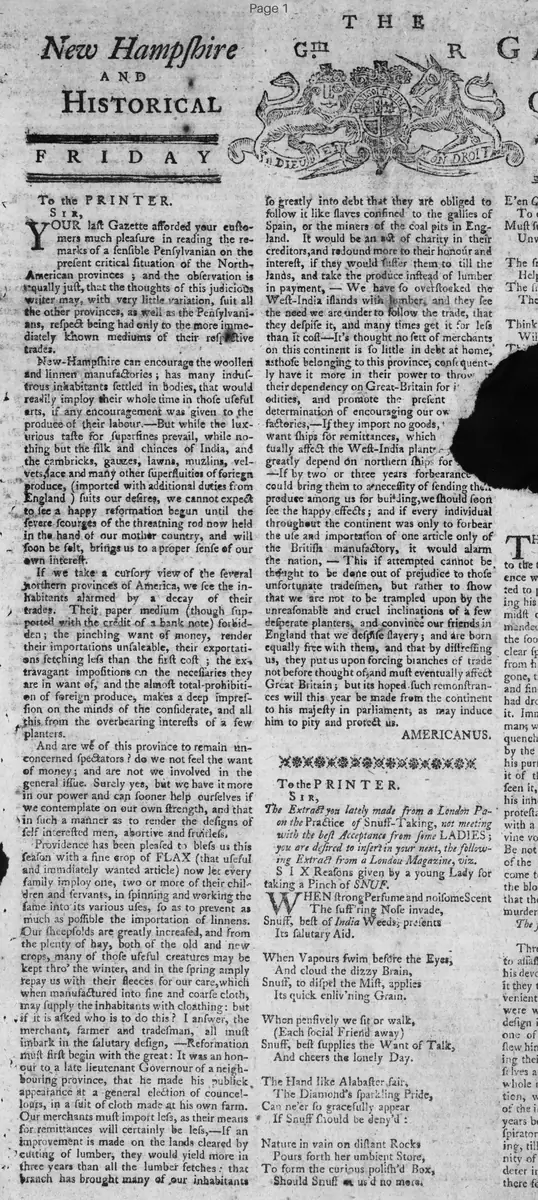
New-Hampshire can encourage the woollen and linnen manufactories: has many industrious inhabitants settled in bodies, that would readily employ their whole time in those useful arts, if any encouragement was given to the produce of their labour.--But while the luxurious taste for superfines prevail, while nothing but the silks and chintzes of India, and the cambricks, gauzes, lawns, muzlins, velvets, lace and many other superfluities of foreign produce (imported with additional duties from England) suits our desires, we cannot expect to see a happy reformation begun until the severe scourges of the threatning rod now held in the hand of our mother country, and will soon be felt, brings us to a proper sense of our own interest.
If we take a cursory view of the several northern provinces of America, we see the inhabitants alarmed by a decay of their trades. Their paper medium (though supported with the credit of a bank note) forbidden; the pinching want of money, render their importations unsaleable, their exportations fetching less than the first cost: the extravagant impositions on the necessaries they are in want of; and the almost total prohibition of foreign produce, makes a deep impression on the minds of the considerate, and all this from the overbearing interests of a few planters.
And are we of this province to remain unconcerned spectators? do we not feel the want of money; and are not we involved in the general issue. Surely yes, but we have it more in our power and can sooner help ourselves if we contemplate on our own strength, and that in such a manner as to render the designs of self interested men, abortive and fruitless.
Providence has been pleased to bless us this season with a fine crop of FLAX (that useful and immediately wanted article) now let every family employ one, two or more of their children and servants, in spinning and working the same into its various uses, so as to prevent as much as possible the importation of linnens.
Our sheepfolds are greatly increased, and from the plenty of hay, both of the old and new crops, many of those useful creatures may be kept thro' the winter, and in the spring amply repay us with their fleeces for our care, which when manufactured into fine and coarse cloth, may supply the inhabitants with cloathing: but if it is asked who is to do this? I answer, the merchant, farmer and tradesman, all must embark in the salutary design, --Reformation must first begin with the great: It was an honour to a late lieutenant Governour of a neighbouring province, that he made his publick appearance at a general election of counsellours, in a suit of cloth made at his own farm.
Our merchants must import less, as their means for remittances will certainly be less,--If an improvement is made on the lands cleared by cutting of lumber, they would yield more in three years than all the lumber fetches: that branch has brought many of our inhabitants so greatly into debt that they are obliged to follow it like slaves confined to the galleys of Spain, or the miners of the coal pits in England. It would be an act of charity in their creditors, and redound more to their honour and interest, if they would suffer them to till the lands, and take the produce instead of lumber in payment, - We have so overstocked the West-India islands with lumber, and they see the need we are under to follow the trade, that they despise it, and many times get it for less than it cost-It's thought no set of merchants on this continent is so little in debt at home, as those belonging to this province, consequently have it more in their power to throw their dependency on Great-Britain for commodities, and promote the present determination of encouraging our own factories,-If they import no goods, want ships for remittances, which actually affect the West-India planters who greatly depend on northern ships for timber by two or three years forbearance could bring them to a necessity of sending their produce among us for building, we should soon see the happy effects; and if every individual throughout the continent was only to forbear the use and importation of one article only of the British manufactory, it would alarm the nation, This if attempted cannot be thought to be done out of prejudice to those unfortunate tradesmen, but rather to shew that we are not to be trampled upon by the unreasonable and cruel inclinations of a few desperate planters, and convince our friends in England that we despise slavery; and are born equally free with them, and that by distressing us, they put us upon forcing branches of trade not before thought of and must eventually affect Great Britain; but its hoped such remonstrances will this year be made from the continent to his majesty in parliament, as may induce him to pity and protect us.
AMERICANUS.
What sub-type of article is it?
What keywords are associated?
What entities or persons were involved?
Editorial Details
Primary Topic
Promoting Colonial Manufacturing And Reducing British Imports For Economic Self Sufficiency
Stance / Tone
Advocacy For Reformation And Independence From British Trade Dependencies
Key Figures
Key Arguments