Thank you for visiting SNEWPapers!
Sign up free
Portland Gazette, And Maine Advertiser
Portland, Cumberland County, Maine
What is this article about?
In Fredericktown, a political dispute arises between Maryland Congressman Philip B. Key and War Secretary Gen. Dearborn over dismissed army commission recommendations due to alleged monarchical tendencies. Key demands retraction via letter, which Dearborn refuses.
Clipping
OCR Quality
Full Text
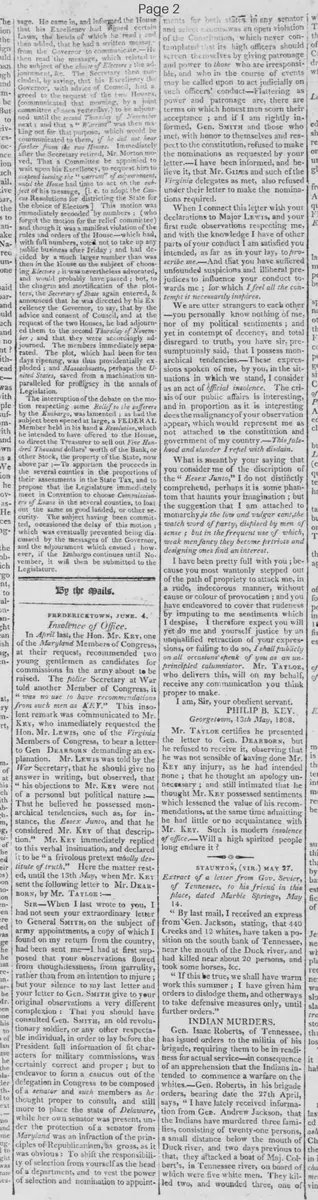
FREDERICKTOWN, JUNE 4.
Insolence of Office.
In April last, the Hon. Mr. KEY, one of the Maryland Members of Congress, at their request, recommended two young gentlemen as candidates for commissions in the army about to be raised. The polite Secretary at War told another Member of Congress, it "was no use to have recommendations from such men as KEY." This insolent remark was communicated to Mr. Key, who immediately requested the Hon. Mr. Lewis, one of the Virginia Members of Congress, to bear a letter to Gen Dearborn demanding an explanation. Mr. Lewis was told by the War Secretary, that he should give no answer in writing, but observed, that "his objections to Mr. Key were not of a personal but political nature: That he believed he possessed monarchical tendencies, such as, for instance, the Essex Junto, and that he considered Mr. Key of that description." Mr. Key immediately replied to this verbal insinuation, and declared it to be "a frivolous pretext wholly destitute of truth." Here the matter rested, until the 13th May, when Mr. KEY sent the following letter to Mr. DEARBORN, by Mr. TAYLOR:---
SIR—When I last wrote to you, I had not seen your extraordinary letter to General SMITH, on the subject of army appointments, a copy of which I found on my return from the country, had been sent me—I had at first supposed that your observations flowed from thoughtlessness, from garrulity, rather than from an intention to injure; but your silence to my last letter and your letter to Gen. Smith give to your original observations a very different complexion: That you should have consulted Gen. SMITH, an old revolutionary soldier, or any other respectable individual, in order to lay before the President full information of fit characters for military commissions, was certainly correct and proper; but to endeavor to form a caucus out of the delegation in Congress to be composed of a senator and such members as he thought proper to consult, and still more to place the state of Delaware, while her own senator was present, under the protection of a senator from Maryland was an infraction of the principles of Republicanism, as gross, as it was obvious: To shift the responsibility of selection from yourself as the head of a department, and to vest the power of selection and nomination to appointments for both states in any senator and select caucus was an open violation of the Constitution, which never contemplated that its high officers should screen themselves by giving patronage and power to those who are irresponsible, and who in the course of events may be called upon to act judicially on such officers' conduct—Flattering as power and patronage are, there are terms on which honest men scorn their acceptance; and if I am rightly informed, Gen. Smith and those who met, with honor to themselves and respect to the constitution, refused to make the nominations as requested by your letter.—I have been informed, and believe it, that Mr. Giles and such of the Virginia delegates as met, also refused under their letter to make the nominations required.
When I connect this letter with your declarations to Major Lewis, and your first rude observations respecting me, and with the knowledge I have of other parts of your conduct I am satisfied you intended, as far as in your lay, to proscribe me.—And that you have suffered unfounded suspicions and illiberal prejudices to influence your conduct towards me; for which I feel all the contempt it necessarily inspires.
We are utter strangers to each other—you personally know nothing of me, nor of my political sentiments; and yet in contempt of decency, and total disregard to truth, you have sir, presumptuously said, that I possess monarchical tendencies.—These expressions spoken of me, by you, in the situations in which we stand, I consider as an act of official insolence. The crisis of our public affairs is interesting and in proportion as it is interesting does the malignancy of your observation appear, which would represent me as not attached to the constitution and government of my country.—This falsehood and slander I repel with disdain.
What is meant by your saying that you consider me of the description of the "Essex Junto," I do not distinctly comprehend, perhaps it is some phantom that haunts your imagination; but the suggestion that I am attached to monarchy, is the low and vulgar cant, the watch word of party, disdised by men of sense; but in the frequent use of which, weak men fancy they become patriots and designing ones find an interest.
I have been pretty full with you; because you most wantonly stepped out of the path of propriety to attack me, in a rude, indecorous manner, without cause or colour of provocation; and you have endeavored to cover that rudeness by imputing to me sentiments which I despise, I therefore expect you will yet do me and yourself justice by an unqualified retraction of your expressions, or failing to do so, I shall publicly on all occasions speak of you as an unprincipled calumniator. Mr. TAYLOR, who delivers this, will on my behalf, receive any communication you think proper to make.
I am, Sir, your obedient servant.
PHILIP B. KEY.
Georgetown, 13th May, 1808.
Mr. TAYLOR certifies he presented the letter to Gen. Dearborn, but he refused to receive it, observing that he was not sensible of having done Mr. Key any injury, as he had intended none; that he thought an apology unnecessary; and still intimated that he thought Mr. Key possessed sentiments which lessened the value of his recommendations, at the same time admitting he had little or no acquaintance with Mr. Key. Such is modern insolence of office.—Will a high spirited people long endure it?
What sub-type of article is it?
What keywords are associated?
What entities or persons were involved?
Where did it happen?
Domestic News Details
Primary Location
Fredericktown
Event Date
April Last To 13th May, 1808; Reported June 4
Key Persons
Outcome
gen. dearborn refused to receive the letter and provide an apology, maintaining his views on mr. key's political sentiments.
Event Details
Philip B. Key, Maryland Congressman, recommended candidates for army commissions in April. War Secretary Gen. Dearborn dismissed the recommendations due to Key's alleged monarchical tendencies and Essex Junto associations. Key demanded explanation and later sent a letter accusing Dearborn of official insolence and demanding retraction, which Dearborn refused.