Thank you for visiting SNEWPapers!
Sign up free
Editorial
March 28, 1857
The Tipton Advertiser
Tipton, Cedar County, Iowa
What is this article about?
This editorial asserts that universal education is an inevitable global movement that ensures freedom, drawing on ancient examples (Egypt, Greece, Rome) and the role of educated Puritans in sparking the American Revolution against British rule.
Clipping
OCR Quality
98%
Excellent
Full Text
Education and Freedom.
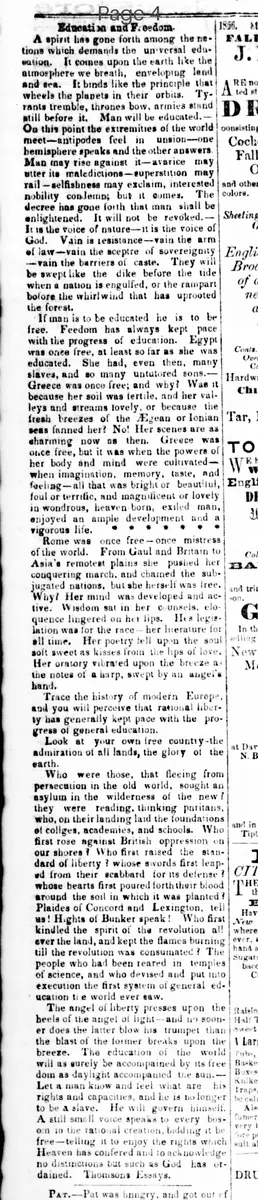
A spirit has gone forth among the nations which demands the universal education. It comes upon the earth like the atmosphere we breathe, enveloping land and sea. It binds like the principle that wheels the planets in their orbits. Tyrants tremble, thrones bow, armies stand still before it. Man will be educated. On this point the extremities of the world meet—antipodes feel in unison—one hemisphere speaks and the other answers.
Man may rise against it—avarice may utter its maledictions—superstition may rail—selfishness may exclaim, interested nobility contemn; but it comes. The decree has gone forth that man shall be enlightened. It will not be revoked.
It is the voice of nature—it is the voice of God. Vain is resistance—vain the arm of law—vain the sceptre of sovereignty—vain the barriers of caste. They will be swept like the dike before the tide when a nation is engulfed, or the rampart before the whirlwind that has uprooted the forest.
If man is to be educated he is to be free. Freedom has always kept pace with the progress of education. Egypt was once free, at least so far as she was educated. She had, even then, many slaves, and so many untutored sons.
Greece was once free: and why? Was it because her soil was fertile, and her valleys and streams lovely, or because the fresh breezes of the Aegean or Ionian seas fanned her? No! Her scenes are as charming now as then. Greece was once free, but it was when the powers of her body and mind were cultivated—when imagination, memory, taste, and feeling—all that was bright or beautiful, foul or terrific, and magnificent or lovely in wondrous, heaven-born, exiled man, enjoyed an ample development and a vigorous life.
Rome was once free—once mistress of the world. From Gaul and Britain to Asia's remotest plains she pushed her conquering march, and chained the subjugated nations, but she herself was free. Why? Her mind was developed and active. Wisdom sat in her counsels, eloquence lingered on her lips. Her legislation was for the race—her literature for all time. Her poetry fell upon the soul soft sweet as kisses from the lips of love. Her oratory vibrated upon the breeze as the notes of a harp, swept by an angel's hand.
Trace the history of modern Europe and you will perceive that rational liberty has generally kept pace with the progress of general education.
Look at your own free country—the admiration of all lands, the glory of the earth.
Who were those, that fleeing from persecution in the old world, sought asylum in the wilderness of the new? They were reading, thinking Puritans, who, on their landing laid the foundations of colleges, academies, and schools. Who first rose against British oppression on our shores? Who first raised the standard of liberty? Whose swords first leaped from their scabbard for its defense? Whose hearts first poured forth their blood around the soil in which it was planted? Plains of Concord and Lexington, tell us! Heights of Bunker speak! Who first kindled the spirit of the revolution all over the land, and kept the flames burning till the revolution was consummated? The people who had been reared in temples of science, and who devised and put into execution the first system of general education the world ever saw.
The angel of liberty presses upon the heels of the angel of light—and no sooner does the latter blow his trumpet than the blast of the former breaks upon the breeze. The education of the world will as surely be accompanied by its freedom as daylight accompanied the sun.
Let a man know and feel what are his rights and capacities, and he is no longer to be a slave. He will govern himself. A still small voice speaks to every bosom in the rational creation, bidding it be free—telling it to enjoy the rights which Heaven has conferred and to acknowledge no distinctions but such as God has ordained. Thomson's Essays.
A spirit has gone forth among the nations which demands the universal education. It comes upon the earth like the atmosphere we breathe, enveloping land and sea. It binds like the principle that wheels the planets in their orbits. Tyrants tremble, thrones bow, armies stand still before it. Man will be educated. On this point the extremities of the world meet—antipodes feel in unison—one hemisphere speaks and the other answers.
Man may rise against it—avarice may utter its maledictions—superstition may rail—selfishness may exclaim, interested nobility contemn; but it comes. The decree has gone forth that man shall be enlightened. It will not be revoked.
It is the voice of nature—it is the voice of God. Vain is resistance—vain the arm of law—vain the sceptre of sovereignty—vain the barriers of caste. They will be swept like the dike before the tide when a nation is engulfed, or the rampart before the whirlwind that has uprooted the forest.
If man is to be educated he is to be free. Freedom has always kept pace with the progress of education. Egypt was once free, at least so far as she was educated. She had, even then, many slaves, and so many untutored sons.
Greece was once free: and why? Was it because her soil was fertile, and her valleys and streams lovely, or because the fresh breezes of the Aegean or Ionian seas fanned her? No! Her scenes are as charming now as then. Greece was once free, but it was when the powers of her body and mind were cultivated—when imagination, memory, taste, and feeling—all that was bright or beautiful, foul or terrific, and magnificent or lovely in wondrous, heaven-born, exiled man, enjoyed an ample development and a vigorous life.
Rome was once free—once mistress of the world. From Gaul and Britain to Asia's remotest plains she pushed her conquering march, and chained the subjugated nations, but she herself was free. Why? Her mind was developed and active. Wisdom sat in her counsels, eloquence lingered on her lips. Her legislation was for the race—her literature for all time. Her poetry fell upon the soul soft sweet as kisses from the lips of love. Her oratory vibrated upon the breeze as the notes of a harp, swept by an angel's hand.
Trace the history of modern Europe and you will perceive that rational liberty has generally kept pace with the progress of general education.
Look at your own free country—the admiration of all lands, the glory of the earth.
Who were those, that fleeing from persecution in the old world, sought asylum in the wilderness of the new? They were reading, thinking Puritans, who, on their landing laid the foundations of colleges, academies, and schools. Who first rose against British oppression on our shores? Who first raised the standard of liberty? Whose swords first leaped from their scabbard for its defense? Whose hearts first poured forth their blood around the soil in which it was planted? Plains of Concord and Lexington, tell us! Heights of Bunker speak! Who first kindled the spirit of the revolution all over the land, and kept the flames burning till the revolution was consummated? The people who had been reared in temples of science, and who devised and put into execution the first system of general education the world ever saw.
The angel of liberty presses upon the heels of the angel of light—and no sooner does the latter blow his trumpet than the blast of the former breaks upon the breeze. The education of the world will as surely be accompanied by its freedom as daylight accompanied the sun.
Let a man know and feel what are his rights and capacities, and he is no longer to be a slave. He will govern himself. A still small voice speaks to every bosom in the rational creation, bidding it be free—telling it to enjoy the rights which Heaven has conferred and to acknowledge no distinctions but such as God has ordained. Thomson's Essays.
What sub-type of article is it?
Education
Constitutional
Social Reform
What keywords are associated?
Universal Education
Freedom And Liberty
Historical Civilizations
American Revolution
Puritans
What entities or persons were involved?
Puritans
British
American Revolutionaries
Editorial Details
Primary Topic
Universal Education Leading To Freedom
Stance / Tone
Advocacy For Inevitable Universal Education And Resulting Liberty
Key Figures
Puritans
British
American Revolutionaries
Key Arguments
Universal Education Is An Unstoppable Global Force Demanded By Nations And Nature.
Education Has Historically Preceded And Enabled Freedom In Civilizations Like Egypt, Greece, And Rome.
Educated Puritans Fleeing Persecution Founded Schools And Led The American Revolution Against British Oppression.
Knowledge Of Rights And Capacities Prevents Enslavement And Promotes Self Governance.