Thank you for visiting SNEWPapers!
Sign up free
Story
July 2, 1849
Lynchburg Virginian
Lynchburg, Virginia
What is this article about?
Editorial response in the Lynchburg Virginian to Wytheville Republican's criticisms of the Virginia & Tennessee Railroad's formation, state involvement, and premature engineer appointment, defending the company's actions as lawful and necessary.
Clipping
OCR Quality
95%
Excellent
Full Text
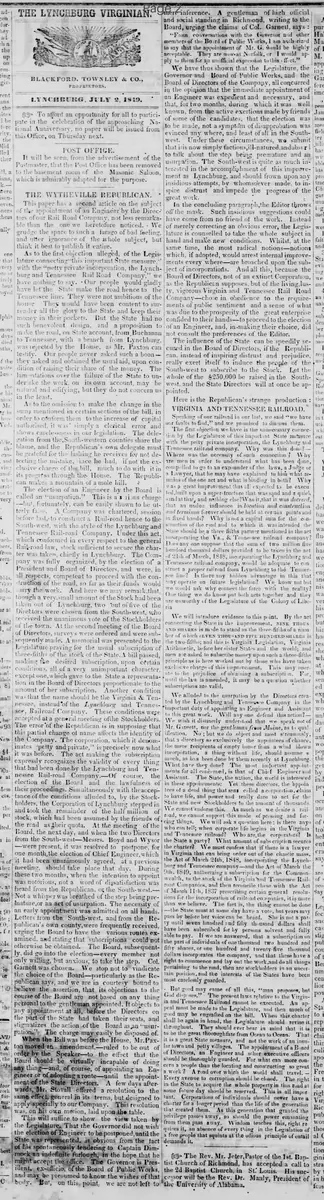
LYNCHBURG VIRGINIAN,
BLACKFORD, TOWNLEY & CO.,
PROPRIETORS.
LYNCHBURG, JULY 2, 1849.
To afford an opportunity for all to participate
in the celebration of the approaching National
Anniversary, no paper will be issued from
this Office, on Thursday next.
POST OFFICE.
It will be seen, from the advertisement of the
Postmaster, that the Post Office has been removed
to the basement room of the Masonic Saloon,
which is admirably adapted for the purpose.
THE WYTHEVILLE REPUBLICAN.
This paper has a second article on the subject
of the appointment of an Engineer by the Directors of our Rail Road Company, not less remarkable than the one we heretofore noticed. We
grudge the space to such a farago of bad feeling,
and utter ignorance of the whole subject, but
think it best to publish it entire.
As to the first objection alleged, of the Legislature connecting this important State measure,
with the "petty private incorporation, the Lynchburg and Tennessee Rail Road Company," we
have nothing to say. Our people would gladly
have let the State make the road hence to the
Tennessee line. They were not ambitious of the
honor They would have been content to surrender all the glory to the State and keep their
money in their pockets. But the State had no
such benevolent design, and a proposition to
make the road, on State account, from Buchanan
to Tennessee, with a branch from Lynchburg
was rejected by the House, as Mr. Paxton can
testify. Our people never asked such a boon—
they asked and obtained the usual aid, upon condition of raising their share of the money. The
lamentations over the failure of the State to undertake the work, on its own account, may be
natural and edifying, but they do not concern us
in the least,
As to the omission to make the change in the
sums mentioned in certain sections of the bill, in
order to conform them to the increase of capital
authorised, it was simply a clerical error and
shows carelessness in our legislation. The delegation from the South-western counties share the
blame, and the Republican's own delegate must
be grateful for the lashing he receives for not detecting the mistake, since he had, if not the exclusive charge of the bill, much to do with it in
its progress through the House. The Republican makes a mountain of a mole hill.
The election of an Engineer by the Board is
called an "usurpation." This is a serious charge
—but, fortunately, can be easily shown to be utterly false. A Company was chartered, session
before last.—to construct a Rail-road hence to the
South-west, with the style of the Lynchburg and
Tennessee Rail-road Company. Under this act,
which conformed in every respect to the general
Rail-road law, stock sufficient to secure the charter was taken, chiefly in Lynchburg. The Company was fully organized, by the election of a
President and Board of Directors, and were, in
all respects, competent to proceed with the construction of the road, so far as their funds would
carry the work. And here we may remark, that,
though a very small amount of the Stock had been
taken out of Lynchburg, two out of five of the
Directors were chosen from the South-west, who
received the unanimous vote of the Stockholders
of the town. At the second meeting of the Board
of Directors, surveys were ordered and were subsequently made. A memorial was presented to the
Legislature praying for the usual subscription of
three-fifths of the stock of the State. A bill passed,
makng the desired subscription, upon certain
conditions, all of a very unimportant character,
except one, which gave to the State a representation in the Board of Directors proportionate to the
amount of her subscription. Another condition
was that the name should be the Virginia & Tennessee, instead of the Lynchburg and Tennessee, Railroad Company. These conditions were
accepted at a general meeting of the Stockholders.
The error of the Republican is in supposing that
this partial change of name affects the identity of
the Company. The corporation, which it denominates 'petty and private," is precisely now what
it was before. The act making the subscription
expressly recognizes the validity of every thing
that had been done by the Lynchburg and Tennessee Rail-road Company.—Of course, the
election of the Board and the lawfulness of
their proceedings. Simultaneously with the acceptance of the conditions alluded to, by the Stockholders, the Corporation of Lynchburg stepped in
and took the remainder of the half million of
stock, which had been assumed by the friends of
the road as their quota. At the meeting of the
Board, the next day, and when the two Directors
from the South-west—Messrs. Boyd and Wysor
—were present, it was resolved to postpone, for
one month, the election of Chief Engineer, which
it had been unanimously agreed, at a previous
meeting, should take place that day. During
these two months, when the intention to appoint
was notorious, not a word of dissatisfaction was
heard from the Republican, or the South-west.—
Not a whisper was breathed of the step being premature, or an act of usurpation. The necessity of
an early appointment was admitted on all hands.
Letters from the South-west, and from the Republican's own county, were frequently received,
urging the Board to have the various routes examined, and stating that subscriptions could not
otherwise be obtained. The Board, subsequently,
did go into the election—every member not
only willing, but anxious, to take the step. Col.
Garnett was chosen. We stop not to vindicate
the choice of the Board—particularly as the Republican says, and we are in courtesy bound to
believe the assertion, that its objections to the
course of the Board are not based on any thing
personal to the gentleman appointed. It objects to
any appointment at all, before the Directors on
the part of the State had taken their seats, and
stigmatizes the action of the Board as an 'usurpation." The charge may easily be disposed of.
When the Bill was before the House, Mr. Paxton moved an amendment,—ruled to be out of
order by the Speaker—to the effect that the
Board should be virtually incapable of doing
any thing and, of course, of appointing an Engineer or of adopting a route—until the appointment of the State Directors. A few days afterwards, Mr. Stovall offered a resolution to the
same effect, general in its terms, but designed to
apply specially to our Company. This resolution was, on his own motion, laid upon the table.
This will suffice to show the view taken by
the Legislature. That the Governor did not wish
the election of Engineer to be postponed, until the
State was represented, is obvious from the fact
of his spontaneously tendering to Captain Dimmock an indefinite furlough, in the hope that he
might accept the office. The Governor is President, ex-officio, of the Board of Public Works.
and may be presumed to know the wishes of that
body. But, on this point, we are not left to
conjecture. A gentleman of high standing in Richmond, writing to the
Board, urging the claims of Col. Garnett, says :
"From conversations with the Governor and other
members of the Board of Public Works, I am authorized to say that the appointment of Mr. G. would be highly
acceptable. They are now at Suffolk, or I would apply to them for an unofficial expression to this effect."
We have thus shown that the Legislature, the
Governor and Board of Public Works, and the
Board of Directors of the Company, all concurred
in the opinion that the immediate appointment of
an Engineer was expedient and necessary, and
that, for two months, during which it was well
known, from the active exertions made by friends
of some of the candidates, that the election was
to be made, not a symptom of disapprobation was
evinced any where, and least of all in the South-west. Under these circumstances, we submit
that it is now simply factious, ill-natured, and absurd to talk about the step being premature and an
usurpation. The South-west is quite as much interested in the accomplishment of this improvement as Lynchburg, and should frown upon any
insidious attempts, by whomsoever made, to inspire distrust and impede the progress of the
great work.
In the concluding paragraph, the Editor throws
off the mask. Such insidious suggestions could
have come from no friend of the work. Instead
of merely correcting an obvious error, the Legislature is counselled to take the whole subject in
hand and make new conditions. Whilst, at the
same time, the most radical notions—notions
which, if adopted, would arrest internal improvements every where—are broached upon the subject of incorporations. And all this, because the
Board of Directors, not of an extinct Corporation, as the Republican supposes, but of the living, lusty, vigorous Virginia and Tennessee Rail Road
Company—chose in obedience to the requirements of public sentiment and a sense of what
was due to the prosperity of the great enterprise
confided to their hands—to proceed to the election of an Engineer, and, in making their choice, did
not consult the preferences of the Editor.
The influence of the State can be speedily secured in the Board of Directors, if the Republican, instead of inspiring distrust and prejudice,
really exert itself to induce the people of the
South-west to subscribe to the Stock. Let the
whole of the $250,000 be raised in the South-west, and the State Directors will at once be appointed.
Here is the Republican's strange production :
VIRGINIA AND TENNESSEE RAILROAD.
Speaking of our railroad in our last, we said "we have
our faults to find," and we promised to discuss them.
The first objection we have is the unnecessary connection by the Legislature of this important State measure
with the petty private incorporation, the Lynchburg and
Tennessee railroad company. Why was this done?—
Where was the necessity of such connection? Why
are men in order to understand what has been done.
compelled to go to an expounder of the laws, a Judge or
a Lawyer, that he may have explained to him what remains of the one act and what is binding in both? Why
was a great improvement that all expected to be executed, built upon a super-structure that was sand and a quick
sand at that, and nothing else? Was it, that it was decreed.
that an undue influence in location and construction
and terminus forever should be held at certain points and
in fixed hands? Why is not a capital sum for the construction of the road and to which it was intended the
State should be a three fifths partner mentioned in the act
incorporating the Va. & Tennessee railroad company?
Does any one suppose that the sum of two million five
hundred thousand dollars provided to be taken in the act
of 24th of March, 1848, incorporating the Lynchburg and
Tennessee railroad company, would be adequate to construct a proper railroad from Lynchburg to the Tennessee line? Is there any hidden advantage in this that
may operate on future legislation? We know not but
we would ask why connect the farce with the reality?
One thing we do know put both acts together and they
are unworthy of the Legislature of the Colony of Liberia
We will introduce evidence to this point. By the act
connecting the State in the improvement, NINE THOUSAND AND FIVE HUNDRED SHARES is made to stand as the three-fifths of a number of which SEVEN THOUSAND FIVE HUNDRED SHARES is
the two-fifths; and this is Virginia Legislation, Virginia
Arithmetic, before her sister States and the world; and
men are asked to subscribe money upon such a three-fifths principle as is here worked out by those who have taken
exclusive charge of this improvement. This may operate to the prejudice of obtaining a subscription. For,
until the law is amended, it may be a question whether
subscriptions are valid.
We alluded to the usurpation by the Directors created by the Lynchburg and Tennessee Company in the
important duty of appointing an Engineer and Assistant
to this great work. Will any one defend this action?—
We wish it distinctly understood that we speak not of
Mr. Garnett, nor the gentleman from Maine, as to qualification. No; but we do object and most strenuously.
that a directory so exclusively the appointees of chance,
the mere recipients of empty honor from a wind blown
incorporation, a thing without life, should assume so
much, as has been done by them recently at Lynchburg.
What have they done? The most important appointments for all concerned, is that of Chief Engineer and
Assistant. The State, the nation, the world is interested in these appointments: Yet these directors, the appointees of a dead thing that was called a corporation, claim to have life, and power and really dare to act for the
State and new Stockholders to the amount of thousands
We cannot endorse this. As much as we desire a rail road, we cannot support this mode of pressing and forcing things. We will ask a question here: is there any one who can tell; when corporate life begins in the Virginia
and Tennessee railroad? Who are the corporators? Is
the State a party? What amount of subscription secures the charter? We must confess that if there is a lawyer in Virginia that can bring order out of the chaotic mass,
the Act of March 24th, 1848, incorporating the Lynchburg and Tennessee company—and the Act of March the
9th, 1849, authorizing a subscription for the Commonwealth, to the stock of the Virginia and Tennessee Railroad Companies, and then reconcile these with the Act
of March 11th, 1837 prescribing certain general resolutions for the incorporation of railroad companies, it is more
than we believe. The fact is, the thing cannot be done—the State must at some day have a vote, but years may
pass by before her voice can be heard. She is not a party until seven hundred and fifty thousand dollars shall
have been subscribed for by persons solvent and fully
able to pay. If we are answered, that a subscription on
the part of individuals of one thousand two hundred and
fifty shares, or one hundred and twenty-five thousand
dollars incorporates the company, and that these have a
right to commence and lay out the work, and do all things pertaining to the road, then are stockholders in an uncertain position, and the interests of the State have been most carelessly guarded.
But good may come of all this, "man proposes, but
God disposes." The present laws relative to the Virginia and Tennessee Railroad cannot be executed. An appeal must be made to the Legislature, and then much of
good may be engrafted on the bill. When this charter
shall be again in hand, the Legislature should revise it
throughout. They should ever bear in mind that it is
to be the great thoroughfare from Ocean to Ocean. That
it is a great State measure, and not the work of an insular town and petty villages. The appointment of a Board
of Directors, an Engineer and other executive officers
should be thoroughly guarded. For what can more concern a people than the locating and constructing so great
a work? A road over which the world shall travel. —
Every avenue to corruption should be closed. The right
in the State to acquire the whole property in this road at
some future day should be reserved. This is all important. Corporations of individuals should never have a
charter for a longer period than the life of the generation that created them. As this generation that granted the
privilege passes away, so should the power emanating
from them pass away. Wisdom teaches this, right requires it, an absence of every thing in the Legislation of
a free people that squints at the odious principle of entail demands it.
BLACKFORD, TOWNLEY & CO.,
PROPRIETORS.
LYNCHBURG, JULY 2, 1849.
To afford an opportunity for all to participate
in the celebration of the approaching National
Anniversary, no paper will be issued from
this Office, on Thursday next.
POST OFFICE.
It will be seen, from the advertisement of the
Postmaster, that the Post Office has been removed
to the basement room of the Masonic Saloon,
which is admirably adapted for the purpose.
THE WYTHEVILLE REPUBLICAN.
This paper has a second article on the subject
of the appointment of an Engineer by the Directors of our Rail Road Company, not less remarkable than the one we heretofore noticed. We
grudge the space to such a farago of bad feeling,
and utter ignorance of the whole subject, but
think it best to publish it entire.
As to the first objection alleged, of the Legislature connecting this important State measure,
with the "petty private incorporation, the Lynchburg and Tennessee Rail Road Company," we
have nothing to say. Our people would gladly
have let the State make the road hence to the
Tennessee line. They were not ambitious of the
honor They would have been content to surrender all the glory to the State and keep their
money in their pockets. But the State had no
such benevolent design, and a proposition to
make the road, on State account, from Buchanan
to Tennessee, with a branch from Lynchburg
was rejected by the House, as Mr. Paxton can
testify. Our people never asked such a boon—
they asked and obtained the usual aid, upon condition of raising their share of the money. The
lamentations over the failure of the State to undertake the work, on its own account, may be
natural and edifying, but they do not concern us
in the least,
As to the omission to make the change in the
sums mentioned in certain sections of the bill, in
order to conform them to the increase of capital
authorised, it was simply a clerical error and
shows carelessness in our legislation. The delegation from the South-western counties share the
blame, and the Republican's own delegate must
be grateful for the lashing he receives for not detecting the mistake, since he had, if not the exclusive charge of the bill, much to do with it in
its progress through the House. The Republican makes a mountain of a mole hill.
The election of an Engineer by the Board is
called an "usurpation." This is a serious charge
—but, fortunately, can be easily shown to be utterly false. A Company was chartered, session
before last.—to construct a Rail-road hence to the
South-west, with the style of the Lynchburg and
Tennessee Rail-road Company. Under this act,
which conformed in every respect to the general
Rail-road law, stock sufficient to secure the charter was taken, chiefly in Lynchburg. The Company was fully organized, by the election of a
President and Board of Directors, and were, in
all respects, competent to proceed with the construction of the road, so far as their funds would
carry the work. And here we may remark, that,
though a very small amount of the Stock had been
taken out of Lynchburg, two out of five of the
Directors were chosen from the South-west, who
received the unanimous vote of the Stockholders
of the town. At the second meeting of the Board
of Directors, surveys were ordered and were subsequently made. A memorial was presented to the
Legislature praying for the usual subscription of
three-fifths of the stock of the State. A bill passed,
makng the desired subscription, upon certain
conditions, all of a very unimportant character,
except one, which gave to the State a representation in the Board of Directors proportionate to the
amount of her subscription. Another condition
was that the name should be the Virginia & Tennessee, instead of the Lynchburg and Tennessee, Railroad Company. These conditions were
accepted at a general meeting of the Stockholders.
The error of the Republican is in supposing that
this partial change of name affects the identity of
the Company. The corporation, which it denominates 'petty and private," is precisely now what
it was before. The act making the subscription
expressly recognizes the validity of every thing
that had been done by the Lynchburg and Tennessee Rail-road Company.—Of course, the
election of the Board and the lawfulness of
their proceedings. Simultaneously with the acceptance of the conditions alluded to, by the Stockholders, the Corporation of Lynchburg stepped in
and took the remainder of the half million of
stock, which had been assumed by the friends of
the road as their quota. At the meeting of the
Board, the next day, and when the two Directors
from the South-west—Messrs. Boyd and Wysor
—were present, it was resolved to postpone, for
one month, the election of Chief Engineer, which
it had been unanimously agreed, at a previous
meeting, should take place that day. During
these two months, when the intention to appoint
was notorious, not a word of dissatisfaction was
heard from the Republican, or the South-west.—
Not a whisper was breathed of the step being premature, or an act of usurpation. The necessity of
an early appointment was admitted on all hands.
Letters from the South-west, and from the Republican's own county, were frequently received,
urging the Board to have the various routes examined, and stating that subscriptions could not
otherwise be obtained. The Board, subsequently,
did go into the election—every member not
only willing, but anxious, to take the step. Col.
Garnett was chosen. We stop not to vindicate
the choice of the Board—particularly as the Republican says, and we are in courtesy bound to
believe the assertion, that its objections to the
course of the Board are not based on any thing
personal to the gentleman appointed. It objects to
any appointment at all, before the Directors on
the part of the State had taken their seats, and
stigmatizes the action of the Board as an 'usurpation." The charge may easily be disposed of.
When the Bill was before the House, Mr. Paxton moved an amendment,—ruled to be out of
order by the Speaker—to the effect that the
Board should be virtually incapable of doing
any thing and, of course, of appointing an Engineer or of adopting a route—until the appointment of the State Directors. A few days afterwards, Mr. Stovall offered a resolution to the
same effect, general in its terms, but designed to
apply specially to our Company. This resolution was, on his own motion, laid upon the table.
This will suffice to show the view taken by
the Legislature. That the Governor did not wish
the election of Engineer to be postponed, until the
State was represented, is obvious from the fact
of his spontaneously tendering to Captain Dimmock an indefinite furlough, in the hope that he
might accept the office. The Governor is President, ex-officio, of the Board of Public Works.
and may be presumed to know the wishes of that
body. But, on this point, we are not left to
conjecture. A gentleman of high standing in Richmond, writing to the
Board, urging the claims of Col. Garnett, says :
"From conversations with the Governor and other
members of the Board of Public Works, I am authorized to say that the appointment of Mr. G. would be highly
acceptable. They are now at Suffolk, or I would apply to them for an unofficial expression to this effect."
We have thus shown that the Legislature, the
Governor and Board of Public Works, and the
Board of Directors of the Company, all concurred
in the opinion that the immediate appointment of
an Engineer was expedient and necessary, and
that, for two months, during which it was well
known, from the active exertions made by friends
of some of the candidates, that the election was
to be made, not a symptom of disapprobation was
evinced any where, and least of all in the South-west. Under these circumstances, we submit
that it is now simply factious, ill-natured, and absurd to talk about the step being premature and an
usurpation. The South-west is quite as much interested in the accomplishment of this improvement as Lynchburg, and should frown upon any
insidious attempts, by whomsoever made, to inspire distrust and impede the progress of the
great work.
In the concluding paragraph, the Editor throws
off the mask. Such insidious suggestions could
have come from no friend of the work. Instead
of merely correcting an obvious error, the Legislature is counselled to take the whole subject in
hand and make new conditions. Whilst, at the
same time, the most radical notions—notions
which, if adopted, would arrest internal improvements every where—are broached upon the subject of incorporations. And all this, because the
Board of Directors, not of an extinct Corporation, as the Republican supposes, but of the living, lusty, vigorous Virginia and Tennessee Rail Road
Company—chose in obedience to the requirements of public sentiment and a sense of what
was due to the prosperity of the great enterprise
confided to their hands—to proceed to the election of an Engineer, and, in making their choice, did
not consult the preferences of the Editor.
The influence of the State can be speedily secured in the Board of Directors, if the Republican, instead of inspiring distrust and prejudice,
really exert itself to induce the people of the
South-west to subscribe to the Stock. Let the
whole of the $250,000 be raised in the South-west, and the State Directors will at once be appointed.
Here is the Republican's strange production :
VIRGINIA AND TENNESSEE RAILROAD.
Speaking of our railroad in our last, we said "we have
our faults to find," and we promised to discuss them.
The first objection we have is the unnecessary connection by the Legislature of this important State measure
with the petty private incorporation, the Lynchburg and
Tennessee railroad company. Why was this done?—
Where was the necessity of such connection? Why
are men in order to understand what has been done.
compelled to go to an expounder of the laws, a Judge or
a Lawyer, that he may have explained to him what remains of the one act and what is binding in both? Why
was a great improvement that all expected to be executed, built upon a super-structure that was sand and a quick
sand at that, and nothing else? Was it, that it was decreed.
that an undue influence in location and construction
and terminus forever should be held at certain points and
in fixed hands? Why is not a capital sum for the construction of the road and to which it was intended the
State should be a three fifths partner mentioned in the act
incorporating the Va. & Tennessee railroad company?
Does any one suppose that the sum of two million five
hundred thousand dollars provided to be taken in the act
of 24th of March, 1848, incorporating the Lynchburg and
Tennessee railroad company, would be adequate to construct a proper railroad from Lynchburg to the Tennessee line? Is there any hidden advantage in this that
may operate on future legislation? We know not but
we would ask why connect the farce with the reality?
One thing we do know put both acts together and they
are unworthy of the Legislature of the Colony of Liberia
We will introduce evidence to this point. By the act
connecting the State in the improvement, NINE THOUSAND AND FIVE HUNDRED SHARES is made to stand as the three-fifths of a number of which SEVEN THOUSAND FIVE HUNDRED SHARES is
the two-fifths; and this is Virginia Legislation, Virginia
Arithmetic, before her sister States and the world; and
men are asked to subscribe money upon such a three-fifths principle as is here worked out by those who have taken
exclusive charge of this improvement. This may operate to the prejudice of obtaining a subscription. For,
until the law is amended, it may be a question whether
subscriptions are valid.
We alluded to the usurpation by the Directors created by the Lynchburg and Tennessee Company in the
important duty of appointing an Engineer and Assistant
to this great work. Will any one defend this action?—
We wish it distinctly understood that we speak not of
Mr. Garnett, nor the gentleman from Maine, as to qualification. No; but we do object and most strenuously.
that a directory so exclusively the appointees of chance,
the mere recipients of empty honor from a wind blown
incorporation, a thing without life, should assume so
much, as has been done by them recently at Lynchburg.
What have they done? The most important appointments for all concerned, is that of Chief Engineer and
Assistant. The State, the nation, the world is interested in these appointments: Yet these directors, the appointees of a dead thing that was called a corporation, claim to have life, and power and really dare to act for the
State and new Stockholders to the amount of thousands
We cannot endorse this. As much as we desire a rail road, we cannot support this mode of pressing and forcing things. We will ask a question here: is there any one who can tell; when corporate life begins in the Virginia
and Tennessee railroad? Who are the corporators? Is
the State a party? What amount of subscription secures the charter? We must confess that if there is a lawyer in Virginia that can bring order out of the chaotic mass,
the Act of March 24th, 1848, incorporating the Lynchburg and Tennessee company—and the Act of March the
9th, 1849, authorizing a subscription for the Commonwealth, to the stock of the Virginia and Tennessee Railroad Companies, and then reconcile these with the Act
of March 11th, 1837 prescribing certain general resolutions for the incorporation of railroad companies, it is more
than we believe. The fact is, the thing cannot be done—the State must at some day have a vote, but years may
pass by before her voice can be heard. She is not a party until seven hundred and fifty thousand dollars shall
have been subscribed for by persons solvent and fully
able to pay. If we are answered, that a subscription on
the part of individuals of one thousand two hundred and
fifty shares, or one hundred and twenty-five thousand
dollars incorporates the company, and that these have a
right to commence and lay out the work, and do all things pertaining to the road, then are stockholders in an uncertain position, and the interests of the State have been most carelessly guarded.
But good may come of all this, "man proposes, but
God disposes." The present laws relative to the Virginia and Tennessee Railroad cannot be executed. An appeal must be made to the Legislature, and then much of
good may be engrafted on the bill. When this charter
shall be again in hand, the Legislature should revise it
throughout. They should ever bear in mind that it is
to be the great thoroughfare from Ocean to Ocean. That
it is a great State measure, and not the work of an insular town and petty villages. The appointment of a Board
of Directors, an Engineer and other executive officers
should be thoroughly guarded. For what can more concern a people than the locating and constructing so great
a work? A road over which the world shall travel. —
Every avenue to corruption should be closed. The right
in the State to acquire the whole property in this road at
some future day should be reserved. This is all important. Corporations of individuals should never have a
charter for a longer period than the life of the generation that created them. As this generation that granted the
privilege passes away, so should the power emanating
from them pass away. Wisdom teaches this, right requires it, an absence of every thing in the Legislation of
a free people that squints at the odious principle of entail demands it.
What sub-type of article is it?
Historical Event
What themes does it cover?
Justice
What keywords are associated?
Railroad Incorporation
State Subscription
Engineer Appointment
Legislative Error
Wytheville Republican
What entities or persons were involved?
Mr. Paxton
Mr. Stovall
Col. Garnett
Captain Dimmock
Messrs. Boyd
Messrs. Wysor
Where did it happen?
Lynchburg, Virginia
Story Details
Key Persons
Mr. Paxton
Mr. Stovall
Col. Garnett
Captain Dimmock
Messrs. Boyd
Messrs. Wysor
Location
Lynchburg, Virginia
Event Date
1849 07 02
Story Details
The Lynchburg Virginian defends the Virginia and Tennessee Railroad Company's organization, state subscription, and election of Col. Garnett as engineer against criticisms from the Wytheville Republican, which alleges usurpation, clerical errors, and improper connection to a prior private incorporation.