Thank you for visiting SNEWPapers!
Sign up free
Daily National Intelligencer
Washington, District Of Columbia
What is this article about?
The letter argues that the scarcity of gold and silver makes them insufficient for modern U.S. domestic currency needs, advocating for a national paper currency based on government faith and citizen industry, critiquing bank notes and referencing essays by 'Homo'.
Merged-components note: These two components are a continuation of the same letter to the editor, as evidenced by the text flow from the end of the first ('from whence flows') to the start of the second ('bles, and tortures...'), forming a coherent single piece signed 'PHILO-HOMO'.
Clipping
OCR Quality
Full Text
Former things
Are laid aside like abdicated kings;
And every moment alters what is done,
And innovates some art till then unknown.
DRYDEN.
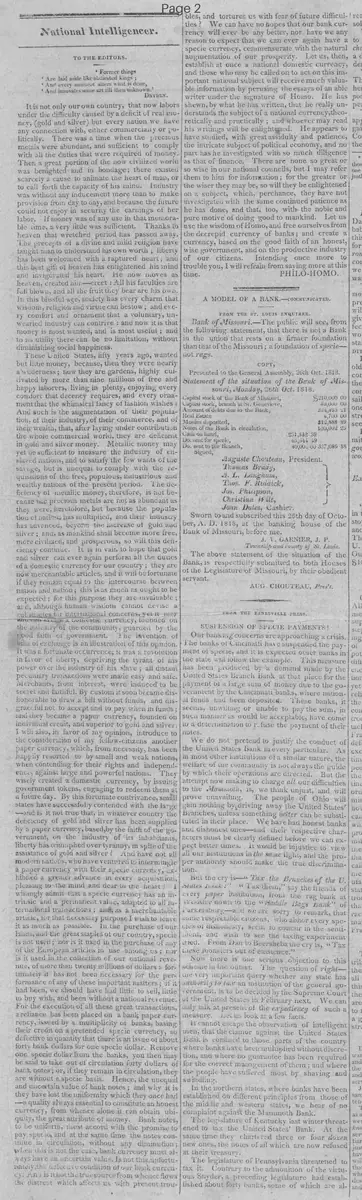
It is not only our own country, that now labors under the difficulty caused by a deficit of real money, (gold and silver) but every nation we have any connection with, either commercially or politically. There was a time when the precious metals were abundant, and sufficient to comply with all the duties that were required of money. Then a great portion of the now civilized world was benighted and in bondage; there existed scarcely a cause to animate the heart of man, or to call forth the capacity of his mind. Industry was without any inducement more than to make provision from day to day, and because the future could not enjoy in security the earnings of her labor. If money was of any use in that memorable time, a very little was sufficient. Thanks to heaven that wretched period has passed away.
The precepts of a divine and mild religion have taught man to understand his own worth; liberty has been welcomed with a raptured heart, and this best gift of heaven has enlightened his mind and invigorated his heart. He now moves as heaven created him erect: All his faculties are full blown, and all the fruit they bear are his own.
In this blissful age, society has every charm that wisdom, religion and virtue can bestow; and every comfort and ornament that a voluntary, unwearied industry can contrive: and now it is that money is most wanted, and is most useful; and to its utility there can be no limitation, without diminishing social happiness.
These United States, fifty years ago, wanted but little money, because, then they were nearly a wilderness; now they are gardens, highly cultivated by more than nine millions of free and happy laborers, living in plenty, enjoying every comfort that decency requires, and every ornament that the whimsical fancy of fashion wishes: And such is the augmentation of their population, of their industry, of their commerce, and of their wealth, that, after laying under contribution the whole commercial world, they are deficient in gold and silver money. Metallic money may yet be sufficient to measure the industry of enslaved nations, and to satisfy the few wants of the savage, but is unequal to comply with the requisitions of the free, populous, industrious and wealthy nations of the present period. The deficiency of metallic money, therefore, is not because the precious metals are not as abundant as they were, heretofore, but because the population of nations has multiplied, and their industry has advanced, beyond the increase of gold and silver; and, as mankind shall become more free, more civilized, and prosperous, so will this deficiency continue. It is in vain to hope that gold and silver can ever again perform all the duties of a domestic currency for our country; they are now merchantable articles, and it will be fortunate if they remain equal to the intercourse between nation and nation; this is as much as ought to be expected; for this purpose they are invaluable; and, although human wisdom cannot devise a substitute for international concerns, yet America can create a domestic currency, founded on the industry of the community, guarded by the good faith of government. The invention of bills of exchange is an illustration of this opinion. It was a fortunate occurrence; it was a revolution in favor of liberty, depriving the tyrant of his power over the industry of his slave; all distant pecuniary transactions were made easy and safe. Merchants, from interest, were induced to be secret and faithful. By custom it soon became dishonorable to draw a bill without funds, and disgraceful not to accept and to pay when in funds; and they became a paper currency, founded on individual credit, and superior to gold and silver.
I will also, in favor of my opinion, introduce to the consideration of my fellow-citizens another paper currency, which, from necessity, has been happily resorted to by small and weak nations, when contending for their rights and independence, against large and powerful nations. They wisely created a domestic currency, by issuing government tokens, engaging to redeem them at a future day. By this fortunate contrivance, small states have successfully contended with the large—and is it not true that, in whatever country the deficiency of gold and silver has been supplied by a paper currency, based by the faith of the government, on the industry of its inhabitants, liberty has triumphed over tyranny, in spite of the assistance of gold and silver? And have not all modern nations, who have ventured to intermingling a paper currency with their specie currency, exhibited a greater advance in every acquisition, pleasing to the mind and dear to the heart? I willingly admit that a specie currency has an intrinsic and a permanent value, adapted to all international transactions; and, as a merchantable article, for that necessary purpose I wish to leave it as much as possible. In the purchase of our lands, and the great staples of our country, specie is not used; nor is it used in the purchase of any of the European articles in use among us; nor is it used in the collection of our national revenue, of more than twenty millions of dollars: fortunately it has not been necessary for the performance of any of these important matters; if it had been, we should have had little to sell, little to buy with, and been without a national revenue.
For the execution of all these great transactions, a reliance has been placed on a bank paper currency, issued by a multiplicity of banks, basing their credit on a pretended specie currency, so defective in quantity that there is an issue of about forty bank dollars for one specie dollar. Remove one specie dollar from the banks, you then may be said to take out of circulation forty dollars of bank notes; or, if they remain in circulation, they are without a specie basis. Hence, the unequal and uncertain value of bank notes; and why it is they have lost the uniformity which they once had—a quality always essential to constitute an honest currency, from whence alone it can obtain ubiquity, the great attribute of money. Bank notes, to be uniform, must accord with the promise to pay specie, and at the same time the notes continue in circulation, without any diminution; when this is not the case, bank currency must always have an uncertain value. Is not this, unfortunately, the defective condition of our bank currency: And is it not the true source from whence flows troubles, and tortures us with fear of future difficulties? We can have no hopes that our bank currency will ever be any better, nor have we any reason to expect that we can ever again have a specie currency, commensurate with the natural augmentation of our prosperity. Let us, then, establish at once a national domestic currency, and those who may be called on to act on this important national subject will receive much valuable information by perusing the essays of an able writer under the signature of Homo. He has shewn, by what he has written, that he really understands the subject of a national currency, theoretically and practically; and whoever may read his writings will be enlightened. He appears to have studied, with great assiduity and patience, the intricate subject of political economy, and no part has he investigated with so much diligence as that of finance. There are none so great or so wise in our national councils, but I may refer them to him for information: for the greater or the wiser they may be, so will they be enlightened on a subject, which, perchance, they have not investigated with the same continued patience as he has done, and that, too, with the noble and pure motive of doing good to mankind. Let us use the wisdom of Homo, and free ourselves from the decrepit currency of banks; and create a currency, based on the good faith of an honest, wise government, and on the productive industry of our citizens. Intending once more to trouble you, I will refrain from saying more at this time.
PHILO-HOMO,
What sub-type of article is it?
What themes does it cover?
What keywords are associated?
What entities or persons were involved?
Letter to Editor Details
Author
Philo Homo
Recipient
To The Editors
Main Argument
due to population growth and industrial advancement, gold and silver are insufficient for u.s. domestic currency; a national paper currency based on government faith and community industry should replace flawed bank notes, as illustrated by bills of exchange and wartime tokens, with reference to 'homo's' essays.
Notable Details