Thank you for visiting SNEWPapers!
Sign up free
Story
February 22, 1957
The Prison Mirror
Stillwater, Washington County, Minnesota
What is this article about?
Article discusses higher reading rates among U.S. prison inmates compared to the general population, with over 50% of inmates borrowing books weekly versus less than 25% nationally. Based on 1956 library data from an unnamed prison, highlighting preferences for fiction, travel, history, and nonfiction amid limited activities.
Clipping
OCR Quality
98%
Excellent
Full Text
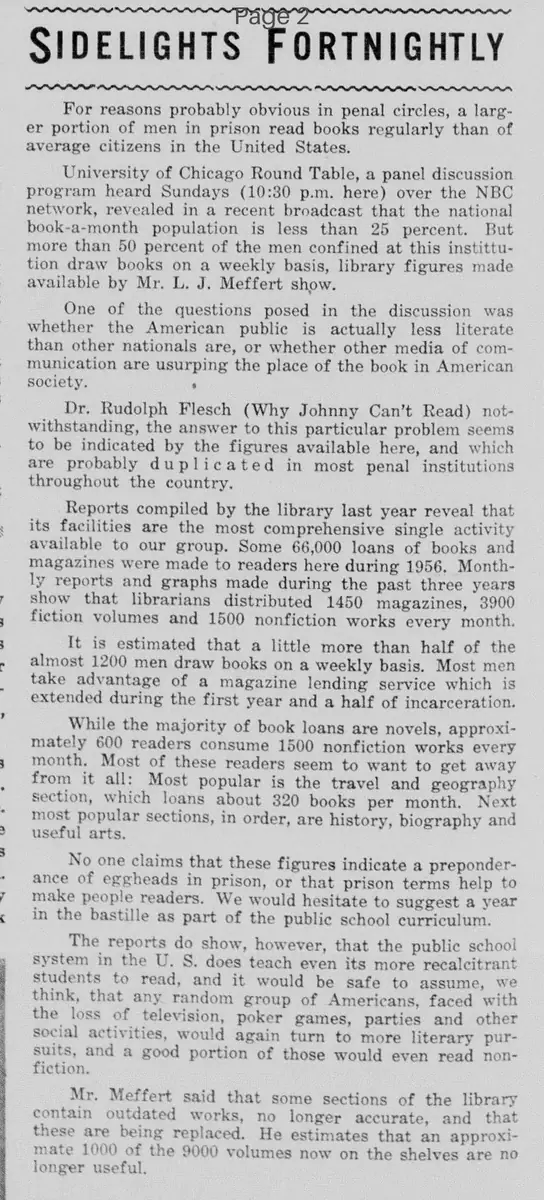
SIDELIGHTS FORTNIGHTLY
For reasons probably obvious in penal circles, a larger portion of men in prison read books regularly than of average citizens in the United States.
University of Chicago Round Table, a panel discussion program heard Sundays (10:30 p.m. here) over the NBC network, revealed in a recent broadcast that the national book-a-month population is less than 25 percent. But more than 50 percent of the men confined at this institution draw books on a weekly basis, library figures made available by Mr. L. J. Meffert show.
One of the questions posed in the discussion was whether the American public is actually less literate than other nationals are. or whether other media of communication are usurping the place of the book in American society.
Dr. Rudolph Flesch (Why Johnny Can't Read) notwithstanding, the answer to this particular problem seems to be indicated by the figures available here, and which are probably duplicated in most penal institutions throughout the country.
Reports compiled by the library last year reveal that its facilities are the most comprehensive single activity available to our group. Some 66,000 loans of books and magazines were made to readers here during 1956. Monthly reports and graphs made during the past three years show that librarians distributed 1450 magazines, 3900 fiction volumes and 1500 nonfiction works every month.
It is estimated that a little more than half of the almost 1200 men draw books on a weekly basis. Most men take advantage of a magazine lending service which is extended during the first year and a half of incarceration.
While the majority of book loans are novels, approximately 600 readers consume 1500 nonfiction works every month. Most of these readers seem to want to get away from it all: Most popular is the travel and geography section, which loans about 320 books per month. Next most popular sections, in order, are history, biography and useful arts.
No one claims that these figures indicate a preponderance of eggheads in prison, or that prison terms help to make people readers. We would hesitate to suggest a year in the bastille as part of the public school curriculum.
The reports do show, however, that the public school system in the U. S. does teach even its more recalcitrant students to read. and it would be safe to assume, we think, that any random group of Americans. faced with the loss of television, poker games, parties and other social activities, would again turn to more literary pursuits, and a good portion of those would even read non-fiction.
Mr. Meffert said that some sections of the library contain outdated works, no longer accurate. and that these are being replaced. He estimates that an approximate 1000 of the 9000 volumes now on the shelves are no longer useful.
For reasons probably obvious in penal circles, a larger portion of men in prison read books regularly than of average citizens in the United States.
University of Chicago Round Table, a panel discussion program heard Sundays (10:30 p.m. here) over the NBC network, revealed in a recent broadcast that the national book-a-month population is less than 25 percent. But more than 50 percent of the men confined at this institution draw books on a weekly basis, library figures made available by Mr. L. J. Meffert show.
One of the questions posed in the discussion was whether the American public is actually less literate than other nationals are. or whether other media of communication are usurping the place of the book in American society.
Dr. Rudolph Flesch (Why Johnny Can't Read) notwithstanding, the answer to this particular problem seems to be indicated by the figures available here, and which are probably duplicated in most penal institutions throughout the country.
Reports compiled by the library last year reveal that its facilities are the most comprehensive single activity available to our group. Some 66,000 loans of books and magazines were made to readers here during 1956. Monthly reports and graphs made during the past three years show that librarians distributed 1450 magazines, 3900 fiction volumes and 1500 nonfiction works every month.
It is estimated that a little more than half of the almost 1200 men draw books on a weekly basis. Most men take advantage of a magazine lending service which is extended during the first year and a half of incarceration.
While the majority of book loans are novels, approximately 600 readers consume 1500 nonfiction works every month. Most of these readers seem to want to get away from it all: Most popular is the travel and geography section, which loans about 320 books per month. Next most popular sections, in order, are history, biography and useful arts.
No one claims that these figures indicate a preponderance of eggheads in prison, or that prison terms help to make people readers. We would hesitate to suggest a year in the bastille as part of the public school curriculum.
The reports do show, however, that the public school system in the U. S. does teach even its more recalcitrant students to read. and it would be safe to assume, we think, that any random group of Americans. faced with the loss of television, poker games, parties and other social activities, would again turn to more literary pursuits, and a good portion of those would even read non-fiction.
Mr. Meffert said that some sections of the library contain outdated works, no longer accurate. and that these are being replaced. He estimates that an approximate 1000 of the 9000 volumes now on the shelves are no longer useful.
What sub-type of article is it?
Curiosity
What themes does it cover?
Social Manners
Misfortune
What keywords are associated?
Prison Reading
Library Usage
Inmate Literacy
Book Loans
Nonfiction Preferences
What entities or persons were involved?
Mr. L. J. Meffert
Dr. Rudolph Flesch
Where did it happen?
Penal Institution In The United States
Story Details
Key Persons
Mr. L. J. Meffert
Dr. Rudolph Flesch
Location
Penal Institution In The United States
Event Date
1956
Story Details
Prison library data shows over 50% of inmates read weekly, far exceeding national average, with 66,000 loans in 1956; preferences for fiction, travel, history; suggests literacy exists but is displaced by other media in free society.