Thank you for visiting SNEWPapers!
Sign up free
Kentucky Gazette
Lexington, Fayette County, Kentucky
What is this article about?
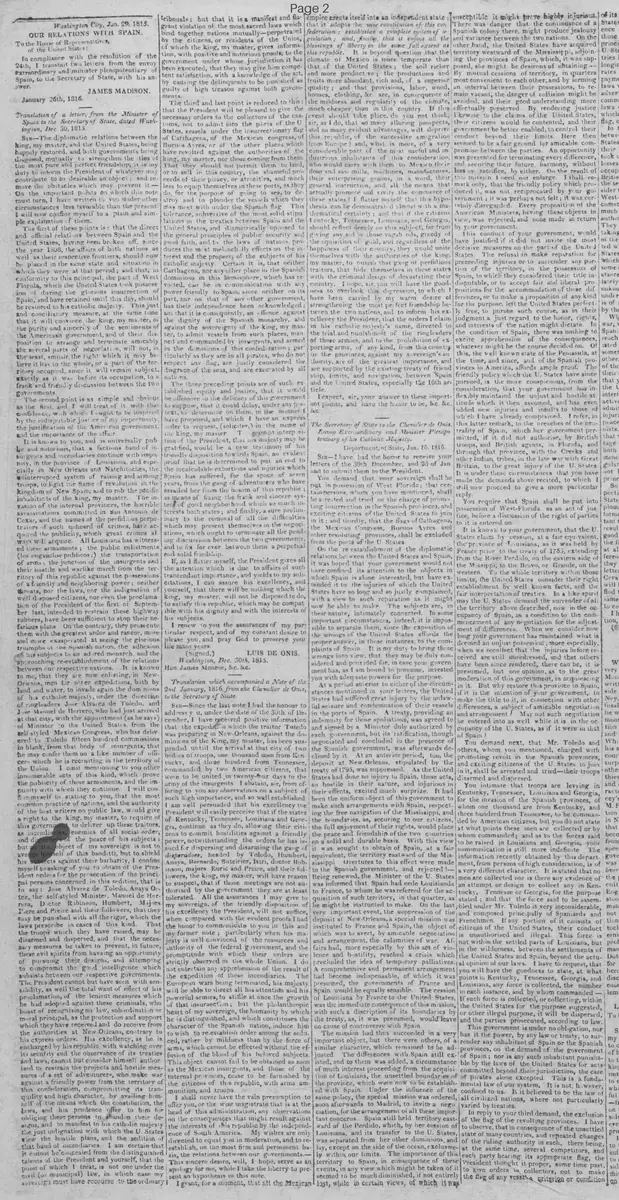
Diplomatic exchange between Spanish envoy Luis de Onis and US Secretary James Monroe in late 1815-early 1816, addressing Spain's demands for West Florida's return, prosecution of US-based insurgents plotting against Spanish Mexico, and barring revolutionary South American flags from US ports; Monroe counters with US grievances over past Spanish actions.
Clipping
OCR Quality
Full Text
JAMES MADISON.
January 26th, 1816.
Translation of a letter, from the Minister of Spain to the Secretary of State, dated Washington, Dec 30, 1815.
Sir—The diplomatic relations between the king, my master, and the United States, being happily restored, and both governments being disposed, mutually to strengthen the ties of the most pure and perfect friendship, it is my duty to inform the President of whatever may contribute to so desirable an object; and remove the obstacles which may prevent it—
On the important points on which this note must turn, I have written to you under other circumstances less favorable than the present. I will now confine myself to a plain and simple explanation of them.
The first of these points is: that the direct and official relations between Spain and the United States, having been broken off, since the year 1808, the affairs of both nations as well as their respective frontiers, should now be placed in the same state and situation in which they were at that period: and that, in conformity to this principle, the part of West Florida, which the United States took possession of during the glorious insurrection of Spain, and have retained until this day, should be restored to his catholic majesty. This just and conciliatory measure, at the same time that it will convince the king, my master, of the purity and sincerity of the sentiments of the American government, and of their disposition to arrange and terminate amicably the several parts of negotiation, will not, in the least, impair the right which it may believe it has to the whole, or a part of the territory occupied, since it will remain subject, exactly as it was before its occupation, to a frank and friendly discussion between the two governments.
The second point is as simple and obvious as the first, and I will treat of it with that confidence, with which I ought to be inspired by the indisputable justice of my importunity, the justification of the American government, and the importance of the affair.
It is known to you, and is universally public and notorious, that a factious band of insurgents and incendiaries continue with impunity, in the province of Louisiana and especially in New Orleans and Natchitoches, the uninterrupted system of raising and arming troops, to light the flame of revolution in the kingdom of New Spain; and to rob the pacific inhabitants of the king, my master. The invasion of the internal provinces, the horrible assassinations committed in San Antonio de Bexar, and the names of the perfidious perpetrators of such unheard of crimes, have acquired the publicity, which great crimes always will acquire. All Louisiana has witnessed these armaments; the public enlistments (los engagements publicos;) the transportation of arms; the junction of the insurgents and their hostile and warlike march from the territory of this republic against the possessions of a friendly and neighboring power; neither threats, nor the laws, nor the indignation of well disposed citizens, nor even the proclamation of the President of the first of September last, intended to restrain these highway robbers, have been sufficient to stop their nefarious plans. On the contrary, they prosecute them with the greatest ardor and rancor, more and more exasperated at seeing the glorious triumphs of the Spanish nation, the adhesion of his subjects to an adored monarch, and the approaching re-establishment of the relations between our respective nations. It is known to me, that they are now enlisting, in New Orleans, men for other expeditions, both by land and water, to invade again the dominions of his catholic majesty, under the direction of ringleaders Jose Alvarez de Toledo, and Jose Manuel de Herrero, who had just arrived at that city, with the appointment (as he says) of Minister to the United States, from the self-styled Mexican Congress, who has delivered to Toledo fifteen hundred commissions in blank, from that body of insurgents, that he may confer them on a like number of officers which he is recruiting in the territory of the Union. I omit mentioning to you other innumerable acts of this kind, which prove the publicity of these armaments, and the impunity with which they continue. I will confine myself to stating to you, that the most common practice of nations, and the authority of the best writers on public law, would give a right to the king, my master, to require of this government to deliver up these traitors, as incendiaries, enemies of all social order, and disturbers of the peace of his subjects: but as the object of my sovereign is not to avenge himself of this banditti, but to shield his subjects against their barbarity, I confine myself to asking of you to obtain of the President orders for the prosecution of the principal persons concerned in this sedition, that is to say: Jose Alvarez de Toledo, Anaya Ortez, the self-styled Minister, Manuel de Herrera, Doctor Robinson, Humbert, Majors Pere and Preire and their followers, that they may be punished with all the rigor, which the laws prescribe in cases of this kind. That the troops which they have raised, may be disarmed and dispersed, and that the necessary measures be taken to prevent, in future, these evil spirits from having an opportunity of pursuing their designs, and attempting to compromit the good intelligence which subsists between our respective governments.
The President cannot but have seen with sensibility, as well the total want of effect of his proclamation, of the lenient measures which he had adopted against these criminals, who boast of recognising no law, subordination or moral principle, as the protection and support which they have received and do receive from the authorities at New Orleans, contrary to his express orders. His excellency, as he is encharged by his republic with watching over its security and the observance of its treaties and laws, cannot but consider himself authorised to restrain the projects and hostile measures of a set of adventurers, who make war against a friendly power from the territory of this confederation, compromitting its tranquility and high character, by availing himself of the means which the constitution, the laws, and his prudence offer to him for obliging these persons to abandon their designs, and to manifest to his catholic majesty the just indignation with which the U. States view the hostile plans, and the sedition of that band of incendiaries. I am certain that it cannot be concealed from the distinguished talents of the President and yourself, that the point of which I treat, is not one under the civil (or municipal) law, in which case my sovereign must have recourse to the ordinary tribunals; but that it is a manifest and flagrant violation of the most sacred laws which bind together nations mutually—perpetrated by the citizens, or residents of the Union, of which the king, my master, gives information, with positive and notorious proofs, to the government under whose jurisdiction it has been executed, that they may give him competent satisfaction, with a knowledge of the act, by causing the delinquents to be punished as guilty of high treason against both governments.
The third and last point is reduced to this: that the President will be pleased to give the necessary orders to the collectors of the customs, not to admit into the ports of the United States, vessels under the insurrectionary flag of Carthagena, of the Mexican congress, of Buenos Ayres, or of the other places which have revolted against the authorities of the king, my master, nor those coming from them. That they should not permit them to land, or to sell in this country, the shameful proceeds of their piracy, or atrocities, and much less to equip themselves in these ports, as they do for the purpose of going to sea, to destroy and to plunder the vessels which they may meet with under the Spanish flag. This tolerance, subversive of the most solid stipulations in the treaties between Spain and the United States, and diametrically opposed to the general principles of public security and good faith, and to the laws of nations, produces the most melancholy effects on the interest and the property of the subjects of his catholic majesty. Certain it is, that neither Carthagena, nor any other place in the Spanish dominions in this hemisphere, which has revolted, can be in communication with any power friendly to Spain, since neither on its part, nor on that of any other government, has their independence been acknowledged; and that it is consequently, an offence against the dignity of the Spanish monarchy, and against the sovereignty of the king, my master, to admit vessels from such places, manned and commanded by insurgents, and armed in the dominions of this confederation; particularly as they are in all pirates, who do not respect any flag, are justly considered the disgrace of the seas, and are execrated by all nations.
The three preceding points are of such established equity and justice, that it would be offensive to the delicacy of this government to suppose, that it could delay, under any pretext, to determine on them, in the manner I have proposed, and which I have an express order to request, (soliciter.) in the name of the king, my master. A prompt interposition of the President, that his majesty may be gratified, would be a new testimony of his friendly disposition towards Spain, an evident proof that he is determined to put an end to the incalculable extortions and injuries which Spain has suffered, for the space of seven years, from the gang of adventurers who have assailed her from the bosom of this republic; as means of fixing the frank and sincere system of good neighborhood which so much interests both states; and finally, a sure preliminary to the removal of all the difficulties which may present themselves in the negotiations, which ought to terminate all the pending discussions between the two governments, and to fix for ever between them a perpetual and solid friendship.
If, as I flatter myself, the President gives all the attention which is due to affairs of such transcendent importance, and yields to my solicitations, I can assure his excellency, and yourself, that there will be nothing which the king, my master, will not be disposed to do, to satisfy this republic, which may be compatible with his dignity and with the interests of his subjects.
I renew to you the assurances of my particular respect, and of my constant desire to please you, and pray God to preserve your life many years.
(Signed,) LUIS DE ONIS.
Washington, Dec. 30th, 1815.
Hon James Monroe, &c. &c.
Translation which accompanied a Note of the 2nd January, 1816 from the Chevalier de Onis, to the Secretary of State.
Sir—Since the last note I had the honour to address you, under the date of the 30th. of December, I have received positive information that the expedition which the traitor Toledo was preparing in New-Orleans, against the dominions of the King, my master, has been suspended until the arrival at that city of two bodies of troops, one thousand men from Kentucky, and three hundred from Tennessee, commanded by two American citizens, that were to be united in twenty-four days to the army of the insurgents. I abstain, sir, from offering to you any observations on a subject of such high importance, and so well established. I am well persuaded that his excellency the President will easily perceive that if the states of Kentucky, Tennessee, Louisiana and Georgia, continue as they do, allowing their citizens to commit hostilities against a friendly power, notwithstanding the orders he has issued for dispersing and disarming the gang of desperadoes, headed by Toledo, Humbert, Anaya, Bernardo, Suteirier, Istri, doctor Robinson, majors Euric and Preire, and their followers, the king, my master, will have reason to suspect, that if those meetings are not authorised by the government they are at least tolerated. All the assurances I may give to my sovereign, of the friendly disposition of his excellency the President, will not suffice, when compared with the evident proofs I had the honor to communicate to you in this and my former note; particularly when his majesty is well convinced of the resources and authority of the federal government, and the promptitude with which their orders are strictly observed in the whole Union. I do not entertain any apprehension of the result of the expedition of these incendiaries. The European wars being terminated, his majesty will be able to direct all his attention and his powerful armies, to stifle at once the growth of that insurrection; but the philanthropic heart of my sovereign, the humanity by which he is distinguished, and which constitutes the character of the Spanish nation, induce him to wish to re-establish order among the seduced, rather by mildness than by the force of arms, which cannot be effected without the effusion of the blood of his beloved subjects. This object cannot fail to be obtained as soon as the Mexican insurgents, and those of the internal provinces, cease to be furnished by the citizens of this republic, with arms, ammunition, and troops.
I shall never have the vain presumption to offer you, or the wise magistrate that is at the head of this administration, any observations on the consequences that might result against the interests of his republic by the independence of South America. My wishes are only directed to equal you in moderation, and to re-establish, on the most firm and permanent basis, the relations between our governments.— This sincere desire, will, I hope, serve as an apology for me, while I take the liberty to present an hypothesis in this note.
I grant, for a moment, that all the Mexican empire erects itself into an independent state; that it adopts the wise constitution of this confederation: establishes a complete system of legislation; and, finally, that it enjoys all the blessings of liberty in the same full extent as this republic. It is beyond question that the climate of Mexico is more temperate than that of the United States; the soil richer and more productive; the productions and fruits more abundant, rich and, of a superior quality; and that provisions, labor, wood, houses, clothing, &c. are, in consequence of the mildness and regularity of the climate, much cheaper than in this country. If this event should take place, do you not think, sir, as I do, that so many alluring prospects, and so many evident advantages, will deprive this republic, of the successive emigration from Europe? and, what is more, of a very considerable part of the most useful and industrious inhabitants of this confederation, who would carry with them to Mexico their flour and saw mills, machines, manufactures, their enterprising genius, in a word, their general instruction, and all the means that actually promote and vivify the commerce of these states? I flatter myself that this hypothesis can be demonstrated almost with a mathematical certainty; and that if the citizens of Kentucky, Tennessee, Louisiana, and Georgia, should reflect deeply on this subject, far from giving any aid to those vagabonds, greedy of the acquisition of gold, and regardless of the happiness of their country, they would unite themselves with the authorities of the king, my master, to punish that gang of perfidious traitors, that hide themselves in these states with the criminal design of devastating their country. I hope, sir, you will have the goodness to overlook this digression, to which I have been carried by my warm desire of strengthening the most perfect friendship between the two nations, and to inform his excellency the President, that the orders I claim in his catholic majesty's name, directed to the trial and punishment of the ringleaders of those armies, and to the prohibition of exporting arms, of any kind, from this country to the provinces, against my sovereign's authority, are of the greatest importance, and are supported by the existing treaty of friendship, limits, and navigation, between Spain and the United States, especially the 16th article.
I expect, sir, your answer to these important points, and have the honor to be, &c. &c. &c.
The Secretary of State to the Chevalier de Onis, Envoy Extraordinary and Minister Plenipotentiary of his Catholic Majesty.
Department of State, Jan. 16. 1816.
Sir—I have had the honor to receive your letters of the 30th December, and 2d of January and to submit them to the President.
You demand that your sovereign shall be put in possession of West Florida; that certain persons, whom you have mentioned, shall be arrested and tried on the charge of promoting insurrection in the Spanish provinces, and exciting citizens of the United States to join in it: and thirdly, that the flags of Carthagena, the Mexican Congress, Buenos Ayres and other revolting provinces, shall be excluded from the ports of the United States.
On the re-establishment of the diplomatic relations between the United States and Spain, it was hoped that your government would not have confined its attention to the objects in which Spain is alone interested, but have extended it to the injuries of which the United States have so long and so justly complained, with a view to such reparation as it might now be able to make. The subjects are, in their nature, intimately connected. In some important circumstances, indeed, it is impossible to separate them, since the exposition of the wrongs of the United States affords the proper answer, in those instances, to the complaints of Spain. It is my duty to bring these wrongs into view, that they may be duly considered and provided for, in case your government has, as I am bound to presume, invested you with adequate powers for the purpose.
At a period anterior to either of the circumstances mentioned in your letters, the United States had suffered great injury by the unlawful seizure and condemnation of their vessels in the ports of Spain. A treaty, providing an indemnity for those spoliations, was agreed to and signed by a Minister duly authorized by each government, but its ratification, though negotiated and concluded in the presence of the Spanish government, was afterwards declined by it. At an anterior period, too, the deposit at New-Orleans, stipulated by the treaty of 1795, was suppressed. As the United States had done no injury to Spain, those acts, so hostile in their nature, and injurious in their effects, excited much surprise. It had been the uniform object of this government to make such arrangements with Spain, respecting the free navigation of the Mississippi, and the boundaries, as, securing to our citizens, the full enjoyment of their rights, would place the peace and friendship of the two countries on a solid and durable basis. With this view it was sought to obtain of Spain, at a fair equivalent, the territory eastward of the Mississippi. Overtures to this effect were made to the Spanish government, and rejected! Being renewed, the Minister of the U. States was informed that Spain had ceded Louisiana to France, to whom he was referred for the acquisition of such territory, in that quarter, as he might be instructed to make. On the last very important event, the suppression of the deposit at New-Orleans, a special mission was instituted to France and Spain, the object of which was to avert, by amicable negotiation and arrangement, the calamities of war. Affairs had, more especially by this act of violence and hostility, reached a crisis which precluded the idea of temporary palliatives. A comprehensive and permanent arrangement had become indispensable, of which it was presumed, the governments of France and Spain would be equally sensible. The cession of Louisiana by France to the United States, was the immediate consequence of this mission, with such a description of its boundaries by the treaty, as, it was presumed, would leave no cause of controversy with Spain.
The mission had thus succeeded in a very important object, but there were others, of a similar character, which remained to be adjusted. The differences with Spain still existed, and to them was added, a circumstance of much interest proceeding from the acquisition of Louisiana, the unsettled boundaries of the province, which were now to be established with Spain. Under the influence of the same policy, the special mission was ordered, soon afterwards to Madrid, to invite a negotiation, for the arrangement of all these important concerns. Spain still held territory eastward of the Perdido, which, by her cession of Louisiana, and its transfer to the U. States, was separated from her other dominions, and lay, except on the side of the ocean, exclusively within our limits. The importance of this territory to Spain, in consequence of these events, in any view which might be taken of it seemed to be much diminished, if not entirely lost, while in certain views, of which it was susceptible it might prove highly injurious. There was danger that the continuance of a Spanish colony there, might produce jealousy and variance between the two nations. On the other hand, the United States have acquired territory westward of the Mississippi, adjoining the provinces of Spain, which, it was supposed, she might be desirous of obtaining.— By mutual cessions of territory, in quarters most convenient to each other, and by forming an interval between their possessions, to remain vacant, the danger of collision might be avoided, and their good understanding more effectually preserved. By rendering justice likewise to the claims of the United States, their citizens would be contented, and their government be better enabled, to control their conduct beyond their limits. Here then seemed to be a fair ground for amicable compromise between the parties. An opportunity was presented for terminating every difference, and securing their future harmony, without loss or sacrifice, by either. On the result of this mission I need not enlarge. I shall remark only, that the friendly policy which produced it, was not reciprocated by your government; it was perhaps not felt; it was certainly disregarded. Every proposition of the American Ministers, having these objects in view, was rejected, and none made in return by your government.
This conduct of your government, would have justified if it did not invite the most decisive measures on the part of the United States. The refusal to make reparation for preceding injuries or to surrender any portion of the territory, in the possession of Spain, to which they considered their title indisputable, or to accept fair and liberal propositions for the accommodation of these differences, or to make a proposition of any kind for the purpose, left the United States perfectly free, to pursue such course, as in their judgment a just regard to the honor, rights, and interests of the nation might dictate. In the condition of Spain, there was nothing to excite apprehension of the consequences, whatever might be the course decided on. Of this, the well known state of the Peninsula, at the time, and since, and of the Spanish provinces in America, affords ample proof. The friendly policy which the U. States have since pursued, is the more conspicuous, from the consideration, that your government has inflexibly maintained the unjust and hostile attitude which it then assumed, and has even added new injuries and insults to those of which I have already complained. I refer, in this latter remark, to the breaches of the neutrality of Spain, which her government permitted, if it did not authorise, by British troops, and British agents, in Florida, and through that province, with the Creeks and other Indian tribes, in the late war with Great Britain, to the great injury of the U. States. It is under these circumstances that you have made the demands above recited, to which I will now proceed to give a more particular reply.
You require that Spain shall be put into possession of West-Florida as an act of justice, before a discussion of the right of parties to it is entered on.
It is known to your government, that the U. States claim by cession, at a fair equivalent, the province of Louisiana, as it was held by France prior to the treaty of 1763, extending from the River Perdido, on the eastern side of the Mississippi, to the Bravo, or Grande, on the western. To the whole territory within those limits, the United States consider their right established by well known facts, and the fair interpretation of treaties. In a like spirit may the U. States demand the surrender of all the territory above described, now in the occupancy of Spain, as a condition to the commencement of any negotiation for the adjustment of differences. When we consider how long your government has maintained what is deemed an unjust possession: more especially, when we recollect that the injuries before received are still unredressed, and that others have been since rendered, there can be, it is presumed, but one opinion, as to the great moderation of this government, in acquiescing in it. But why restore this province to Spain, if it is the intention of your government, to make the title to it, in connection with other differences, a subject of amicable negotiation and arrangement? May not such negotiation be entered into as well while it is in the occupancy of the U. States, as if it were in that of Spain!
You demand next, that Mr. Toledo and others, whom you mentioned, charged with promoting revolt in the Spanish provinces, and exciting citizens of the U. States to join in it, shall be arrested and tried—their troops disarmed and dispersed.
You intimate that troops are levying in Kentucky, Tennessee, Louisiana and Georgia, for the invasion of the Spanish provinces, of whom one thousand are from Kentucky, and three hundred from Tennessee, to be commanded by American citizens, but you do not state at what points these men are collected or by whom commanded: and as to the forces said to be raised in Louisiana and Georgia, your communication is still more indefinite. The information recently obtained by this department, from persons of high consideration, is of a very different character. It is stated that no men are collected nor is there any evidence of an attempt or design to collect any in Kentucky, Tennessee or Georgia, for the purpose stated; and that the force said to be assembled under Mr. Toledo is very inconsiderable, and composed principally of Spaniards and Frenchmen. If any portion of it consists of citizens of the United States, their conduct is unauthorised and illegal. This force is not within the settled parts of Louisiana, but in the wilderness, between the settlements of the United States and Spain, beyond the actual operation of our laws. I have to request, that you will have the goodness to state, at what points in Kentucky, Tennessee, Georgia, and Louisiana, any force is collected, the number in each instance, and by whom commanded— If such force is collected, or collecting, within the United States for the purpose suggested, or other illegal purpose, it will be dispersed, and the parties prosecuted, according to law.
This government is under no obligation, nor has it the power, by any law or treaty, to surrender any inhabitant of Spain or the Spanish provinces, on the demand of the government of Spain; nor is any such inhabitant punishable by the laws of the United States for acts committed beyond their jurisdiction, the case of pirates alone excepted. This is a fundamental law of our system. It is not, however, confined to us. It is believed to be the law of all civilized nations, where not particularly varied by treaties.
In reply to your third demand, the exclusion of the flag of the revolting provinces, I have to observe, that in consequence of the unsettled state of many countries, and repeated changes of the ruling authority in each, there being, at the same time, several competitors, and each party bearing its appropriate flag, the President thought it proper, some time past, to give orders to collectors, not to make the flag of any vessel a criterion or condition of admission into the ports of the United States. Having taken no part in the differences and convulsions which have disturbed those countries, it is consistent with the just principles, as it is with the interests of the United States, to receive the vessels of all countries into their ports, to whatever party belonging, and under whatever flag sailing, pirates excepted, requiring of them only the payment of the duties, and obedience to the laws while under their jurisdiction; without adverting to the question, whether they had committed any violation of the allegiance or laws obligatory on them in the countries to which they belonged, either in assuming such flag, or in any other respect.
In the differences which have subsisted between Spain and her colonies, the United States have observed all proper respects to their friendly relations with Spain. They took no measures to indemnify themselves for losses and injuries; none to guard against the occupancy of the Spanish territory by the British forces in the late war, or to occupy the territory to which the United States consider their title good, except in the instance of West-Florida, and in that instance under circumstances which made their interposition as much an act of accommodation to the Spanish authority there, as of security to themselves. They have also prohibited their citizens from taking any part in the war; and the inhabitants of the colonies, and other foreigners connected with them, from recruiting men in the U. States for the purpose. The proclamations which have been issued by the governors of some of the states and territories at the instance of the President, and the proclamation lately issued by the President himself, are not unknown to your government. This conduct under such circumstances, and at such a time is of a character too marked to be mistaken by the impartial world.
What will be the final result of the civil war, which prevails between Spain and the Spanish provinces in America, is beyond the reach of human foresight. It has already existed many years, and with various success, sometimes one party prevailing, and then the other. In some of the provinces, the success of the revolutionists appears to have given to them cause more stability than in others. All that your government had a right to claim of the United States, was that they should not interfere in the contest, or promote, by any active service, the success of the revolution, admitting that they continued to overlook the injuries received from Spain, and remained at peace. This right was common to the colonists. With equal justice might they claim, that we would not interfere to their disadvantage: that our ports should remain open to both parties, as they were before the commencement of the struggle; that our laws regulating commerce with foreign nations should not be changed to their injury. On these principles the U. S. have acted.
So much I have thought proper to state, respecting the relations existing between the U. States and Spain. The restoration of the diplomatic intercourse between our governments forms an epoch which cannot fail to be important to both nations. If it does not produce a result favorable to their future friendship and good understanding, to your government will the failure be imputable. The U States have at all times been willing to settle their differences on just principles and conditions, and they still are. Of this I informed you in my letter of the 8th of May, as I likewise did Mr. Cevallos, in a letter of the 17th of July. It will be very satisfactory to the President, to find that your government entertains now the same disposition, and has given you full power to conclude a treaty for these purposes.
I have the honor to be, with great consideration, sir, your very obedient servant,
(Signed) JAMES MONROE.
What sub-type of article is it?
What keywords are associated?
What entities or persons were involved?
Where did it happen?
Foreign News Details
Primary Location
Spanish America
Event Date
1815 12 30 To 1816 01 16
Key Persons
Outcome
no immediate resolution; monroe rejects demands, cites us injuries from spain, affirms neutrality in spanish colonial revolts, and requests specifics on alleged insurgent forces.
Event Details
Onis demands US return West Florida to pre-1808 status, prosecute leaders like Toledo for arming insurgents in Louisiana for attacks on Spanish Mexico including San Antonio de Bexar, and exclude vessels under revolutionary flags from Buenos Ayres, Mexican Congress, and Cartagena from US ports. He warns of emigration risks if Mexico gains independence. Monroe responds by listing US complaints: spoliations, New Orleans deposit suppression, boundary disputes, rejected negotiations, and British use of Florida; refuses unilateral West Florida return, denies organized US troop involvement in revolts, upholds neutrality allowing all non-pirate vessels in ports, and invites comprehensive treaty talks.