Thank you for visiting SNEWPapers!
Sign up free
Story
November 15, 1955
Daily Sitka Sentinel And The Arrowhead Press
Sitka, Alaska
What is this article about?
Dr. B. E. McBrayer spoke to the Sitka Woman's Club about proposed Alaska mental health law reforms, emphasizing better treatment and examinations. Dr. Spangler discussed national mental health issues. Club handled business including donations and sponsorships.
Clipping
OCR Quality
98%
Excellent
Full Text
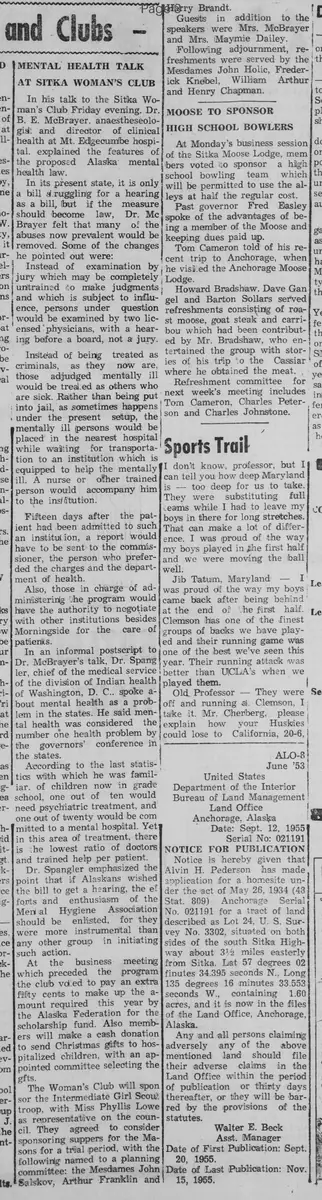
AT SITKA WOMAN'S CLUB
In his talk to the Sitka Woman's Club Friday evening, Dr. B. E. McBrayer, anesthesiologist and director of clinical health at Mt. Edgecumbe hospital, explained the features of the proposed Alaska mental health law.
In its present state, it is only a bill struggling for a hearing as a bill, but if the measure should become law, Dr. McBrayer felt that many of the abuses now prevalent would be removed. Some of the changes he pointed out were:
Instead of examination by jury which may be completely untrained to make judgments and which is subject to influence, persons under question would be examined by two licensed physicians, with a hearing before a board, not a jury.
Instead of being treated as criminals, as they now are, those adjudged mentally ill would be treated as others who are sick. Rather than being put into jail, as sometimes happens under the present setup, the mentally ill persons would be placed in the nearest hospital while waiting for transportation to an institution which is equipped to help the mentally ill. A nurse or other trained person would accompany him to the institution.
Fifteen days after the patient had been admitted to such an institution, a report would have to be sent to the commissioner, the person who preferred the charges and the department of health.
Also, those in charge of administering the program would have the authority to negotiate with other institutions besides Morningside for the care of patients.
In an informal postscript to Dr. McBrayer's talk, Dr. Spangler, chief of the medical service of the division of Indian health of Washington, D. C., spoke about mental health as a problem in the states. He said mental health was considered the number one health problem by the governors' conference in the states.
According to the last statistics with which he was familiar, of children now in grade school, one out of ten would need psychiatric treatment, and one out of twenty would be committed to a mental hospital. Yet in this area of treatment, there is the lowest ratio of doctors and trained help per patient.
Dr. Spangler emphasized the point that if Alaskans wished the bill to get a hearing, the efforts and enthusiasm of the Mental Hygiene Association should be enlisted, for they were more instrumental than any other group in initiating such action.
At the business meeting which preceded the program the club voted to pay an extra fifty cents to make up the amount required this year by the Alaska Federation for the scholarship fund. Also members will make a cash donation to send Christmas gifts to hospitalized children, with an appointed committee selecting the gifts.
The Woman's Club will sponsor the Intermediate Girl Scout troop, with Miss Phyllis Lowe as representative on the council. They agreed to consider sponsoring suppers for the Masons for a trial period, with the following named to a planning committee: the Mesdames John Salskov, Arthur Franklin and
Guests in addition to the speakers were Mrs. McBrayer and Mrs. Maymie Dailey.
Following adjournment, refreshments were served by the Mesdames John Holic, Frederick Knebel, William Arthur and Henry Chapman.
In his talk to the Sitka Woman's Club Friday evening, Dr. B. E. McBrayer, anesthesiologist and director of clinical health at Mt. Edgecumbe hospital, explained the features of the proposed Alaska mental health law.
In its present state, it is only a bill struggling for a hearing as a bill, but if the measure should become law, Dr. McBrayer felt that many of the abuses now prevalent would be removed. Some of the changes he pointed out were:
Instead of examination by jury which may be completely untrained to make judgments and which is subject to influence, persons under question would be examined by two licensed physicians, with a hearing before a board, not a jury.
Instead of being treated as criminals, as they now are, those adjudged mentally ill would be treated as others who are sick. Rather than being put into jail, as sometimes happens under the present setup, the mentally ill persons would be placed in the nearest hospital while waiting for transportation to an institution which is equipped to help the mentally ill. A nurse or other trained person would accompany him to the institution.
Fifteen days after the patient had been admitted to such an institution, a report would have to be sent to the commissioner, the person who preferred the charges and the department of health.
Also, those in charge of administering the program would have the authority to negotiate with other institutions besides Morningside for the care of patients.
In an informal postscript to Dr. McBrayer's talk, Dr. Spangler, chief of the medical service of the division of Indian health of Washington, D. C., spoke about mental health as a problem in the states. He said mental health was considered the number one health problem by the governors' conference in the states.
According to the last statistics with which he was familiar, of children now in grade school, one out of ten would need psychiatric treatment, and one out of twenty would be committed to a mental hospital. Yet in this area of treatment, there is the lowest ratio of doctors and trained help per patient.
Dr. Spangler emphasized the point that if Alaskans wished the bill to get a hearing, the efforts and enthusiasm of the Mental Hygiene Association should be enlisted, for they were more instrumental than any other group in initiating such action.
At the business meeting which preceded the program the club voted to pay an extra fifty cents to make up the amount required this year by the Alaska Federation for the scholarship fund. Also members will make a cash donation to send Christmas gifts to hospitalized children, with an appointed committee selecting the gifts.
The Woman's Club will sponsor the Intermediate Girl Scout troop, with Miss Phyllis Lowe as representative on the council. They agreed to consider sponsoring suppers for the Masons for a trial period, with the following named to a planning committee: the Mesdames John Salskov, Arthur Franklin and
Guests in addition to the speakers were Mrs. McBrayer and Mrs. Maymie Dailey.
Following adjournment, refreshments were served by the Mesdames John Holic, Frederick Knebel, William Arthur and Henry Chapman.
What sub-type of article is it?
Public Lecture
Community Meeting
What themes does it cover?
Justice
Recovery
What keywords are associated?
Mental Health Law
Alaska Bill
Sitka Woman's Club
Psychiatric Treatment
Patient Rights
Community Meeting
What entities or persons were involved?
Dr. B. E. Mcbrayer
Dr. Spangler
Mrs. Mcbrayer
Mrs. Maymie Dailey
Miss Phyllis Lowe
Mesdames John Salskov
Arthur Franklin
John Holic
Frederick Knebel
William Arthur
Henry Chapman
Where did it happen?
Sitka, Alaska
Story Details
Key Persons
Dr. B. E. Mcbrayer
Dr. Spangler
Mrs. Mcbrayer
Mrs. Maymie Dailey
Miss Phyllis Lowe
Mesdames John Salskov
Arthur Franklin
John Holic
Frederick Knebel
William Arthur
Henry Chapman
Location
Sitka, Alaska
Event Date
Friday Evening
Story Details
Dr. McBrayer explains proposed Alaska mental health bill reforms for better patient treatment and examinations; Dr. Spangler discusses national mental health statistics and urges support; club votes on donations, sponsorships, and committees.