Thank you for visiting SNEWPapers!
Sign up free
Editorial
July 19, 1780
The Virginia Gazette
Richmond, Williamsburg, Richmond County, Virginia
What is this article about?
In 'Crisis, No. IX,' the author urges Americans to renew their revolutionary spirit amid reports of Charleston's potential fall, emphasizing patriotism, unity, and preparation for allied support from France and Spain against Britain. Highlights voluntary efforts in Philadelphia to bolster the war effort.
Clipping
OCR Quality
95%
Excellent
Full Text
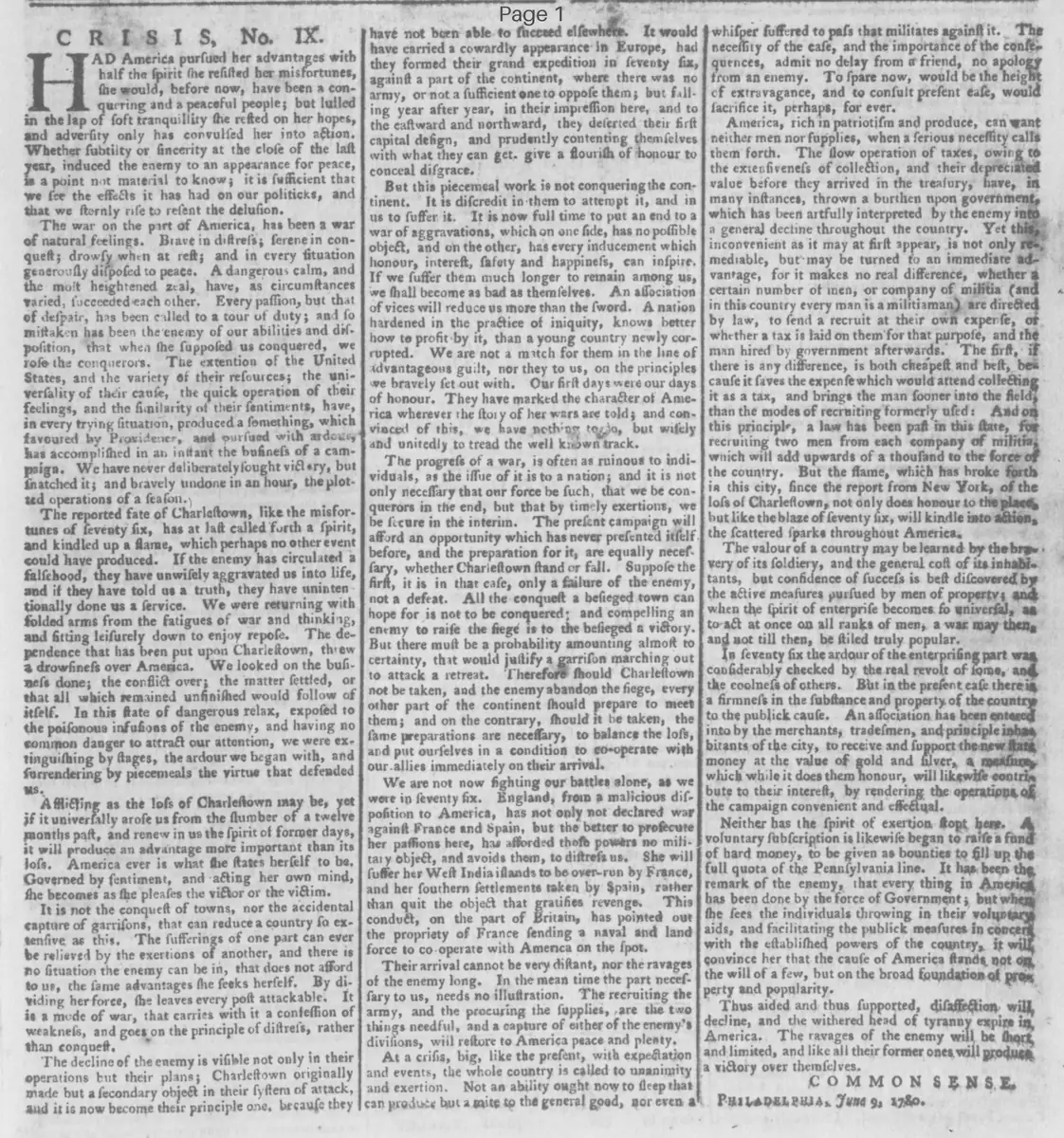
CRISIS, No. IX.
As America pursued her advantages with half the spirit she resisted her misfortunes, her inquiring and a peaceful people; but lulled in the lap of soft tranquillity she rested on her hopes, and adversity only has convulsed her into action.
Whether subtlety or insincerity at the close of the last year, induced the enemy to an appearance for peace, is a point not material to know; it is sufficient that we see the effects it has had on our politics, and that we tenderly rise to resent the delusion.
The war on the part of America, has been a war of natural feelings. Brave in distress; serene in conquest; drowsy when at rest; and in every situation generously disposed to peace. A dangerous calm, and the most heightened zeal, have, as circumstances varied, succeeded each other. Every passion, but that of despair, has been called to a tour of duty; and so mistaken has been the enemy of our abilities and disposition, that when they supposed us conquered, we rose the conquerors. The extension of the United States, and the variety of their resources; the universality of their cause, the quick operation of their feelings, and the similarity of their sentiments, have, in every trying situation, produced a something, which favoured by Providence, and pursued with ardour, has accomplished in an instant the business of a campaign. We have never deliberately fought victory, but snatched it; and bravely undone in an hour, the plotted operations of a season.
The reported fate of Charleston, like the misfortunes of seventy six, has at last called forth a spirit, and kindled up a flame, which perhaps no other event could have produced. If the enemy has circulated a falsehood, they have unwisely aggravated us into life, and if they have told us a truth, they have unintentionally done us a service. We were returning with folded arms from the fatigues of war and thinking, and sitting leisurely down to enjoy repose. The dependence that has been put upon Charleston, threw a drowsiness over America. We looked on the business done; the conflict over; the matter settled, or that all which remained unfinished would follow of itself. In this state of dangerous relax, exposed to the poisonous infusions of the enemy, and having no common danger to attract our attention, we were extinguishing by stages, the ardour we began with, and surrendering by piecemeals the virtue that defended us.
A misling as the loss of Charleston maybe, yet if it universally arouse us from the slumber of a twelve months past, and renew in us the spirit of former days, it will produce an advantage more important than its loss. America ever is what she states herself to be. Governed by sentiment, and acting her own mind, she becomes as she pleases the victor or the victim. It is not the conquest of towns, nor the accidental capture of garrisons, that can reduce a country so extensive as this. The sufferings of one part can ever be relieved by the exertions of another, and there is no situation the enemy can be in, that does not afford to us, the same advantages they seek herself. By dividing her force, she leaves every post attackable. It is a mode of war, that carries with it a confession of weakness, and goes on the principle of distress, rather than conquest.
The decline of the enemy is visible not only in their operations but their plans; Charleston originally made but a secondary object in their system of attack, and it is now become their principal one. because they have not been able to succeed elsewhere.
It would have carried a cowardly appearance in Europe, had they formed their grand expedition in seventy six, against a part of the continent, where there was no army, or not a sufficient one to oppose them; but falling year after year, in their impression here, and to the eastward and northward, they deserted their first capital design, and prudently contenting themselves with what they can get, give a flourish of honour to conceal disgrace.
But this piecemeal work is not conquering the continent. It is discredit in them to attempt it, and in us to suffer it. It is now full time to put an end to a war of aggravations, which on one side, has no possible object, and on the other, has every inducement which honour, interest, safety and happiness, can inspire.
If we suffer them much longer to remain among us, we shall become as bad as themselves. An association of vices will reduce us more than the sword. A nation hardened in the practice of iniquity, knows better how to profit by it, than a young country newly corrupted.
We are not a match for them in the line of advantageous guilt, nor they to us, on the principles we bravely set out with. Our first days were our days of honour. They have marked the character of America wherever the story of her wars are told; and convinced of this, we have nothing to do, but wisely and unitedly to tread the well known track.
The progress of a war, is often as ruinous to individuals, as the issue of it is to a nation; and it is not only necessary that our force be such, that we be conquerors in the end, but that by timely exertions, we be secure in the interim. The present campaign will afford an opportunity which has never presented itself before, and the preparation for it, are equally necessary, whether Charleston stand or fall. Suppose the first, it is in that case, only a failure of the enemy, not a defeat. All the conquest a besieged town can hope for is not to be conquered; and compelling an enemy to raise the siege is to the besieged a victory.
But there must be a probability amounting almost to certainty, that would justify a garrison marching out to attack a retreat. Therefore should Charleston not be taken, and the enemy abandon the siege, every other part of the continent should prepare to meet them; and on the contrary, should it be taken, the same preparations are necessary, to balance the loss, and put ourselves in a condition to co-operate with our allies immediately on their arrival.
We are not now fighting our battles alone, as we were in seventy six. England, from a malicious disposition to America, has not only not declared war against France and Spain, but the better to prosecute her passions here, has afforded those powers no military object, and avoids them, to distress us. She will suffer her West India islands to be over-run by France, and her southern settlements taken by Spain, rather than quit the object that gratifies revenge.
This conduct, on the part of Britain, has pointed out the propriety of France sending a naval and land force to co-operate with America on the spot.
Their arrival cannot be very distant, nor the ravages of the enemy long. In the mean time the part necessary to us, needs no illustration. The recruiting the army, and the procuring the supplies, are the two things needful, and a capture of either of the enemy's divisions, will restore to America peace and plenty.
At a crisis, big, like the present, with expectation and events, the whole country is called to unanimity and exertion. Not an ability ought now to sleep that can produce but a mite to the general good, nor even a whisper suffered to pass that militates against it. The necessity of the case, and the importance of the consequences, admit no delay from a friend, no apology from an enemy. To spare now, would be the height of extravagance, and to consult present ease, would sacrifice it, perhaps, for ever.
America, rich in patriotism and produce, can want neither men nor supplies, when a serious necessity calls them forth. The slow operation of taxes, owing to the extensiveness of collection, and their depreciated value before they arrived in the treasury, have, in many instances, thrown a burthen upon government, which has been artfully interpreted by the enemy into a general decline throughout the country. Yet this, inconvenient as it may at first appear, is not only remediable, but may be turned to an immediate advantage, for it makes no real difference, whether a certain number of men, or company of militia (and in this country every man is a militiaman) are directed by law, to send a recruit at their own expense, or whether a tax is laid on them for that purpose, and the man hired by government afterwards. The first, if there is any difference, is both cheaper and best, because it saves the expense which would attend collecting it as a tax, and brings the man sooner into the field than the modes of recruiting formerly used. And on this principle, a law has been passed in this state, for recruiting two men from each company of militia, which will add upwards of a thousand to the force of the country. But the flame, which has broke forth in this city, since the report from New York, of the loss of Charleston, not only does honour to the place but like the blaze of seventy six, will kindle into action, the scattered sparks throughout America.
The valour of a country may be learned by the bravery of its soldiery, and the general cast of its inhabitants, but confidence of success is best discovered by the active measures pursued by men of property; and when the spirit of enterprise becomes so universal, as to act at once on all ranks of men, a war may then and not till then, be styled truly popular.
In seventy six the ardour of the enterprising part was considerably checked by the real revolt of some, and the coolness of others.
But in the present case there is a firmness in the substance and property of the country to the publick cause. An association has been entered into by the merchants, tradesmen, and principal inhabitants of the city, to receive and support the new state money at the value of gold and silver, a measure which while it does them honour, will likewise contribute to their interest, by rendering the operations of the campaign convenient and effectual.
Neither has the spirit of exertion stopped here. A voluntary subscription is likewise began to raise a fund of hard money, to be given as bounties to fill up the full quota of the Pennsylvania line. It has been the remark of the enemy, that everything in America has been done by the force of Government; but when she sees the individuals throwing in their voluntary aids, and facilitating the publick measures in concert with the established powers of the country, it will convince her that the cause of America stands not on the will of a few, but on the broad foundation of property and popularity.
Thus aided and thus supported, disaffection will decline, and the withered head of tyranny expire in America.
The ravages of the enemy will be short and limited, and like all their former ones will produce a victory over themselves.
COMMON SENSE
PHILADELPHIA JUNE 9 1780.
As America pursued her advantages with half the spirit she resisted her misfortunes, her inquiring and a peaceful people; but lulled in the lap of soft tranquillity she rested on her hopes, and adversity only has convulsed her into action.
Whether subtlety or insincerity at the close of the last year, induced the enemy to an appearance for peace, is a point not material to know; it is sufficient that we see the effects it has had on our politics, and that we tenderly rise to resent the delusion.
The war on the part of America, has been a war of natural feelings. Brave in distress; serene in conquest; drowsy when at rest; and in every situation generously disposed to peace. A dangerous calm, and the most heightened zeal, have, as circumstances varied, succeeded each other. Every passion, but that of despair, has been called to a tour of duty; and so mistaken has been the enemy of our abilities and disposition, that when they supposed us conquered, we rose the conquerors. The extension of the United States, and the variety of their resources; the universality of their cause, the quick operation of their feelings, and the similarity of their sentiments, have, in every trying situation, produced a something, which favoured by Providence, and pursued with ardour, has accomplished in an instant the business of a campaign. We have never deliberately fought victory, but snatched it; and bravely undone in an hour, the plotted operations of a season.
The reported fate of Charleston, like the misfortunes of seventy six, has at last called forth a spirit, and kindled up a flame, which perhaps no other event could have produced. If the enemy has circulated a falsehood, they have unwisely aggravated us into life, and if they have told us a truth, they have unintentionally done us a service. We were returning with folded arms from the fatigues of war and thinking, and sitting leisurely down to enjoy repose. The dependence that has been put upon Charleston, threw a drowsiness over America. We looked on the business done; the conflict over; the matter settled, or that all which remained unfinished would follow of itself. In this state of dangerous relax, exposed to the poisonous infusions of the enemy, and having no common danger to attract our attention, we were extinguishing by stages, the ardour we began with, and surrendering by piecemeals the virtue that defended us.
A misling as the loss of Charleston maybe, yet if it universally arouse us from the slumber of a twelve months past, and renew in us the spirit of former days, it will produce an advantage more important than its loss. America ever is what she states herself to be. Governed by sentiment, and acting her own mind, she becomes as she pleases the victor or the victim. It is not the conquest of towns, nor the accidental capture of garrisons, that can reduce a country so extensive as this. The sufferings of one part can ever be relieved by the exertions of another, and there is no situation the enemy can be in, that does not afford to us, the same advantages they seek herself. By dividing her force, she leaves every post attackable. It is a mode of war, that carries with it a confession of weakness, and goes on the principle of distress, rather than conquest.
The decline of the enemy is visible not only in their operations but their plans; Charleston originally made but a secondary object in their system of attack, and it is now become their principal one. because they have not been able to succeed elsewhere.
It would have carried a cowardly appearance in Europe, had they formed their grand expedition in seventy six, against a part of the continent, where there was no army, or not a sufficient one to oppose them; but falling year after year, in their impression here, and to the eastward and northward, they deserted their first capital design, and prudently contenting themselves with what they can get, give a flourish of honour to conceal disgrace.
But this piecemeal work is not conquering the continent. It is discredit in them to attempt it, and in us to suffer it. It is now full time to put an end to a war of aggravations, which on one side, has no possible object, and on the other, has every inducement which honour, interest, safety and happiness, can inspire.
If we suffer them much longer to remain among us, we shall become as bad as themselves. An association of vices will reduce us more than the sword. A nation hardened in the practice of iniquity, knows better how to profit by it, than a young country newly corrupted.
We are not a match for them in the line of advantageous guilt, nor they to us, on the principles we bravely set out with. Our first days were our days of honour. They have marked the character of America wherever the story of her wars are told; and convinced of this, we have nothing to do, but wisely and unitedly to tread the well known track.
The progress of a war, is often as ruinous to individuals, as the issue of it is to a nation; and it is not only necessary that our force be such, that we be conquerors in the end, but that by timely exertions, we be secure in the interim. The present campaign will afford an opportunity which has never presented itself before, and the preparation for it, are equally necessary, whether Charleston stand or fall. Suppose the first, it is in that case, only a failure of the enemy, not a defeat. All the conquest a besieged town can hope for is not to be conquered; and compelling an enemy to raise the siege is to the besieged a victory.
But there must be a probability amounting almost to certainty, that would justify a garrison marching out to attack a retreat. Therefore should Charleston not be taken, and the enemy abandon the siege, every other part of the continent should prepare to meet them; and on the contrary, should it be taken, the same preparations are necessary, to balance the loss, and put ourselves in a condition to co-operate with our allies immediately on their arrival.
We are not now fighting our battles alone, as we were in seventy six. England, from a malicious disposition to America, has not only not declared war against France and Spain, but the better to prosecute her passions here, has afforded those powers no military object, and avoids them, to distress us. She will suffer her West India islands to be over-run by France, and her southern settlements taken by Spain, rather than quit the object that gratifies revenge.
This conduct, on the part of Britain, has pointed out the propriety of France sending a naval and land force to co-operate with America on the spot.
Their arrival cannot be very distant, nor the ravages of the enemy long. In the mean time the part necessary to us, needs no illustration. The recruiting the army, and the procuring the supplies, are the two things needful, and a capture of either of the enemy's divisions, will restore to America peace and plenty.
At a crisis, big, like the present, with expectation and events, the whole country is called to unanimity and exertion. Not an ability ought now to sleep that can produce but a mite to the general good, nor even a whisper suffered to pass that militates against it. The necessity of the case, and the importance of the consequences, admit no delay from a friend, no apology from an enemy. To spare now, would be the height of extravagance, and to consult present ease, would sacrifice it, perhaps, for ever.
America, rich in patriotism and produce, can want neither men nor supplies, when a serious necessity calls them forth. The slow operation of taxes, owing to the extensiveness of collection, and their depreciated value before they arrived in the treasury, have, in many instances, thrown a burthen upon government, which has been artfully interpreted by the enemy into a general decline throughout the country. Yet this, inconvenient as it may at first appear, is not only remediable, but may be turned to an immediate advantage, for it makes no real difference, whether a certain number of men, or company of militia (and in this country every man is a militiaman) are directed by law, to send a recruit at their own expense, or whether a tax is laid on them for that purpose, and the man hired by government afterwards. The first, if there is any difference, is both cheaper and best, because it saves the expense which would attend collecting it as a tax, and brings the man sooner into the field than the modes of recruiting formerly used. And on this principle, a law has been passed in this state, for recruiting two men from each company of militia, which will add upwards of a thousand to the force of the country. But the flame, which has broke forth in this city, since the report from New York, of the loss of Charleston, not only does honour to the place but like the blaze of seventy six, will kindle into action, the scattered sparks throughout America.
The valour of a country may be learned by the bravery of its soldiery, and the general cast of its inhabitants, but confidence of success is best discovered by the active measures pursued by men of property; and when the spirit of enterprise becomes so universal, as to act at once on all ranks of men, a war may then and not till then, be styled truly popular.
In seventy six the ardour of the enterprising part was considerably checked by the real revolt of some, and the coolness of others.
But in the present case there is a firmness in the substance and property of the country to the publick cause. An association has been entered into by the merchants, tradesmen, and principal inhabitants of the city, to receive and support the new state money at the value of gold and silver, a measure which while it does them honour, will likewise contribute to their interest, by rendering the operations of the campaign convenient and effectual.
Neither has the spirit of exertion stopped here. A voluntary subscription is likewise began to raise a fund of hard money, to be given as bounties to fill up the full quota of the Pennsylvania line. It has been the remark of the enemy, that everything in America has been done by the force of Government; but when she sees the individuals throwing in their voluntary aids, and facilitating the publick measures in concert with the established powers of the country, it will convince her that the cause of America stands not on the will of a few, but on the broad foundation of property and popularity.
Thus aided and thus supported, disaffection will decline, and the withered head of tyranny expire in America.
The ravages of the enemy will be short and limited, and like all their former ones will produce a victory over themselves.
COMMON SENSE
PHILADELPHIA JUNE 9 1780.
What sub-type of article is it?
War Or Peace
Foreign Affairs
Moral Or Religious
What keywords are associated?
American Revolution
Charleston Siege
Patriotism
War Effort
Allied Cooperation
Voluntary Subscriptions
Recruitment
What entities or persons were involved?
America
Britain
Charleston
France
Spain
Pennsylvania
Editorial Details
Primary Topic
Response To Reported Loss Of Charleston And Call For Renewed American Revolutionary Effort
Stance / Tone
Patriotic Exhortation To Unity And Action Against British Enemy
Key Figures
America
Britain
Charleston
France
Spain
Pennsylvania
Key Arguments
Reported Loss Of Charleston Awakens American Spirit Like 1776
America Fights With Natural Bravery And Sentiment, Snatching Victories
British Strategy Shows Weakness Through Piecemeal Attacks
Allied Forces From France And Spain Will Soon Cooperate
Voluntary Civilian Efforts In Philadelphia Support Recruitment And Currency
Unity And Exertion Now Essential To End War Victoriously