Thank you for visiting SNEWPapers!
Sign up free
Story
August 21, 1928
The Bismarck Tribune
Bismarck, Mandan, Burleigh County, Morton County, North Dakota
What is this article about?
The North Dakota State Bar Association committee recommends reducing peremptory challenges in jury selection, repealing a 1913 law on directed verdicts, and enacting provisions for registering out-of-state judgments and simplifying probate procedures to improve judicial efficiency.
Clipping
OCR Quality
88%
Good
Full Text
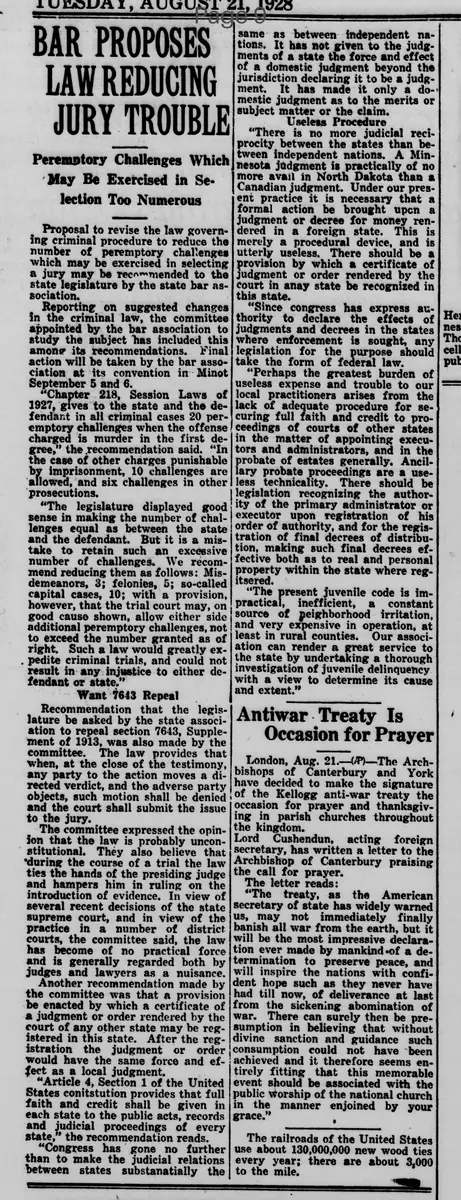
BAR PROPOSES
LAW REDUCING
JURY TROUBLE
Peremptory Challenges Which 'May Be Exercised in Se- lection Too Numerous
Proposal to revise the law govern- ing criminal procedure to reduce the number of peremptory chal- lenges which may be exercised in selecting a jury may be recommended to the state legislature by the state bar as- sociation.
Reporting on suggested changes in the criminal law, the committee appointed by the bar association to study the subject has included this among its recommendations. Final action will be taken by the bar asso- ciation at its convention in Minot September 5 and 6.
"Chapter 218, Session Laws of 1927, gives to the state and the de- fendant in all criminal cases 20 per- emptory challenges when the offense charged is murder in the first de- gree," the recommendation said. "In the case of other charges punishable by imprisonment, 10 challenges are allowed, and six challenges in other prosecutions.
"The legislature displayed good sense in making the number of chal- lenges equal as between the state and the defendant. But it is a mis- take to retain such an excessive number of challenges. We recom- mend reducing them as follows: Mis- demeanors, 3; felonies, 5; so-called capital cases, 10; with a provision, however, that the trial court may, on good cause shown, allow either side additional peremptory challenges, not to exceed the number granted as of right. Such a law would greatly ex- pedite criminal trials, and could not result in any injustice to either de- fendant or state."
Want 7643 Repeal
Recommendation that the legis- lature be asked by the state associ- ation to repeal section 7643, Supple- ment of 1913, was also made by the committee. The law provides that when, at the close of the testimony, any party to the action moves a di- rected verdict, and the adverse party objects, such motion shall be denied and the court shall submit the issue to the jury.
The committee expressed the opin- ion that the law is probably uncon- stitutional. They also believe that during the course of a trial the law ties the hands of the presiding judge and hampers him in ruling on the introduction of evidence. In view of several recent decisions of the state supreme court, and in view of the practice in a number of district courts, the committee said, the law has become of no practical force and is generally regarded both by judges and lawyers as a nuisance.
Another recommendation made by the committee was that a provision be enacted by which a certificate of a judgment or order rendered by the court of any other state may be reg- istered in this state. After the reg- istration the judgment or order would have the same force and ef- fect as a local judgment.
"Article 4, Section 1 of the United States constitution provides that full faith and credit shall be given in each state to the public acts, records and judicial proceedings of every state," the recommendation reads. "Congress has gone no further than to make the judicial relations same as between independent na- tions. It has not given to the judg- ments of a state the force and effect of a domestic judgment beyond the jurisdiction declaring it to be a judg- ment. It has made it only a do- mestic judgment as to the merits or subject matter or the claim.
Useless Procedure
"There is no more judicial reci- procity between the states than be- tween independent nations. A Min- nesota judgment is practically of no more avail in North Dakota than a Canadian judgment. Under our pres- ent practice it is necessary that a formal action be brought upon a judgment or decree for money ren- dered in a foreign state. This is merely a procedural device, and is utterly useless. There should be a provision by which a certificate of judgment or order rendered by the court in any state be recognized in this state.
"Since congress has express au- thority to declare the effects of judgments and decrees in the states where enforcement is sought, any legislation for the purpose should take the form of federal law.
"Perhaps the greatest burden of useless expense and trouble to our local practitioners arises from the lack of adequate procedure for se- curing full faith and credit to pro- ceedings of courts of other states in the matter of appointing execu- tors and administrators, and in the probate of estates generally. Ancil- lary probate proceedings are a use- less technicality. There should be legislation recognizing the author- ity of the primary administrator or executor upon registration of his order of authority, and for the regis- tration of final decrees of distribu- tion, making such final decrees ef- fective both as to real and personal property within the state where reg- istered.
"The present juvenile code is im- practical, inefficient, a constant source of neighborhood irritation, and very expensive in operation, at least in rural counties. Our associ- ation can render a great service to the state by undertaking a thorough investigation of juvenile delinquency with a view to determine its cause and extent."
LAW REDUCING
JURY TROUBLE
Peremptory Challenges Which 'May Be Exercised in Se- lection Too Numerous
Proposal to revise the law govern- ing criminal procedure to reduce the number of peremptory chal- lenges which may be exercised in selecting a jury may be recommended to the state legislature by the state bar as- sociation.
Reporting on suggested changes in the criminal law, the committee appointed by the bar association to study the subject has included this among its recommendations. Final action will be taken by the bar asso- ciation at its convention in Minot September 5 and 6.
"Chapter 218, Session Laws of 1927, gives to the state and the de- fendant in all criminal cases 20 per- emptory challenges when the offense charged is murder in the first de- gree," the recommendation said. "In the case of other charges punishable by imprisonment, 10 challenges are allowed, and six challenges in other prosecutions.
"The legislature displayed good sense in making the number of chal- lenges equal as between the state and the defendant. But it is a mis- take to retain such an excessive number of challenges. We recom- mend reducing them as follows: Mis- demeanors, 3; felonies, 5; so-called capital cases, 10; with a provision, however, that the trial court may, on good cause shown, allow either side additional peremptory challenges, not to exceed the number granted as of right. Such a law would greatly ex- pedite criminal trials, and could not result in any injustice to either de- fendant or state."
Want 7643 Repeal
Recommendation that the legis- lature be asked by the state associ- ation to repeal section 7643, Supple- ment of 1913, was also made by the committee. The law provides that when, at the close of the testimony, any party to the action moves a di- rected verdict, and the adverse party objects, such motion shall be denied and the court shall submit the issue to the jury.
The committee expressed the opin- ion that the law is probably uncon- stitutional. They also believe that during the course of a trial the law ties the hands of the presiding judge and hampers him in ruling on the introduction of evidence. In view of several recent decisions of the state supreme court, and in view of the practice in a number of district courts, the committee said, the law has become of no practical force and is generally regarded both by judges and lawyers as a nuisance.
Another recommendation made by the committee was that a provision be enacted by which a certificate of a judgment or order rendered by the court of any other state may be reg- istered in this state. After the reg- istration the judgment or order would have the same force and ef- fect as a local judgment.
"Article 4, Section 1 of the United States constitution provides that full faith and credit shall be given in each state to the public acts, records and judicial proceedings of every state," the recommendation reads. "Congress has gone no further than to make the judicial relations same as between independent na- tions. It has not given to the judg- ments of a state the force and effect of a domestic judgment beyond the jurisdiction declaring it to be a judg- ment. It has made it only a do- mestic judgment as to the merits or subject matter or the claim.
Useless Procedure
"There is no more judicial reci- procity between the states than be- tween independent nations. A Min- nesota judgment is practically of no more avail in North Dakota than a Canadian judgment. Under our pres- ent practice it is necessary that a formal action be brought upon a judgment or decree for money ren- dered in a foreign state. This is merely a procedural device, and is utterly useless. There should be a provision by which a certificate of judgment or order rendered by the court in any state be recognized in this state.
"Since congress has express au- thority to declare the effects of judgments and decrees in the states where enforcement is sought, any legislation for the purpose should take the form of federal law.
"Perhaps the greatest burden of useless expense and trouble to our local practitioners arises from the lack of adequate procedure for se- curing full faith and credit to pro- ceedings of courts of other states in the matter of appointing execu- tors and administrators, and in the probate of estates generally. Ancil- lary probate proceedings are a use- less technicality. There should be legislation recognizing the author- ity of the primary administrator or executor upon registration of his order of authority, and for the regis- tration of final decrees of distribu- tion, making such final decrees ef- fective both as to real and personal property within the state where reg- istered.
"The present juvenile code is im- practical, inefficient, a constant source of neighborhood irritation, and very expensive in operation, at least in rural counties. Our associ- ation can render a great service to the state by undertaking a thorough investigation of juvenile delinquency with a view to determine its cause and extent."
What sub-type of article is it?
Legal Reform
Legislative Proposal
What themes does it cover?
Justice
What keywords are associated?
Peremptory Challenges
Jury Selection
Criminal Procedure
State Bar Association
Legal Reform
North Dakota
Directed Verdict
Full Faith And Credit
Probate Procedures
Juvenile Code
Where did it happen?
North Dakota
Story Details
Location
North Dakota
Event Date
September 5 And 6
Story Details
State bar association committee recommends reducing peremptory challenges in jury selection for criminal cases, repealing a 1913 law on directed verdicts, registering out-of-state judgments for full faith and credit, simplifying probate procedures, and investigating juvenile delinquency.