Thank you for visiting SNEWPapers!
Sign up free
Editorial
March 19, 1856
Weekly North Carolina Standard
Raleigh, Wake County, North Carolina
What is this article about?
Editorial speculates on whether former President Millard Fillmore will accept the 1856 Know Nothing nomination, arguing against it due to his prior term, party's weakness, convention splits, platform shifts on immigration, Catholicism, and slavery, and risk of aiding Republicans by splitting anti-Republican votes. Hopes he declines.
Clipping
OCR Quality
98%
Excellent
Full Text
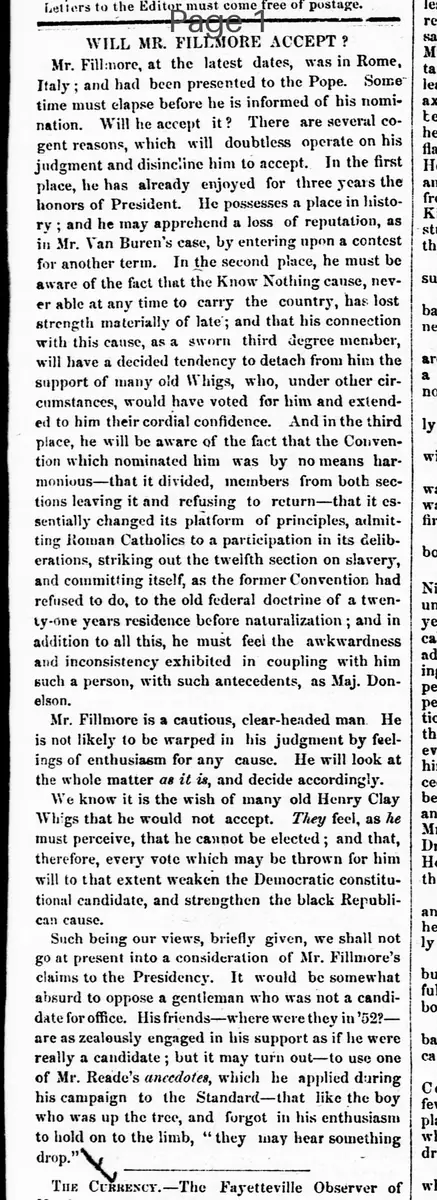
WILL MR. FILLMORE ACCEPT?
Mr. Fillmore, at the latest dates, was in Rome, Italy; and had been presented to the Pope. Some time must elapse before he is informed of his nomination. Will he accept it? There are several cogent reasons, which will doubtless operate on his judgment and disincline him to accept. In the first place, he has already enjoyed for three years the honors of President. He possesses a place in history; and he may apprehend a loss of reputation, as in Mr. Van Buren's case, by entering upon a contest for another term. In the second place, he must be aware of the fact that the Know Nothing cause, never able at any time to carry the country, has lost strength materially of late; and that his connection with this cause, as a sworn third degree member, will have a decided tendency to detach from him the support of many old Whigs, who, under other circumstances, would have voted for him and extended to him their cordial confidence. And in the third place, he will be aware of the fact that the Convention which nominated him was by no means harmonious—that it divided, members from both sections leaving it and refusing to return—that it essentially changed its platform of principles, admitting Roman Catholics to a participation in its deliberations, striking out the twelfth section on slavery, and committing itself, as the former Convention had refused to do, to the old federal doctrine of a twenty-one years residence before naturalization; and in addition to all this, he must feel the awkwardness and inconsistency exhibited in coupling with him such a person, with such antecedents, as Maj. Donelson.
Mr. Fillmore is a cautious, clear-headed man. He is not likely to be warped in his judgment by feelings of enthusiasm for any cause. He will look at the whole matter as it is, and decide accordingly.
We know it is the wish of many old Henry Clay Whigs that he would not accept. They feel, as he must perceive, that he cannot be elected; and that, therefore, every vote which may be thrown for him will to that extent weaken the Democratic constitutional candidate, and strengthen the black Republican cause.
Such being our views, briefly given, we shall not go at present into a consideration of Mr. Fillmore's claims to the Presidency. It would be somewhat absurd to oppose a gentleman who was not a candidate for office. His friends—where were they in '52?—are as zealously engaged in his support as if he were really a candidate; but it may turn out—to use one of Mr. Read's anecdotes, which he applied during his campaign to the Standard—that like the boy who was up the tree, and forgot in his enthusiasm to hold on to the limb, "they may hear something drop."
Mr. Fillmore, at the latest dates, was in Rome, Italy; and had been presented to the Pope. Some time must elapse before he is informed of his nomination. Will he accept it? There are several cogent reasons, which will doubtless operate on his judgment and disincline him to accept. In the first place, he has already enjoyed for three years the honors of President. He possesses a place in history; and he may apprehend a loss of reputation, as in Mr. Van Buren's case, by entering upon a contest for another term. In the second place, he must be aware of the fact that the Know Nothing cause, never able at any time to carry the country, has lost strength materially of late; and that his connection with this cause, as a sworn third degree member, will have a decided tendency to detach from him the support of many old Whigs, who, under other circumstances, would have voted for him and extended to him their cordial confidence. And in the third place, he will be aware of the fact that the Convention which nominated him was by no means harmonious—that it divided, members from both sections leaving it and refusing to return—that it essentially changed its platform of principles, admitting Roman Catholics to a participation in its deliberations, striking out the twelfth section on slavery, and committing itself, as the former Convention had refused to do, to the old federal doctrine of a twenty-one years residence before naturalization; and in addition to all this, he must feel the awkwardness and inconsistency exhibited in coupling with him such a person, with such antecedents, as Maj. Donelson.
Mr. Fillmore is a cautious, clear-headed man. He is not likely to be warped in his judgment by feelings of enthusiasm for any cause. He will look at the whole matter as it is, and decide accordingly.
We know it is the wish of many old Henry Clay Whigs that he would not accept. They feel, as he must perceive, that he cannot be elected; and that, therefore, every vote which may be thrown for him will to that extent weaken the Democratic constitutional candidate, and strengthen the black Republican cause.
Such being our views, briefly given, we shall not go at present into a consideration of Mr. Fillmore's claims to the Presidency. It would be somewhat absurd to oppose a gentleman who was not a candidate for office. His friends—where were they in '52?—are as zealously engaged in his support as if he were really a candidate; but it may turn out—to use one of Mr. Read's anecdotes, which he applied during his campaign to the Standard—that like the boy who was up the tree, and forgot in his enthusiasm to hold on to the limb, "they may hear something drop."
What sub-type of article is it?
Partisan Politics
Immigration
Slavery Abolition
What keywords are associated?
Fillmore Nomination
Know Nothing Party
Whig Support
Presidential Election
Naturalization Policy
Slavery Platform
Roman Catholics
Convention Disharmony
What entities or persons were involved?
Mr. Fillmore
Pope
Mr. Van Buren
Know Nothing
Whigs
Democratic Constitutional Candidate
Black Republican
Henry Clay Whigs
Maj. Donelson
Mr. Read
Editorial Details
Primary Topic
Whether Millard Fillmore Will Accept The Know Nothing Nomination For President
Stance / Tone
Discouraging Acceptance To Avoid Weakening Democratic Candidate
Key Figures
Mr. Fillmore
Pope
Mr. Van Buren
Know Nothing
Whigs
Democratic Constitutional Candidate
Black Republican
Henry Clay Whigs
Maj. Donelson
Mr. Read
Key Arguments
Fillmore Has Already Served As President For Three Years And Risks Loss Of Reputation By Seeking Another Term
Know Nothing Cause Has Lost Strength And His Membership Will Alienate Old Whigs
Convention Was Disharmonious With Members Leaving And Platform Changes Admitting Roman Catholics, Striking Slavery Section, And Adopting 21 Year Naturalization Requirement
Awkward Pairing With Maj. Donelson
Fillmore Cannot Be Elected And Votes For Him Will Strengthen Republicans
Wish Of Old Henry Clay Whigs That He Declines