Thank you for visiting SNEWPapers!
Sign up free
Alexandria Advertiser And Commercial Intelligencer
Alexandria, Virginia
What is this article about?
On December 28, the Alexandria Lodge No. 22 of Ancient York Masons assembled in their new lodge room for St. John's Day. Worshipful Master G. Deane delivered an address on Masonic history, virtues like charity and brotherly love, the legacy of St. John the Evangelist, and George Washington's involvement with the lodge.
Clipping
OCR Quality
Full Text
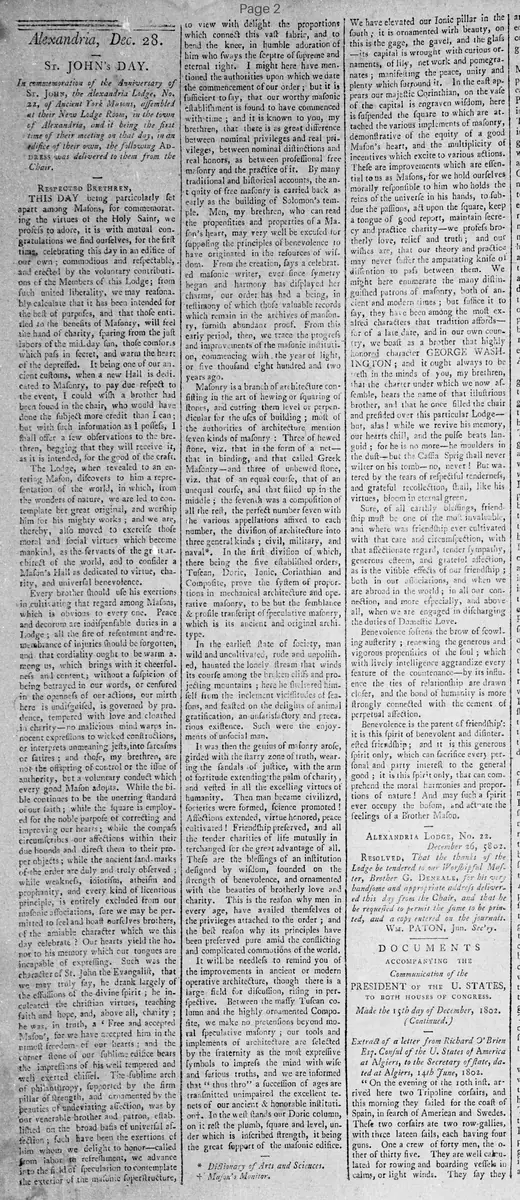
ST. JOHN'S DAY.
In commemoration of the Anniversary of St. John, the Alexandria Lodge, No. 22, of Ancient York Masons, assembled at their New Lodge Room, in the town of Alexandria, and it being the first time of their meeting on that day, in an edifice of their own, the following Address was delivered to them from the Chair.
Respected Brethren,
THIS DAY being particularly set apart among Masons, for commemorating the virtues of the Holy Saint, we profess to adore, it is with mutual congratulations we find ourselves, for the first time, celebrating this day in an edifice of our own; commodious and respectable, and erected by the voluntary contributions of the Members of this Lodge; from such united liberality, we may reasonably calculate that it has been intended for the best of purposes, and that those entitled to the benefits of Masonry, will feel the hand of charity, parting from the joint labors of the mid day sun, those comforts which pass in secret, and warm the heart of the depressed. It being one of our ancient customs, when a new Hall is dedicated to Masonry, to pay due respect to the event, I could wish a brother had been found in the chair, who would have done the subject more credit than I can; but with such information as I possess, I shall offer a few observations to the brethren, begging that they will receive it, as it is intended, for the good of the craft.
The Lodge, when revealed to an entering Mason, discovers to him a representation of the world, in which, from the wonders of nature, we are led to contemplate her great original, and worship him for his mighty works; and we are, thereby, also moved to exercise those moral and social virtues which become mankind, as the servants of the great architect of the world, and to consider a Mason's Hall as dedicated to virtue, charity, and universal benevolence.
Every brother should use his exertions in cultivating that regard among Masons, which is obvious to every one. Peace and decorum are indispensable duties in a Lodge; all the fire of resentment and remembrance of injuries should be forgotten, and that cordiality ought to be warm among us, which brings with it cheerfulness and content; without a suspicion of being betrayed in our words, or censured in the openness of our actions, our mirth here is undisguised, is governed by prudence, tempered with love and clothed in charity—no malicious mind warps innocent expressions to wicked constructions, or interprets unmeaning jests, into sarcasms or satires; and those, my brethren, are not the offspring of control or the issue of authority, but a voluntary conduct which every good Mason adopts. While the Bible continues to be the unerring standard of our faith; while the square is employed for the noble purpose of correcting and improving our hearts; while the compass circumscribes our affections within their due bounds and direct them to their proper objects; while the ancient land-marks of the order are duly and truly observed: while weakness, idolatry, atheism and profanity, and every kind of licentious principle, is entirely excluded from our masonic associations, or we may be permitted to feel and boast ourselves brothers, of the amiable character which we this day celebrate? Our hearts yield the honor to his memory which our tongues are incapable of expressing. Such was the character of St. John the Evangelist, that we may truly say, he drank largely of the effusions of the divine spirit; he inculcated the christian virtues, teaching faith and hope, and, above all, charity; he was, in truth, a Free and accepted Mason, for we have accepted him in the inmost freedom of our hearts; and the corner stone of our sublime edifice bears the impressions of his well tempered and well exerted chisel. The sublime arch of philanthropy, supported by the firm pillar of strength, and ornamented by the beauties of undeviating erection, was by our venerable brother and patron, established on the broad basis of universal affection: such have been the exertions of him whom we delight to honor—called from labor to refreshment, we advance into the field of speculation to contemplate the exterior of the masonic superstructure.
to view with delight the proportions which connect this vast fabric, and to bend the knee, in humble adoration of him who wields the sceptre of supreme and eternal right. I might here have mentioned the authorities upon which we date the commencement of our order; but it is sufficient to say, that our worthy masonic establishment is found to have commenced with time; and it is known to you, my brethren, that there is as great difference between nominal privileges and real privileges, between nominal distinctions and real honors, as between professional free masonry and the practice of it. By many traditional and historical accounts, the antiquity of free masonry is carried back as early as the building of Solomon's temple. Men, my brethren, who can read the propensities and properties of a Mason's heart, may very well be excused for supposing the principles of benevolence to have originated in the resources of wisdom. From the creation, says a celebrated masonic writer, ever since geometry began and harmony has displayed her charms, our order has had a being, in testimony of which those valuable records which remain in the archives of masonry, furnish abundant proof. From this early period, then, we trace the progress and improvements of the masonic institution, commencing with the year of light, or five thousand eight hundred and two years ago.
Masonry is a branch of architecture consisting in the art of hewing or squaring of stones, and cutting them level or perpendicular for the uses of building; most of the authorities of architecture mention seven kinds of masonry: Three of hewed stone, viz. that in the form of a net—that in binding, and that called Greek Masonry—and three of unhewed stone, viz. that of an equal course, that of an unequal course, and that filled up in the middle: the seventh was a composition of all the rest, the perfect number even with the various appellations affixed to each number, the division of architecture into three general kinds; civil, military, and naval. In the first division of which, there being the five established orders, Tuscan, Doric, Ionic, Corinthian and Composite, prove the system of proportions in mechanical architecture and operative masonry, to be but the semblance & profile transcript of speculative masonry, which is its ancient and original archetype.
In the earliest state of society, man wild and uncultivated, rude and unpolished, haunted the lonely stream that winds its course among the broken cliffs and projecting mountains; here he sheltered himself from the inclement vicissitudes of seasons, and feasted on the delights of animal gratification, an unsatisfactory and precarious existence. Such were the enjoyments of unsocial man.
It was then the genius of masonry arose, girded with the starry zone of truth, wearing the sandals of justice, with the arm of fortitude extending the palm of charity, and vested in all the excelling virtues of humanity. Then man became civilized, societies were formed, science promoted! Affections extended, virtue honored, peace cultivated! Friendship preserved, and all the tender charities of life mutually interchanged for the great advantage of all. These are the blessings of an institution designed by wisdom, founded on the strength of benevolence, and ornamented with the beauties of brotherly love and charity. This is the reason why men in every age, have availed themselves of the privileges attached to the order; and the best reason why its principles have been preserved pure amid the conflicting and complicated commotions of the world.
It will be needless to remind you of the improvements in ancient or modern operative architecture, though there is a large field for discussion, rising in perspective. Between the massy Tuscan column and the highly ornamented Composite, we make no pretensions beyond moral speculative masonry; our tools and implements of architecture are selected by the fraternity as the most expressive symbols to impress the mind with wise and serious truths, and we are informed that "thus thro' a succession of ages are transmitted unimpaired the excellent tenets of our ancient & honorable institution. In the west stands our Doric column, on it rest the plumb, square and level, under which is inscribed strength, it being the great support of the masonic edifice.
* Dictionary of Arts and Sciences.
+ Mason's Monitor.
We have elevated our Ionic pillar in the south: it is ornamented with beauty, on this is the gauge, the gavel, and the glass—its capital is wrought with curious ornaments, of lily, net work and pomegranates; manifesting the peace, unity and plenty which surround it. In the east appears our majestic Corinthian, on the vase of the capital is engraven wisdom, here is suspended the square to which are attached the various implements of masonry, demonstrative of the equity of a good Mason's heart, and the multiplicity of incentives which excite to various actions.
These are improvements which are essential to us as Masons, for we hold ourselves morally responsible to him who holds the reins of the universe in his hands, to subdue the passions, act upon the square, keep a tongue of good report, maintain secrecy and practice charity—we profess brotherly love, relief and truth; and our wishes are, that our theory and practice may never suffer the amputating knife of dissention to pass between them. We might here enumerate the many distinguished patrons of masonry, both of ancient and modern times; but suffice it to say, they have been among the most exalted characters that tradition affords—for of a late date, and in our own country, we boast as a brother that highly honored character GEORGE WASHINGTON: and it ought always to be fresh in the minds of you, my brethren, that the charter under which we now assemble, bears the name of that illustrious brother, and that he once filled the chair and presided over this particular Lodge—but, alas! while we revive his memory, our hearts chill, and the pulse beats languid; for he is no more—he moulders in the dust—but the Cassia Sprig shall never wither on his tomb—no, never! But watered by the tears of respectful tenderness, and grateful recollection, shall, like his virtues, bloom in eternal green.
Sure, of all earthly blessings, friendship must be one of the most invaluable, and where was friendship ever cultivated with that care and circumspection, with that affectionate regard, tender sympathy, generous esteem, and grateful affection, as is the visible effects of our friendship; both in our associations, and when we are abroad in the world: in all our connection, and more especially, and above all, when we are engaged in discharging the duties of Domestic Love.
Benevolence softens the brow of scowling austerity; renewing the generous and vigorous propensities of the soul; which with lively intelligence aggrandize every feature of the countenance—by its influence the ties of relationship are drawn closer, and the bond of humanity is more strongly connected with the cement of perpetual affection.
Benevolence is the parent of friendship: it is this spirit of benevolent and disinterested friendship; and it is this generous spirit only, which can sacrifice every personal and party interest to the general good; it is this spirit only, that can comprehend the moral harmonies and proportions of nature! And may such a spirit ever occupy the bosom, and actuate the feelings of a Brother Mason.
ALEXANDRIA LODGE, No. 22.
December 26, 5802.
Resolved, That the thanks of the Lodge be tendered to our Worshipful Master, Brother G. Deane, for his very handsome and appropriate address delivered this day from the Chair, and that he be requested to permit the same to be printed, and a copy entered on the journals.
WM. PATON, Jun. Sec'ry.
What sub-type of article is it?
What themes does it cover?
What keywords are associated?
What entities or persons were involved?
Where did it happen?
Story Details
Key Persons
Location
Alexandria, New Lodge Room
Event Date
Dec. 28
Story Details
The Alexandria Lodge No. 22 assembles for the first time in their new hall on St. John's Day. Worshipful Master G. Deane delivers an address commemorating St. John, outlining Masonic principles of virtue, charity, and brotherly love, tracing the order's history from creation and Solomon's Temple, describing architectural symbols, and honoring George Washington as a past master of the lodge.