Thank you for visiting SNEWPapers!
Sign up free
Literary
December 5, 1845
Burlington Free Press
Burlington, Chittenden County, Vermont
What is this article about?
A virtuous clerk named Henry supports his widowed mother and blind grandfather with his modest salary, forgoing better clothes. His employer, wealthy Mr. Dana, discovers this and learns of Henry's love for his daughter Caroline. Approving of Henry's character, Mr. Dana arranges their marriage, ensuring happiness for all.
Clipping
OCR Quality
95%
Excellent
Full Text
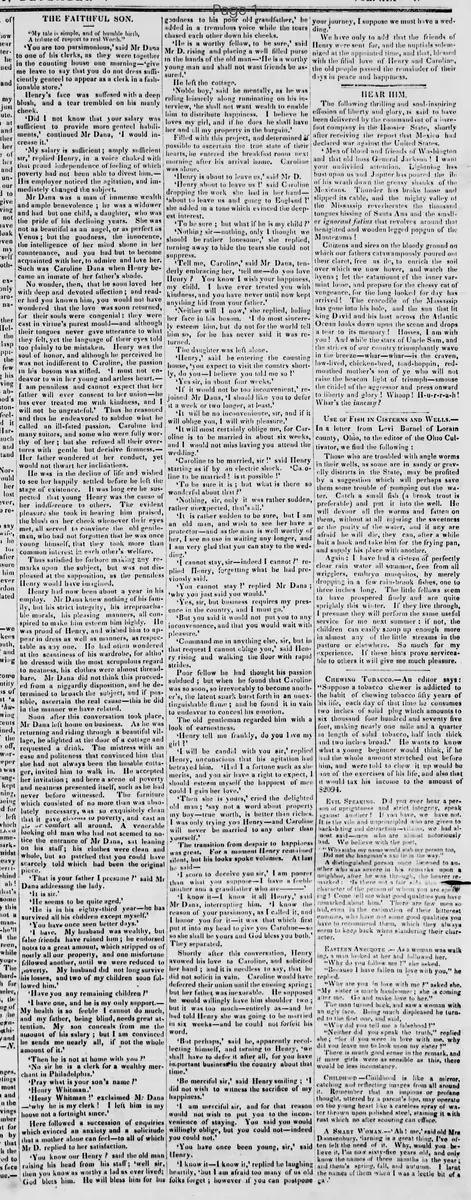
THE FAITHFUL SON.
"My tale is simple, and of humble birth,
A tribute of respect to real Worth."
'You are too parsimonious,' said Mr Dana to one of his clerks, as they were together in the counting house one morning--'give me leave to say that you do not dress sufficiently genteel to appear as a clerk in a fashionable store.'
Henry's face was suffused with a deep blush, and a tear trembled on his manly cheek.
'Did I not know that your salary was sufficient to provide more genteel habiliments,' continued Mr Dana, 'I would increase it.'
'My salary is sufficient; amply sufficient sir,' replied Henry, in a voice choked with that proud independence of feeling of which poverty had not been able to divest him.-- His employer noticed the agitation, and immediately changed the subject.
Mr Dana was a man of immense wealth and ample benevolence : he was a widower and had but one child, a daughter, who was the pride of his declining years. She was not as beautiful as an angel, or as perfect as Venus; but the goodness, the innocence, the intelligence of her mind shone in her countenance, and you had but to become acquainted with her, to admire and love her. Such was Caroline Dana when Henry became an inmate of her father's abode.
No wonder, then, that he soon loved her with deep and devoted affection; and reader had you known him, you would not have wondered that the love was soon returned, for their souls were congenial: they were cast in virtue's purest mould--and although their tongues never gave utterance to what they felt, yet the language of their eyes told too plainly to be mistaken. Henry was the soul of honor, and although he perceived he was not indifferent to Caroline, the passion in his bosom was stifled. 'I must not endeavor to win her young and artless heart.-- I am penniless and cannot expect that her father will ever consent to her union--he has ever treated me with kindness, and I will not be ungrateful.' Thus he reasoned and thus he endeavored to subdue what he called an ill-fated passion. Caroline had many suitors, and some who were fully worthy of her ;but she refused all their overtures with gentle but decisive firmness.-- Her father wondered at her conduct, yet would not thwart her inclinations.
He was in the decline of life and wished to see her happily settled before he left the stage of existence. It was long ere he suspected that young Henry was the cause of her indifference to others. The evident pleasure she took in hearing him praised, the blush on her cheek whenever their eyes met, all served to convince the old gentleman, who had not forgotten that he was once young himself, that they took more than common interest in each other's welfare.
Thus satisfied he forbore making any remarks upon the subject, but was not displeased at the supposition. as the penniless Henry would have imagined.
Henry had now been about a year in his employ. Mr Dana knew nothing of his family, but his strict integrity, his irreproachable morals, his pleasing manners, all conspired to make him esteem him highly. He was proud of Henry, and wished him to appear in dress as well as manners, as respectable as any one. He had often wondered at the scantiness of his wardrobe, for altho' he dressed with the most scrupulous regard to neatness, his clothes were almost thread-bare. Mr Dana did not think this proceeded from a niggardly disposition, and he determined to broach the subject, and if possible, ascertain the real cause--this he did in the manner we have related.
Soon after this conversation took place, Mr Dana left home on business. As he was returning and riding through a beautiful village, he alighted at the door of a cottage and requested a drink. The mistress with an ease and politeness that convinced him that she had not always been the humble cottager, invited him to walk in. He accepted her invitation; and here a scene of poverty and neatness presented itself, such as he had never before witnessed. The furniture which consisted of no more than was absolutely necessary, was so exquisitely clean that it gave charms to poverty, and cast an air of comfort all around. A venerable looking old man who had not seemed to notice the entrance of Mr Dana, sat leaning on his staff'; his clothes were clean and whole, but so patched that you could have scarcely told which had been the original piece.
'That is your father I presume ?'said Mr Dana addressing the lady.
'It is sir.'
'He seems to be quite aged.'
'He is in his eighty-third year--he has survived all his children except myself.'
'You have once seen better days.'
'I have. My husband was wealthy,but false friends have ruined him; he endorsed notes to a great amount, which stripped us of nearly all our property, and one misfortune followed another, until we were reduced to poverty. My husband did not long survive his losses, and two of my children soon followed him.'
'Have you any remaining children ?'
'I have one, and he is my only support.-- My health is so feeble I cannot do much, and my father, being blind, needs great attention. My son conceals from me the amount of his salary ; but I am convinced he sends me nearly all, if not the whole amount of it.'
'Then he is not at home with you?'
'No sir he is a clerk for a wealthy merchant in Philadelphia.'
'Pray what is your son's name ?'
'Henry Whitman.'
'Henry Whitman !'exclaimed Mr. Dana --'why he is my clerk! I let him in my house not a fortnight since.'
Here followed a succession of enquiries which evinced an anxiety and a solicitude that a mother alone can feel--to all of which Mr D. replied to her satisfaction.
'You know our Henry ? said the old man raising his head from his staff'; 'well sir, then you know as worthy a lad as ever lived; God bless him. He will bless him for his goodness to his poor old grandfather,' he added in a tremulous voice while the tears chased each other down his cheeks.
'Ile is a worthy fellow, to be sure,' said Mr D. rising and placing a well filled purse in the hands of the old man--'He is a worthy young man and shall not want friends be assured.'
He left the cottage.
'Noble boy,' said he mentally, as he was riding leisurely along ruminating on his interview. he shall not want wealth to enable him to distribute happiness. I believe he loves my girl, and if he does he shall have her and all my property in the bargain.
Filled with this project, and determined possible to ascertain the true state of their hearts, he entered the breakfast room next morning after his arrival home, Caroline was alone.
'Henry is about to leave us,' said Mr D.
'Henry about to leave us ?' said Caroline dropping the work she had in her hand-- 'about to leave us and going to England ?' she added in a tone which evinced the deepest interest,
'To be sure ; but what if he is my child ?'
'Nothing? sir--nothing, only I thought we should be rather lonesome,' she replied, turning away to hide the tears she could not suppress.
'Tell me. Caroline,' said Mr Dana, tenderly embracing her, 'tell me--do you love Henry ? You know I wish your happiness, my child. I have ever treated you with kindness, and you have never until now kept anything hid from your father.'
'Neither will I now,' she replied, hiding her face in his bosom. 'I do most sincerely esteem him, but do not for the world tell him so. for he has never said it was returned.'
The daughter was left alone.
'Henry,' said he entering the counting house, 'you expect to visit the country shortly, do you--I believe you told me so ?'
'Yes sir, in about four weeks.'
'If it would not be too inconvenient.' rejoined Mr Dana, 'I should like you to defer it a week or two longer, at least.'
'It will be no inconvenience, sir, and if it will oblige you, I will with pleasure.'
'It will most certainly oblige me, for Caroline is to be married in about six weeks. and I would not miss having you attend the wedding.'
'Caroline to be married, sir !' said Henry starting as if by an electric shock. 'Caroline to be married ! is it possible !'
'To be sure it is ; but what is there so wonderful about that ?'
'Nothing, sir, only it was rather sudden, rather unexpected, that's all.'
'It is rather sudden to be sure, but I am an old man, and wish to see her have a protector--and as the man is well worthy of her, I see no use in waiting any longer, and I am very glad that you can stay to the wedding.'
'I cannot stay, sir--indeed I cannot ?' replied Henry, forgetting what he had previously said.
'You cannot stay ?' replied Mr Dana ; 'why you just said you would.'
'Yes, sir, but business requires my presence in the country, and I must go.'
'But you said it would not put you to any inconvenience, and that you would wait with pleasure.'
'Command me in anything else, sir, but in that request I cannot oblige you,' said Henry rising and walking the floor with rapid strides.
Poor fellow he had thought his passion subdued; but when he found that Caroline was so soon, so irrevocably to become another's, the latent spark burst forth in an unextinguishable flame ; and he found it in vain to endeavor to conceal his emotion.
The old gentleman regarded him with a look of earnestness.
'Henry tell me frankly, do you love my girl ?'
'I will be candid with you sir,' replied Henry, unconscious that his agitation had betrayed him. 'Had I a fortune such as she merits, and you sir have a right to expect, I should esteem myself the happiest of men could I gain her love.'
'Then she is yours,' cried the delighted old man; 'say not a word about property my boy--true worth, is better than riches. I was only trying you Henry--and Caroline will never be married to any other than yourself.'
The transition from despair to happiness was great. For a moment Henry remained silent, but his looks spoke volumes. At last he said--
'I scorn to deceive you sir,' I am poorer than what you suppose--I have a feeble mother and a grandfather who are--'
'I know it--I know it all Henry,' said Mr Dana, interrupting him. I know the reason of your parsimony, as I called it, and I honor you for it--it was that which first put it into my head to give you Caroline--so so she shall be yours and God bless you both.
They separated.
Shortly after this conversation, Henry avowed his love to Caroline, and solicited her hand ; and it is needless to say, that he did not solicit in vain. Caroline would have deferred their union until the ensuing spring; but her father was inexorable. He supposed he would willingly have him shoulder two : but it was too much--entirely so--and he had told Henry she was going to be married in six weeks--and he could not forfeit his word.
'But perhaps,' said he, apparently recollecting himself. and turning to Henry, 'we shall have to defer it after all, for you have important business in the country about that time.'
'Be merciful sir,'said Henry smiling ;'I did not wish to witness the sacrifice of my happiness.'
'I am merciful sir. and for that reason would not wish to put you to the inconvenience of staying. You said you would willingly oblige, but you could not--indeed you could not.'
'You have once been young, sir,' said Henry.
'I know it--I know it,' replied he laughing heartily, 'but I am afraid too many of us old folks forget; however if you can postpone your journey, I suppose we must have a wedding.
We have only to add that the friends of Henry were sent for, and the nuptials solemnized at the appointed time, and that, blessed with the filial love of Henry and Caroline, the old people passed the remainder of their days in peace and happiness.
"My tale is simple, and of humble birth,
A tribute of respect to real Worth."
'You are too parsimonious,' said Mr Dana to one of his clerks, as they were together in the counting house one morning--'give me leave to say that you do not dress sufficiently genteel to appear as a clerk in a fashionable store.'
Henry's face was suffused with a deep blush, and a tear trembled on his manly cheek.
'Did I not know that your salary was sufficient to provide more genteel habiliments,' continued Mr Dana, 'I would increase it.'
'My salary is sufficient; amply sufficient sir,' replied Henry, in a voice choked with that proud independence of feeling of which poverty had not been able to divest him.-- His employer noticed the agitation, and immediately changed the subject.
Mr Dana was a man of immense wealth and ample benevolence : he was a widower and had but one child, a daughter, who was the pride of his declining years. She was not as beautiful as an angel, or as perfect as Venus; but the goodness, the innocence, the intelligence of her mind shone in her countenance, and you had but to become acquainted with her, to admire and love her. Such was Caroline Dana when Henry became an inmate of her father's abode.
No wonder, then, that he soon loved her with deep and devoted affection; and reader had you known him, you would not have wondered that the love was soon returned, for their souls were congenial: they were cast in virtue's purest mould--and although their tongues never gave utterance to what they felt, yet the language of their eyes told too plainly to be mistaken. Henry was the soul of honor, and although he perceived he was not indifferent to Caroline, the passion in his bosom was stifled. 'I must not endeavor to win her young and artless heart.-- I am penniless and cannot expect that her father will ever consent to her union--he has ever treated me with kindness, and I will not be ungrateful.' Thus he reasoned and thus he endeavored to subdue what he called an ill-fated passion. Caroline had many suitors, and some who were fully worthy of her ;but she refused all their overtures with gentle but decisive firmness.-- Her father wondered at her conduct, yet would not thwart her inclinations.
He was in the decline of life and wished to see her happily settled before he left the stage of existence. It was long ere he suspected that young Henry was the cause of her indifference to others. The evident pleasure she took in hearing him praised, the blush on her cheek whenever their eyes met, all served to convince the old gentleman, who had not forgotten that he was once young himself, that they took more than common interest in each other's welfare.
Thus satisfied he forbore making any remarks upon the subject, but was not displeased at the supposition. as the penniless Henry would have imagined.
Henry had now been about a year in his employ. Mr Dana knew nothing of his family, but his strict integrity, his irreproachable morals, his pleasing manners, all conspired to make him esteem him highly. He was proud of Henry, and wished him to appear in dress as well as manners, as respectable as any one. He had often wondered at the scantiness of his wardrobe, for altho' he dressed with the most scrupulous regard to neatness, his clothes were almost thread-bare. Mr Dana did not think this proceeded from a niggardly disposition, and he determined to broach the subject, and if possible, ascertain the real cause--this he did in the manner we have related.
Soon after this conversation took place, Mr Dana left home on business. As he was returning and riding through a beautiful village, he alighted at the door of a cottage and requested a drink. The mistress with an ease and politeness that convinced him that she had not always been the humble cottager, invited him to walk in. He accepted her invitation; and here a scene of poverty and neatness presented itself, such as he had never before witnessed. The furniture which consisted of no more than was absolutely necessary, was so exquisitely clean that it gave charms to poverty, and cast an air of comfort all around. A venerable looking old man who had not seemed to notice the entrance of Mr Dana, sat leaning on his staff'; his clothes were clean and whole, but so patched that you could have scarcely told which had been the original piece.
'That is your father I presume ?'said Mr Dana addressing the lady.
'It is sir.'
'He seems to be quite aged.'
'He is in his eighty-third year--he has survived all his children except myself.'
'You have once seen better days.'
'I have. My husband was wealthy,but false friends have ruined him; he endorsed notes to a great amount, which stripped us of nearly all our property, and one misfortune followed another, until we were reduced to poverty. My husband did not long survive his losses, and two of my children soon followed him.'
'Have you any remaining children ?'
'I have one, and he is my only support.-- My health is so feeble I cannot do much, and my father, being blind, needs great attention. My son conceals from me the amount of his salary ; but I am convinced he sends me nearly all, if not the whole amount of it.'
'Then he is not at home with you?'
'No sir he is a clerk for a wealthy merchant in Philadelphia.'
'Pray what is your son's name ?'
'Henry Whitman.'
'Henry Whitman !'exclaimed Mr. Dana --'why he is my clerk! I let him in my house not a fortnight since.'
Here followed a succession of enquiries which evinced an anxiety and a solicitude that a mother alone can feel--to all of which Mr D. replied to her satisfaction.
'You know our Henry ? said the old man raising his head from his staff'; 'well sir, then you know as worthy a lad as ever lived; God bless him. He will bless him for his goodness to his poor old grandfather,' he added in a tremulous voice while the tears chased each other down his cheeks.
'Ile is a worthy fellow, to be sure,' said Mr D. rising and placing a well filled purse in the hands of the old man--'He is a worthy young man and shall not want friends be assured.'
He left the cottage.
'Noble boy,' said he mentally, as he was riding leisurely along ruminating on his interview. he shall not want wealth to enable him to distribute happiness. I believe he loves my girl, and if he does he shall have her and all my property in the bargain.
Filled with this project, and determined possible to ascertain the true state of their hearts, he entered the breakfast room next morning after his arrival home, Caroline was alone.
'Henry is about to leave us,' said Mr D.
'Henry about to leave us ?' said Caroline dropping the work she had in her hand-- 'about to leave us and going to England ?' she added in a tone which evinced the deepest interest,
'To be sure ; but what if he is my child ?'
'Nothing? sir--nothing, only I thought we should be rather lonesome,' she replied, turning away to hide the tears she could not suppress.
'Tell me. Caroline,' said Mr Dana, tenderly embracing her, 'tell me--do you love Henry ? You know I wish your happiness, my child. I have ever treated you with kindness, and you have never until now kept anything hid from your father.'
'Neither will I now,' she replied, hiding her face in his bosom. 'I do most sincerely esteem him, but do not for the world tell him so. for he has never said it was returned.'
The daughter was left alone.
'Henry,' said he entering the counting house, 'you expect to visit the country shortly, do you--I believe you told me so ?'
'Yes sir, in about four weeks.'
'If it would not be too inconvenient.' rejoined Mr Dana, 'I should like you to defer it a week or two longer, at least.'
'It will be no inconvenience, sir, and if it will oblige you, I will with pleasure.'
'It will most certainly oblige me, for Caroline is to be married in about six weeks. and I would not miss having you attend the wedding.'
'Caroline to be married, sir !' said Henry starting as if by an electric shock. 'Caroline to be married ! is it possible !'
'To be sure it is ; but what is there so wonderful about that ?'
'Nothing, sir, only it was rather sudden, rather unexpected, that's all.'
'It is rather sudden to be sure, but I am an old man, and wish to see her have a protector--and as the man is well worthy of her, I see no use in waiting any longer, and I am very glad that you can stay to the wedding.'
'I cannot stay, sir--indeed I cannot ?' replied Henry, forgetting what he had previously said.
'You cannot stay ?' replied Mr Dana ; 'why you just said you would.'
'Yes, sir, but business requires my presence in the country, and I must go.'
'But you said it would not put you to any inconvenience, and that you would wait with pleasure.'
'Command me in anything else, sir, but in that request I cannot oblige you,' said Henry rising and walking the floor with rapid strides.
Poor fellow he had thought his passion subdued; but when he found that Caroline was so soon, so irrevocably to become another's, the latent spark burst forth in an unextinguishable flame ; and he found it in vain to endeavor to conceal his emotion.
The old gentleman regarded him with a look of earnestness.
'Henry tell me frankly, do you love my girl ?'
'I will be candid with you sir,' replied Henry, unconscious that his agitation had betrayed him. 'Had I a fortune such as she merits, and you sir have a right to expect, I should esteem myself the happiest of men could I gain her love.'
'Then she is yours,' cried the delighted old man; 'say not a word about property my boy--true worth, is better than riches. I was only trying you Henry--and Caroline will never be married to any other than yourself.'
The transition from despair to happiness was great. For a moment Henry remained silent, but his looks spoke volumes. At last he said--
'I scorn to deceive you sir,' I am poorer than what you suppose--I have a feeble mother and a grandfather who are--'
'I know it--I know it all Henry,' said Mr Dana, interrupting him. I know the reason of your parsimony, as I called it, and I honor you for it--it was that which first put it into my head to give you Caroline--so so she shall be yours and God bless you both.
They separated.
Shortly after this conversation, Henry avowed his love to Caroline, and solicited her hand ; and it is needless to say, that he did not solicit in vain. Caroline would have deferred their union until the ensuing spring; but her father was inexorable. He supposed he would willingly have him shoulder two : but it was too much--entirely so--and he had told Henry she was going to be married in six weeks--and he could not forfeit his word.
'But perhaps,' said he, apparently recollecting himself. and turning to Henry, 'we shall have to defer it after all, for you have important business in the country about that time.'
'Be merciful sir,'said Henry smiling ;'I did not wish to witness the sacrifice of my happiness.'
'I am merciful sir. and for that reason would not wish to put you to the inconvenience of staying. You said you would willingly oblige, but you could not--indeed you could not.'
'You have once been young, sir,' said Henry.
'I know it--I know it,' replied he laughing heartily, 'but I am afraid too many of us old folks forget; however if you can postpone your journey, I suppose we must have a wedding.
We have only to add that the friends of Henry were sent for, and the nuptials solemnized at the appointed time, and that, blessed with the filial love of Henry and Caroline, the old people passed the remainder of their days in peace and happiness.
What sub-type of article is it?
Prose Fiction
What themes does it cover?
Moral Virtue
What keywords are associated?
Filial Duty
Moral Tale
Virtue Rewarded
Poverty
Romantic Love
Family Support
Literary Details
Title
The Faithful Son.
Key Lines
"My Tale Is Simple, And Of Humble Birth,
A Tribute Of Respect To Real Worth."
'I Must Not Endeavor To Win Her Young And Artless Heart. I Am Penniless And Cannot Expect That Her Father Will Ever Consent To Her Union He Has Ever Treated Me With Kindness, And I Will Not Be Ungrateful.'
'Then She Is Yours,' Cried The Delighted Old Man; 'Say Not A Word About Property My Boy True Worth, Is Better Than Riches.'
We Have Only To Add That The Friends Of Henry Were Sent For, And The Nuptials Solemnized At The Appointed Time, And That, Blessed With The Filial Love Of Henry And Caroline, The Old People Passed The Remainder Of Their Days In Peace And Happiness.