Thank you for visiting SNEWPapers!
Sign up free
Editorial
August 15, 1954
Atlanta Daily World
Atlanta, Fulton County, Georgia
What is this article about?
This editorial reviews the post-Reconstruction disenfranchisement of African Americans in the South through tactics like grandfather clauses and white primaries, traces their political exploitation, and warns against similar manipulations in the ongoing gubernatorial election to safeguard voting rights.
Clipping
OCR Quality
98%
Excellent
Full Text
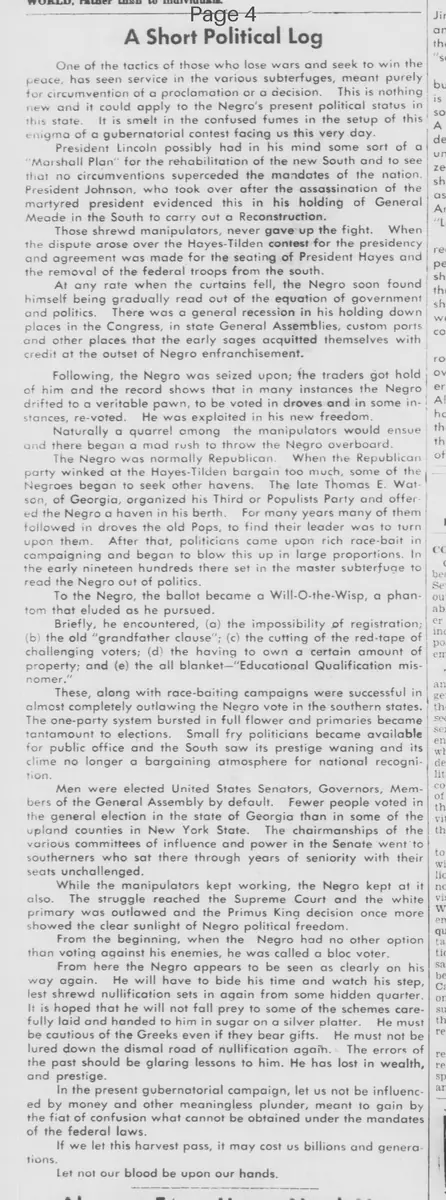
A Short Political Log
One of the tactics of those who lose wars and seek to win the peace, has seen service in the various subterfuges, meant purely for circumvention of a proclamation or a decision. This is nothing new and it could apply to the Negro's present political status in this state. It is smelt in the confused fumes in the setup of this enigma of a gubernatorial contest facing us this very day.
President Lincoln possibly had in his mind some sort of a "Marshall Plan" for the rehabilitation of the new South and to see that no circumventions superceded the mandates of the nation.
President Johnson, who took over after the assassination of the martyred president evidenced this in his holding of General Meade in the South to carry out a Reconstruction.
Those shrewd manipulators, never gave up the fight. When the dispute arose over the Hayes-Tilden contest for the presidency and agreement was made for the seating of President Hayes and the removal of the federal troops from the south.
At any rate when the curtains fell, the Negro soon found himself being gradually read out of the equation of government and politics. There was a general recession in his holding down places in the Congress, in state General Assemblies, custom ports and other places that the early sages acquitted themselves with credit at the outset of Negro enfranchisement.
Following, the Negro was seized upon; the traders got hold of him and the record shows that in many instances the Negro drifted to a veritable pawn, to be voted in droves and in some instances, re-voted. He was exploited in his new freedom.
Naturally a quarrel among the manipulators would ensue and there began a mad rush to throw the Negro overboard.
The Negro was normally Republican. When the Republican party winked at the Hayes-Tilden bargain too much, some of the Negroes began to seek other havens. The late Thomas E. Watson, of Georgia, organized his Third or Populists Party and offered the Negro a haven in his berth. For many years many of them followed in droves the old Pops, to find their leader was to turn upon them. After that, politicians came upon rich race-bait in campaigning and began to blow this up in large proportions. In the early nineteen hundreds there set in the master subterfuge to read the Negro out of politics.
To the Negro, the ballot became a Will-O-the-Wisp, a phantom that eluded as he pursued.
Briefly, he encountered, (a) the impossibility of registration; (b) the old "grandfather clause"; (c) the cutting of the red-tape of challenging voters; (d) the having to own a certain amount of property; and (e) the all blanket-"Educational Qualification misnomer."
These, along with race-baiting campaigns were successful in almost completely outlawing the Negro vote in the southern states.
The one-party system bursted in full flower and primaries became tantamount to elections. Small fry politicians became available for public office and the South saw its prestige waning and its clime no longer a bargaining atmosphere for national recognition.
Men were elected United States Senators, Governors, Members of the General Assembly by default. Fewer people voted in the general election in the state of Georgia than in some of the upland counties in New York State. The chairmanships of the various committees of influence and power in the Senate went to southerners who sat there through years of seniority with their seats unchallenged.
While the manipulators kept working, the Negro kept at it also. The struggle reached the Supreme Court and the white primary was outlawed and the Primus King decision once more showed the clear sunlight of Negro political freedom.
From the beginning, when the Negro had no other option than voting against his enemies, he was called a bloc voter.
From here the Negro appears to be seen as clearly on his way again. He will have to bide his time and watch his step, lest shrewd nullification sets in again from some hidden quarter.
It is hoped that he will not fall prey to some of the schemes carefully laid and handed to him in sugar on a silver platter. He must be cautious of the Greeks even if they bear gifts. He must not be lured down the dismal road of nullification again. The errors of the past should be glaring lessons to him. He has lost in wealth, and prestige.
In the present gubernatorial campaign, let us not be influenced by money and other meaningless plunder, meant to gain by the fiat of confusion what cannot be obtained under the mandates of the federal laws.
If we let this harvest pass, it may cost us billions and generations.
Let not our blood be upon our hands.
One of the tactics of those who lose wars and seek to win the peace, has seen service in the various subterfuges, meant purely for circumvention of a proclamation or a decision. This is nothing new and it could apply to the Negro's present political status in this state. It is smelt in the confused fumes in the setup of this enigma of a gubernatorial contest facing us this very day.
President Lincoln possibly had in his mind some sort of a "Marshall Plan" for the rehabilitation of the new South and to see that no circumventions superceded the mandates of the nation.
President Johnson, who took over after the assassination of the martyred president evidenced this in his holding of General Meade in the South to carry out a Reconstruction.
Those shrewd manipulators, never gave up the fight. When the dispute arose over the Hayes-Tilden contest for the presidency and agreement was made for the seating of President Hayes and the removal of the federal troops from the south.
At any rate when the curtains fell, the Negro soon found himself being gradually read out of the equation of government and politics. There was a general recession in his holding down places in the Congress, in state General Assemblies, custom ports and other places that the early sages acquitted themselves with credit at the outset of Negro enfranchisement.
Following, the Negro was seized upon; the traders got hold of him and the record shows that in many instances the Negro drifted to a veritable pawn, to be voted in droves and in some instances, re-voted. He was exploited in his new freedom.
Naturally a quarrel among the manipulators would ensue and there began a mad rush to throw the Negro overboard.
The Negro was normally Republican. When the Republican party winked at the Hayes-Tilden bargain too much, some of the Negroes began to seek other havens. The late Thomas E. Watson, of Georgia, organized his Third or Populists Party and offered the Negro a haven in his berth. For many years many of them followed in droves the old Pops, to find their leader was to turn upon them. After that, politicians came upon rich race-bait in campaigning and began to blow this up in large proportions. In the early nineteen hundreds there set in the master subterfuge to read the Negro out of politics.
To the Negro, the ballot became a Will-O-the-Wisp, a phantom that eluded as he pursued.
Briefly, he encountered, (a) the impossibility of registration; (b) the old "grandfather clause"; (c) the cutting of the red-tape of challenging voters; (d) the having to own a certain amount of property; and (e) the all blanket-"Educational Qualification misnomer."
These, along with race-baiting campaigns were successful in almost completely outlawing the Negro vote in the southern states.
The one-party system bursted in full flower and primaries became tantamount to elections. Small fry politicians became available for public office and the South saw its prestige waning and its clime no longer a bargaining atmosphere for national recognition.
Men were elected United States Senators, Governors, Members of the General Assembly by default. Fewer people voted in the general election in the state of Georgia than in some of the upland counties in New York State. The chairmanships of the various committees of influence and power in the Senate went to southerners who sat there through years of seniority with their seats unchallenged.
While the manipulators kept working, the Negro kept at it also. The struggle reached the Supreme Court and the white primary was outlawed and the Primus King decision once more showed the clear sunlight of Negro political freedom.
From the beginning, when the Negro had no other option than voting against his enemies, he was called a bloc voter.
From here the Negro appears to be seen as clearly on his way again. He will have to bide his time and watch his step, lest shrewd nullification sets in again from some hidden quarter.
It is hoped that he will not fall prey to some of the schemes carefully laid and handed to him in sugar on a silver platter. He must be cautious of the Greeks even if they bear gifts. He must not be lured down the dismal road of nullification again. The errors of the past should be glaring lessons to him. He has lost in wealth, and prestige.
In the present gubernatorial campaign, let us not be influenced by money and other meaningless plunder, meant to gain by the fiat of confusion what cannot be obtained under the mandates of the federal laws.
If we let this harvest pass, it may cost us billions and generations.
Let not our blood be upon our hands.
What sub-type of article is it?
Suffrage
Partisan Politics
Social Reform
What keywords are associated?
Negro Disenfranchisement
Reconstruction
Gubernatorial Contest
Voting Rights
Southern Politics
White Primary
Grandfather Clause
What entities or persons were involved?
President Lincoln
President Johnson
General Meade
Hayes
Tilden
Thomas E. Watson
Supreme Court
Primus King
Editorial Details
Primary Topic
History Of Negro Disenfranchisement In The South And Caution In Gubernatorial Election
Stance / Tone
Cautionary Warning Against Political Manipulation
Key Figures
President Lincoln
President Johnson
General Meade
Hayes
Tilden
Thomas E. Watson
Supreme Court
Primus King
Key Arguments
Tactics To Circumvent Reconstruction Mandates Disenfranchised Negroes
Hayes Tilden Compromise Led To Removal Of Federal Troops And Negro Exclusion From Politics
Negroes Exploited As Pawns In Voting
Methods Like Grandfather Clause And Educational Qualifications Outlawed Negro Vote
One Party System In South Led To Unchallenged Seniority
Supreme Court Outlawed White Primary Restoring Negro Political Freedom
Negroes Must Avoid Manipulation In Current Gubernatorial Campaign