Thank you for visiting SNEWPapers!
Sign up free
Virginia Free Press
Charles Town, Jefferson County, West Virginia
What is this article about?
Newspaper editorial exchange between Free Press and Spirit of Jefferson debating American Party's anti-slavery stance, Kansas admission, platforms, and judicial interpretations of the Fugitive Slave Law, with mutual accusations of abolitionism.
Clipping
OCR Quality
Full Text
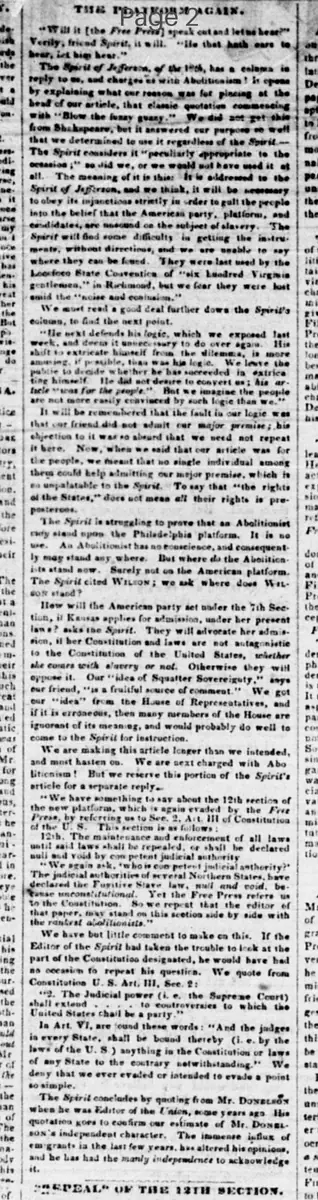
Verily, friend Spirit, it will
"He
that hath ears
to hear, let him hear."
The Spirit of Jefferson, of the Leech, has a colleague in
reply to me, and charges me with Abolitionism! In response
by explaining what our reason was for placing at the
head of our article, that classic
quotation commencing
with "Blow the windy
gauze."
We did not get this
from Shakespeare, but it answered our purpose so well
that we determined to use it regardless of the Spirit.--
The Spirit considers it "peculiarly appropriate to the
occasion ;" so did we, or we would not have used it at
all. The meaning of it is this: It is addressed to the
Spirit of Jefferson, and we think, it will be necessary
to obey its injunctions strictly in order to gull the people
into the belief that the American party, platform, and
candidates, are sound on the subject of slavery. The
Spirit will find some difficulty in getting the instruments,
without detriment, and we are unable to say
where they can be found. They were last used by the
Loco Foco State Convention of "six hundred Virginian
gentlemen." in Richmond, but we fear they were lost
amid the "noise and confusion."
We must read a good deal further down the Spirit's
columns, to find the next point.
"The next defends his logic, which we exposed last
week, and deems it unnecessary to do over again. His
shift to extricate himself from the dilemma, is more
amusing, if possible, than was his logic. We leave the
public to decide whether he has succeeded in extricating
himself. He did not desire to convert us: his article
"was for the people." But we imagine the people
are not more easily convinced by such logic than we."
It will be remembered that the fault in our logic was
that our friend did not admit our major premise; his
objection to it was so absurd that we need not repeat
it here. Now, when we said that our article was for
the people, we meant that no single individual among
them could help admitting our major premise, which is
so impregnable to the Spirit. To say that "the rights
of the States," does not mean all their rights is pre-
posterous.
The Spirit is struggling to prove that an Abolitionist
can stand upon the Philadelphia platform. It is no
use. An Abolitionist has no conscience, and consequently
may stand anywhere. But where do the Abolitionists
stand now. Surely not on the American platform.
The Spirit cited Wilson; we ask where does Wilmot
stand?
How will the American party act under the 7th Section,
if Kansas applies for admission, under her present
laws? Like the Spirit. They will advocate her admission,
if her Constitution and laws are not antagonistic
to the Constitution of the United States, whether
she comes with slavery or not. Otherwise they will
oppose it. Our "ideas of Squatter Sovereignty," says
our friend, "are a fruitful source of comment." We got
our "idea" from the House of Representatives, and
if it is erroneous, then many members of the House are
ignorant of its meaning, and would probably do well to
come to the Spirit for instruction.
We are making this article longer than we intended,
and must hasten on. We are next charged with Abolitionism!
But we reserve this portion of the Spirit's
article for a separate reply.
We have something to say about the 12th section of
the new platform, which is again evaded by the Free
Press, by referring us to Sec. 2. Art. III of Constitution
of the U. S. This section is as follows:
12th. The maintenance and enforcement of all laws
until said laws shall be repealed, or shall be declared
null and void by competent judicial authority
We again ask. "whose competent judicial authority?"
The judicial authorities of several Northern States, have
declared the Fugitive Slave law, null and void, because
unconstitutional. Yet the Free Press refers us
to the Constitution. So we repeat that the editor of
that paper, may stand on this section side by side with
the rankest abolitionists."
We have but little comment to make on this. If the
Editor of the Spirit had taken the trouble to look at the
part of the Constitution designated, he would have had
no occasion to repeat his question.
We quote from Constitution U. S. Art. III, Sec. 2:
"The Judicial power (i. e. the
Supreme Court)
shall extend to controversies
which United States shall be a party
In Art. VI, are found these words: "And the judges
in every State, shall be bound thereby (i. e. by the
laws of the U. S.) anything in the Constitution or laws
of any State to the contrary notwithstanding." We
den y that we ever evaded or intended to evade a point
so simple.
The Spirit concludes by quoting from Mr. Douglas
when he was Editor of the Union, one year ago. His
quotation goes to confirm our estimate of Mr. Douglas's
independent character. The immense influx of
emigrants in the last few years, has altered his opinions.
and he has had the manly independence to acknowledge
it.
What sub-type of article is it?
What themes does it cover?
What keywords are associated?
What entities or persons were involved?
Where did it happen?
Story Details
Key Persons
Location
Philadelphia, Richmond, Kansas, Northern States
Story Details
The Free Press responds to the Spirit of Jefferson's charges of abolitionism, defending their use of a quotation, debating logic on state rights and party platforms, discussing American Party stance on Kansas admission under squatter sovereignty, and clarifying the 12th section of the platform regarding judicial authority on laws like the Fugitive Slave Law.