Thank you for visiting SNEWPapers!
Sign up free
The Jasper Weekly Courier
Jasper, Dubois County, Indiana
What is this article about?
The 'Cereal Region' of the US, spanning 10 states around the Mississippi, is portrayed as the world's granary, with stats on 751,736 sq mi, 14M population, $4.3B farm value in 1870, and 1873 yields of 184M bu wheat, 591M bu corn, 169M bu oats.
Clipping
OCR Quality
Full Text
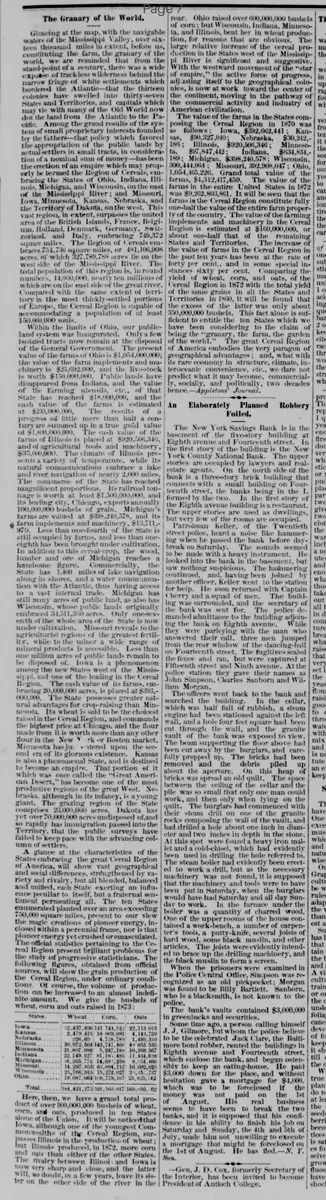
Glancing at the map, with the navigable waters of the Mississippi Valley, over sixteen thousand miles in extent, before us, constituting the farm, the granary of the world, we are reminded that from the stand-point of a century, there was a wide expanse of trackless wilderness behind the narrow fringe of white settlements which bordered the Atlantic—that the thirteen colonies have swelled into thirty-seven States and Territories, and capitals which may vie with many of the Old World now dot the land from the Atlantic to the Pacific. Among the grand results of the system of small proprietary interests founded by the fathers—that policy which favored the appropriation of the public lands by actual settlers in small tracts, in consideration of a nominal sum of money—has been the erection of an empire which may properly be termed the Region of Cereals, embracing the States of Ohio, Indiana, Illinois, Michigan, and Wisconsin, on the east of the Mississippi River; and Missouri, Iowa, Minnesota, Kansas, Nebraska, and the Territory of Dakota, on the west. This vast region, in extent, surpasses the united area of the British Islands, France, Belgium, Holland, Denmark, Germany, Switzerland, and Italy, embracing 749,372 square miles. The Region of Cereals embraces 751,736 square miles, or 481,106,908 acres, of which 327,789,788 acres lie on the west side of the Mississippi River. The total population of this region is, in round numbers, 14,000,000, nearly ten millions of which are on the east side of the great river. Compared with the same extent of territory in the most thickly-settled portions of Europe, the Cereal Region is capable of accommodating a population of at least 150,000,000 souls.
Within the limits of Ohio, our public-land system was inaugurated. Only a few isolated tracts now remain at the disposal of the General Government. The present value of the farms of Ohio is $1,054,000,000; the value of the farm implements and machinery is $25,692,000, and the live-stock is worth $150,000,000. Public lands have disappeared from Indiana, and the value of the farming utensils, etc., of that State has reached $15,000,000, and the cash value of the farms is estimated at $230,000,000. The results of a progress of little more than half a century are summed up in a true gold value of $1,500,000,000. The cash value of the farms of Illinois is placed at $920,106,346, and of agricultural tools and machinery, $35,000,000. The climate of Illinois presents a variety of temperature, while its natural communications embrace a lake and river navigation of nearly 2,000 miles. The commerce of the State has reached magnificent proportions. Its railroad tonnage is worth at least $1,500,000,000, and its leading city, Chicago, exports annually 100,000,000 bushels of grain. Michigan's farms are valued at $398,240,578, and its farm implements and machinery, $13,711,979. Less than one-fourth of the State is still occupied by farms, and less than one-eighth has been brought under cultivation. In addition to this cereal crop, the wood, lumber and ore of Michigan reaches a handsome figure. Commercially, the State has 1,400 miles of lake navigation along its shores, and a water communication with the Atlantic, thus having access to a vast internal trade. Michigan has still many acres of public land, as also has Wisconsin, whose public lands originally embraced 34,511,390 acres. Only one-seventh of the whole area of the State is now under cultivation. Missouri reveals to the agriculturist regions of the greatest fertility, while to the miner a wide range of mineral products is accessible. Less than one million acres of public lands remain to be disposed of. Iowa is a phenomenon among the new States west of the Mississippi, and one of the leading in the Cereal Region. The cash value of its farms, embracing 20,000,000 acres, is placed at $393,000,000. The State possesses greater natural advantages for crop-raising than Minnesota. Its wheat is said to be the choicest raised in the Cereal Region, and commands the highest price at Chicago, and the flour made from it is worth more than any other flour in the New York or Boston market. Minnesota has just entered upon the second era of its glorious existence. Kansas is also a phenomenal State, and is destined to become an empire. That portion of it which was once called the "Great American Desert," has become one of the most productive regions of the great West. Nebraska, although in its infancy, is a young giant. The grazing region of the State comprises 23,000,000 acres. Dakota has yet over 70,000,000 acres undisposed of, and so rapidly has immigration passed into the Territory, that the public surveys have failed to keep pace with the advancing column of settlers.
A glance at the characteristics of the States embracing the great Cereal Region of America, will show vast geographical and social differences, strengthened by variety and rivalry, but all blended, balanced and unified, each State exerting an influence peculiar to itself, but a fraternal sentiment permeating all. The ten States enumerated planted over an area exceeding 750,000 square miles, present to our view the magic creations of pioneer energy, enclosed within a perennial frame, nor is that pioneer energy yet crushed or emasculated. The official statistics pertaining to the Cereal Region present brilliant problems for the study of progressive statisticians. The following figures, obtained from official sources, will show the grain production of the Cereal Region, under ordinary conditions. Of course, the volume of production can be increased to an almost indefinite amount. We give the bushels of wheat, corn and oats raised in 1873:
Total --- 184,421,273 591,160,017 169,450,062
Here, then, we have a grand total product of over 500,000,000 bushels of wheat, corn, and oats, produced in ten States alone of the Union. It will be noticed that Iowa, although one of the youngest Commonwealths of the Cereal Region, surpasses Illinois in the production of wheat; but Illinois produced, in 1872, more corn and oats than either of the other States. The rivalry between Illinois and Iowa is now very sharp and close, and the latter will, no doubt, in a few years, leave its sister on the other side of the river in the rear. Ohio raised over 600,000,000 bushels of corn; but Wisconsin, Indiana, Minnesota, and Illinois, beat her in wheat production, for reasons that are obvious. The large relative increase of the cereal production in the States west of the Mississippi River is significant and suggestive. With the westward movement of the "star of empire," the active force of progress, adjusting itself to the geographical colonies, is now at work toward the center of the continent, moving in the pathway of the commercial activity and industry of American civilization.
The value of the farms in the States composing the Cereal Region in 1870 was as follows: Iowa, $392,662,441; Kansas, $90,327,040; Nebraska, $30,242,186; Illinois, $920,506,346; Minnesota, $97,847,442; Indiana, $634,834,189; Michigan, $398,240,578; Wisconsin, $300,444,064; Missouri, $392,908,017; Ohio, $1,054,465,226. Grand total value of the farms, $4,312,417,459. The value of the farms in the entire United States in 1872 was $9,262,803,861. It will be seen that the farms in the Cereal Region constitute fully one-half the value of the entire farm property of the country. The value of the farming implements and machinery in the Cereal Region is estimated at $160,000,000, or about one-half that of the remaining States and Territories. The increase of the value of farms in the Cereal Region in the past ten years has been at the rate of forty per cent., and in some special instances sixty per cent. Comparing the yield of wheat, corn, and oats, of the Cereal Region in 1872 with the total yield of the same grains in all the States and Territories in 1870, it will be found that the excess of the latter was only about 350,000,000 bushels. This fact alone is sufficient to entitle the ten States which we have been considering to the claim of being the "granary, the farm, the garden of the world." The great Cereal Region of America embodies the very paragon of geographical advantages; and, what with its rare economy in structure, climate, interoceanic convenience, etc., we dare not predict what it may become, commercially, socially, and politically, two decades hence.—Appletons' Journal.
What sub-type of article is it?
What themes does it cover?
What keywords are associated?
Where did it happen?
Story Details
Location
Mississippi Valley, United States (States: Ohio, Indiana, Illinois, Michigan, Wisconsin, Missouri, Iowa, Minnesota, Kansas, Nebraska, Dakota Territory)
Event Date
1870 1873
Story Details
Overview of the transformation of the Mississippi Valley from wilderness to the 'Cereal Region' empire through public land policies, detailing geographical extent, population, farm values, agricultural implements, livestock, and 1873 grain productions (wheat, corn, oats) across ten states, emphasizing productivity and future potential.