Thank you for visiting SNEWPapers!
Sign up free
Editorial
May 26, 1874
Providence Morning Star
Providence, Providence County, Rhode Island
What is this article about?
The 1874 editorial reassures that current economic difficulties are overstated, citing 1824 examples of similar complaints amid greater hardships, and notes advancements in comforts and transport despite rising expectations for luxuries.
Clipping
OCR Quality
95%
Excellent
Full Text
The Morning Star.
TUESDAY, MAY 26, 1874.
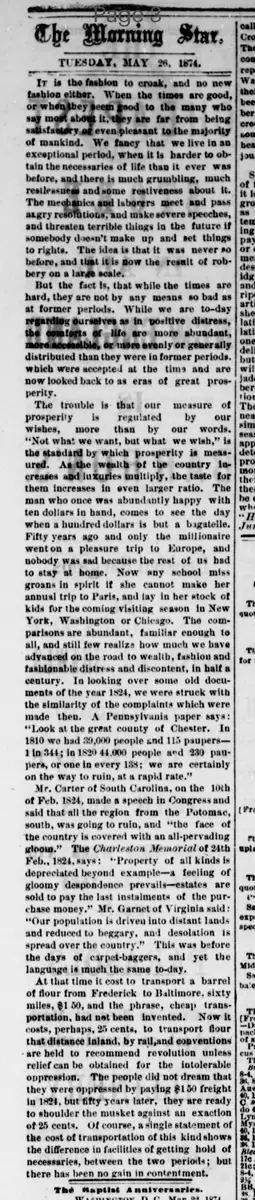
It is the fashion to croak, and no new fashion either. When the times are good, or when they seem good to the many who say most about it, they are far from being satisfactory or even pleasant to the majority of mankind. We fancy that we live in an exceptional period, when it is harder to obtain the necessaries of life than it ever was before, and there is much grumbling, much restlessness and some restiveness about it. The mechanics and laborers meet and pass angry resolutions, and make severe speeches, and threaten terrible things in the future if somebody doesn't make up and set things to rights. The idea is that it was never so before, and that it is now the result of robbery on a large scale.
But the fact is, that while the times are hard, they are not by any means so bad as at former periods. While we are to-day regarding ourselves as in positive distress, the comforts of life are more abundant, more accessible, or more evenly or generally distributed than they were in former periods, which were accepted at the time and are now looked back to as eras of great prosperity.
The trouble is that our measure of prosperity is regulated by our wishes, more than by our words. "Not what we want, but what we wish," is the standard by which prosperity is measured. As the wealth of the country increases and luxuries multiply, the taste for them increases in even larger ratio. The man who once was abundantly happy with ten dollars in hand, comes to see the day when a hundred dollars is but a bagatelle. Fifty years ago and only the millionaire went on a pleasure trip to Europe, and nobody was sad because the rest of us had to stay at home. Now any school miss groans in spirit if she cannot make her annual trip to Paris, and lay in her stock of kids for the coming visiting season in New York, Washington or Chicago. The comparisons are abundant, familiar enough to all, and still few realize how much we have advanced on the road to wealth, fashion and fashionable distress and discontent, in half a century. In looking over some old documents of the year 1824, we were struck with the similarity of the complaints which were made then. A Pennsylvania paper says: "Look at the great county of Chester. In 1810 we had 39,000 people and 115 paupers—1 in 344; in 1820 44,000 people and 230 paupers, or one in every 191; we are certainly on the way to ruin, at a rapid rate." Mr. Carter of South Carolina, on the 10th of Feb. 1824, made a speech in Congress and said that all the region from the Potomac south, was going to ruin, and "the face of the country is covered with an all-pervading gloom." The Charleston Memorial of 24th Feb., 1824, says: "Property of all kinds is depreciated beyond example—a feeling of gloomy despondence prevails—estates are sold to pay the last installments of the purchase money." Mr. Garnett of Virginia said: "Our population is driven into distant lands and reduced to beggary, and desolation is spread over the country." This was before the days of carpet-baggers, and yet the language is much the same to-day. At that time it cost to transport a barrel of flour from Frederick to Baltimore, sixty miles, $1.50, and the phrase, cheap transportation, had not been invented. Now it costs, perhaps, 25 cents, to transport flour that distance inland, by rail, and conventions are held to recommend revolution unless relief can be obtained for the intolerable oppression. The people did not dream that they were oppressed by paying $1.50 freight in 1824, but fifty years later, they are ready to shoulder the musket against an exaction of 25 cents. Of course, a single statement of the cost of transportation of this kind shows the difference in facilities of getting hold of necessaries, between the two periods; but there has been no gain in contentment.
TUESDAY, MAY 26, 1874.
It is the fashion to croak, and no new fashion either. When the times are good, or when they seem good to the many who say most about it, they are far from being satisfactory or even pleasant to the majority of mankind. We fancy that we live in an exceptional period, when it is harder to obtain the necessaries of life than it ever was before, and there is much grumbling, much restlessness and some restiveness about it. The mechanics and laborers meet and pass angry resolutions, and make severe speeches, and threaten terrible things in the future if somebody doesn't make up and set things to rights. The idea is that it was never so before, and that it is now the result of robbery on a large scale.
But the fact is, that while the times are hard, they are not by any means so bad as at former periods. While we are to-day regarding ourselves as in positive distress, the comforts of life are more abundant, more accessible, or more evenly or generally distributed than they were in former periods, which were accepted at the time and are now looked back to as eras of great prosperity.
The trouble is that our measure of prosperity is regulated by our wishes, more than by our words. "Not what we want, but what we wish," is the standard by which prosperity is measured. As the wealth of the country increases and luxuries multiply, the taste for them increases in even larger ratio. The man who once was abundantly happy with ten dollars in hand, comes to see the day when a hundred dollars is but a bagatelle. Fifty years ago and only the millionaire went on a pleasure trip to Europe, and nobody was sad because the rest of us had to stay at home. Now any school miss groans in spirit if she cannot make her annual trip to Paris, and lay in her stock of kids for the coming visiting season in New York, Washington or Chicago. The comparisons are abundant, familiar enough to all, and still few realize how much we have advanced on the road to wealth, fashion and fashionable distress and discontent, in half a century. In looking over some old documents of the year 1824, we were struck with the similarity of the complaints which were made then. A Pennsylvania paper says: "Look at the great county of Chester. In 1810 we had 39,000 people and 115 paupers—1 in 344; in 1820 44,000 people and 230 paupers, or one in every 191; we are certainly on the way to ruin, at a rapid rate." Mr. Carter of South Carolina, on the 10th of Feb. 1824, made a speech in Congress and said that all the region from the Potomac south, was going to ruin, and "the face of the country is covered with an all-pervading gloom." The Charleston Memorial of 24th Feb., 1824, says: "Property of all kinds is depreciated beyond example—a feeling of gloomy despondence prevails—estates are sold to pay the last installments of the purchase money." Mr. Garnett of Virginia said: "Our population is driven into distant lands and reduced to beggary, and desolation is spread over the country." This was before the days of carpet-baggers, and yet the language is much the same to-day. At that time it cost to transport a barrel of flour from Frederick to Baltimore, sixty miles, $1.50, and the phrase, cheap transportation, had not been invented. Now it costs, perhaps, 25 cents, to transport flour that distance inland, by rail, and conventions are held to recommend revolution unless relief can be obtained for the intolerable oppression. The people did not dream that they were oppressed by paying $1.50 freight in 1824, but fifty years later, they are ready to shoulder the musket against an exaction of 25 cents. Of course, a single statement of the cost of transportation of this kind shows the difference in facilities of getting hold of necessaries, between the two periods; but there has been no gain in contentment.
What sub-type of article is it?
Economic Policy
What keywords are associated?
Hard Times
Economic Prosperity
Historical Comparison
Contentment
Transportation Costs
What entities or persons were involved?
Mr. Carter
Mr. Garnett
Charleston Memorial
Editorial Details
Primary Topic
Perceptions Of Economic Hardship Compared To Historical Periods
Stance / Tone
Reassuring Critique Of Modern Discontent
Key Figures
Mr. Carter
Mr. Garnett
Charleston Memorial
Key Arguments
Current Hard Times Are Not As Bad As In The Past
Prosperity Is Measured By Wishes Rather Than Reality
Historical Complaints From 1824 Mirror Today's Grumbling
Improvements In Comforts And Transportation Are Overlooked
Rising Expectations Lead To Increased Discontent