Thank you for visiting SNEWPapers!
Sign up free
The Alexandria Herald
Alexandria, Virginia
What is this article about?
In 1822, William Cumming publicly brands George McDuffie a coward after a failed duel attempt near the North Carolina-South Carolina border. McDuffie counters, accusing Cumming of refusing to meet due to fear and seeking unfair advantages, detailing negotiations and delays.
Clipping
OCR Quality
Full Text
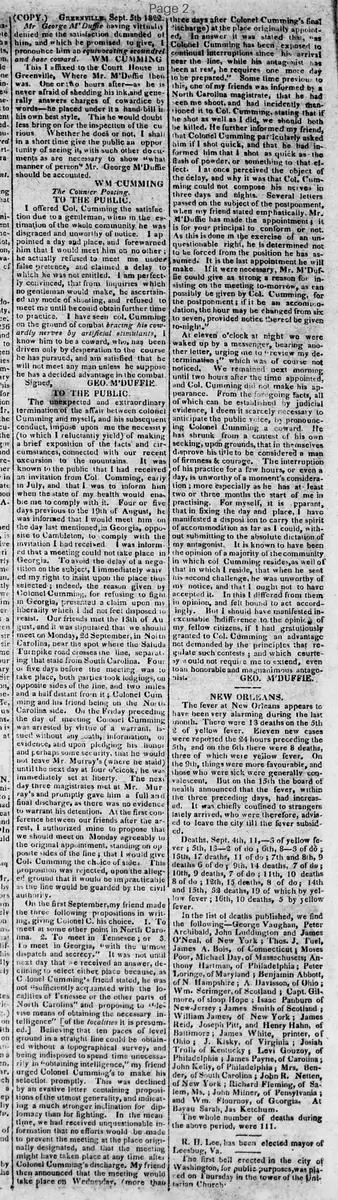
Mr George M'Duffie having virtually denied me the satisfaction demanded of him, and which he promised to give I pronounce him an equivocating scoundrel and base coward. WM. CUMMING
This I affixed to the Court House in Greenville, Where Mr. M'Duffie then was. One or two hours after—as he is never afraid of shedding his ink, and generally answers charges of cowardice by words—he placed under it a hand bill in his own best style. This he would doubtless bring on for the inspection of the curious Whether he does or not, I shall in a short time give the public an opportunity of seeing it, with such other documents as are necessary to show "what manner of person" Mr. George M'Duffie should be accounted.
WM. CUMMING
The Courier Posting.
TO THE PUBLIC.
I offered Col. Cumming the satisfaction due to a gentleman, when in the estimation of the whole community he was disgraced and unworthy of notice. I appointed a day and place, and forewarned him that I would meet him on no other; he actually refused to meet me under false pretence, and claimed a delay to which he was not entitled. I am perfectly convinced, that from inquiries which no gentleman would make, he ascertained my mode of shooting, and refused to meet me until he could obtain further time to practice. I have seen col. Cumming on the ground of combat bracing his cowardly nerves by artificial stimulants, I know him to be a coward, who, has been driven only by desperation to the course he has pursued, and am satisfied that he will not meet any man unless he suppose he has a decided advantage in the combat
Signed,
GEO. M'DUFFIE.
TO THE PUBLIC.
The unexpected and extraordinary termination of the affair between colonel Cumming and myself, and his subsequent conduct, impose upon me the necessity (to which I reluctantly yield) of making a brief exposition of the facts and circumstances, connected with our recent excursion to the mountains. It was known to the public that I had received an invitation from Col. Cumming, early in July, and that I was to inform him when the state of my health would enable me to comply with it. Four or five days previous to the 19th of August, he was informed that I would meet him on the day last mentioned, in Georgia, opposite to Cambelton, to comply with the invitation I had received. I was informed that a meeting could not take place in Georgia. To avoid the delay of a negotiation on the subject, I immediately waived my right to insist upon the place thus selected; indeed, the reason given by Colonel Cumming, for refusing to fight in Georgia, presented a claim upon my liberality which I did not feel disposed to resist. Our friends met the 18th of August. and it was stipulated that we should meet on Monday, 2d September, in North Carolina, near the spot where the Saluda Turnpike road crosses the line, separating that state from South Carolina. Four or five days before the meeting was to take place, both parties took lodgings, on opposite sides of the line, and two miles and a half distant from it; Colonel Cumming and his friend being on the North Carolina side. On the Friday preceding the day of meeting Colonel Cumming was arrested by virtue of a warrant, issued without any oath, information, or evidence, and upon pledging his honor and perhaps some security, that he would not leave Mr. Murray's (where he staid) until the next day at four o'clock, he was immediately set at liberty. The next day three magistrates met at Mr. Murray's and promptly gave him a full and final discharge, as there was no evidence to warrant his detention. At the first conference between our friends after the arrest, I authorized mine to propose that we should meet on Monday agreeably to the original appointment, standing on opposite sides of the line; that I would give Col. Cumming the choice of sides. This proposition was rejected, upon the alleged ground that it would be impracticable as the line would be guarded by the civil authority. On the 1st September, my friend made the three following propositions in writing, giving Colonel C. his choice. 1. To meet at some other point in North Carolina. 2. To meet in Tennessee; or 3. To meet in Georgia, "with the utmost dispatch and secrecy." It was not until next day that we received an answer, declining to select either place because, as Colonel Cumming's friend stated, he was not "sufficiently acquainted with the localities of Tennessee or the other parts of North Carolina" and proposing to "devise means of obtaining the necessary intelligence" of the localities it is presumed. Believing that ten paces of level ground in a straight line could be obtained without a topographical survey, and being indisposed to spend time unnecessarily in "obtaining intelligence," my friend urged Colonel Cumming to make his selection promptly. This was declined by an evasive letter containing propositions of the utmost generality, and indicating a much stronger inclination for diplomacy than for fighting. In the mean time, we had received unquestionable information that no efforts would be made to prevent the meeting at the place originally designated, and that the meeting might have taken place at any time after Colonel Cumming's discharge. My friend then announced that the meeting would take place on Wednesday, (more than three days after Colonel Cumming's final discharge) at the place originally appointed in answer it was stated that, "as Colonel Cumming has been exposed to continual interruptions since his arrival near the line, while his antagonist has been at rest, he requires one more day to be prepared." Some time previous to this one of my friends was informed by a North Carolina magistrate, that he had seen me shoot, and had incidentally thrown it to Col. Cumming, stating that if he shot as well as I did, we should both be killed. He further informed my friend, that Colonel Cumming particularly asked him if I shot quick, and that he had informed him that I shot as quick as the flash of powder, or something to that effect. I at once perceived the object of the delay, and why it was that Col. Cumming could not compose his nerves in three days and nights. Several letters passed on the subject of the postponement, when my friend stated emphatically. Mr. M'Duffie has made the appointment; it is for your principal to conform or not. As this is done in the exercise of an unquestionable right, he is determined not to be forced from the position he has assumed. It is the last appointment he will make. If it were necessary, Mr. M'Duffie could give as strong a reason for insisting on the meeting to-morrow, as can possibly be given by Col. Cumming. for the postponement; if it be an accommodation, the hour may be changed from six to seven, provided notice thereof be given to-night. At eleven o'clock at night we were waked up by a messenger, bearing another letter, urging me to "review my determination;" which was of course not noticed. We remained next morning until two hours after the time appointed. and Col. Cumming did not make his appearance. From the foregoing Facts, all of which can be established by judicial evidence, I deem it scarcely necessary to anticipate the public voice, by pronouncing Colonel Cumming a coward. He has shrunk from a contest of his own seeking, upon grounds, that in themselves disprove his title to be considered a man of firmness & courage. The interruption of his practice for a few hours, or even a day, is unworthy of a moment's consideration; more especially as he has at least two or three months the start of me in practising. For myself, it is apparent, that in fixing the day and place, I have manifested a disposition to carry the spirit of accommodation as far as I could, without submitting to the absolute dictation of my antagonist. It is known to have been the opinion of a majority of the community in which col Cumming resides, as well of that in which I reside, that when he sent his second challenge, he was unworthy of my notice, and that I ought not to have accepted it. In this I differed from them in opinion, and felt bound to act accordingly. But I should have manifested inexcusable indifference to the opinion of my fellow citizens, if I had gratuitously granted to Col. Cumming an advantage not demanded by the principles that regulate such contests; and which courtesy would not require me to extend, even to an honorable and magnanimous antagonist
GEO. M'DUFFIE.
What sub-type of article is it?
What themes does it cover?
What keywords are associated?
What entities or persons were involved?
Where did it happen?
Story Details
Key Persons
Location
Greenville; Near The North Carolina South Carolina Border; Saluda Turnpike Road
Event Date
Sept. 5th 1822; August September 1822
Story Details
William Cumming accuses George McDuffie of cowardice after failing to meet for a duel, posting a notice in Greenville. McDuffie responds publicly, detailing negotiations, Cumming's arrest and delays, and claims Cumming sought advantages due to fear of McDuffie's shooting skill, leading to Cumming's no-show.