Thank you for visiting SNEWPapers!
Sign up free
The Portland Daily Press
Portland, Cumberland County, Maine
What is this article about?
Retrospective on Queen Victoria's nearly 60-year reign, highlighting her conscientious service, loyalty to the constitution, and the era's material, intellectual, and moral progress without major calamities, contrasting with predecessors' reigns marked by strife.
Clipping
OCR Quality
Full Text
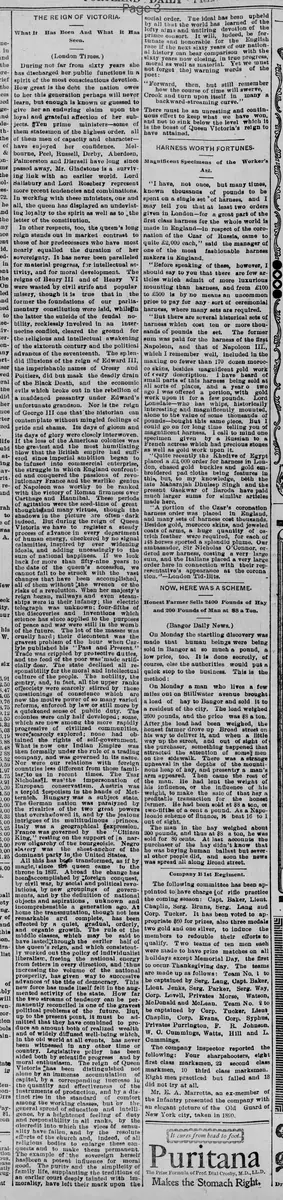
(London Times.)
During not far from sixty years she has discharged her public functions in a spirit of the most conscientious devotion. How great is the debt the nation owes to her this generation perhaps will never learn, but enough is known or guessed to give her an enduring claim upon the loyal and grateful affection of her subjects. Ten prime ministers—some of them statesmen of the highest order, all of them men of capacity and character—have enjoyed her confidence. Melbourne, Peel, Russell, Derby, Aberdeen, Palmerston and Disraeli have long since passed away. Mr. Gladstone is a surviving link with an earlier world. Lord Salisbury and Lord Rosebery represent more recent tendencies and combinations.
In working with these ministers, one and all, the queen has displayed an undeviating loyalty to the spirit as well as to the letter of the constitution.
In other respects, too, the queen's long reign stands out in marked contrast to those of her predecessors who have most nearly equalled the duration of her sovereignty. It has never been paralleled for material progress, for intellectual activity, and for moral development. The reigns of Henry III and of Henry VI were wasted by civil strife and popular misery, though it is true that in the former the foundations of our parliamentary constitution were laid, while in the latter the suicide of the feudal nobility, recklessly involved in an internecine conflict, cleared the ground for the religious and intellectual awakening of the sixteenth century and the political advances of the seventeenth. The splendid illusions of the reign of Edward III., the imperishable names of Cressy and Poitiers, did but mask the deadly drain of the Black Death, and the economic evils which broke out in the rebellion of a maddened peasantry under Edward's unfortunate grandson. Nor is the reign of George III one that the historian can contemplate without mingled feelings of pride and shame. Its days of gloom and its days of glory were closely interwoven.
If the loss of the American colonies was the greatest and the most humiliating blow that the British empire had suffered since imperial ambition began to be infused into commercial enterprise, the struggle in which England confronted and conquered the passions of revolutionary France and the warlike genius of Napoleon was worthy to be ranked with the victory of Roman firmness over Carthage and Hannibal. These periods of agitation were the seed-time of great thoughts and many virtues, though the shadows in the picture are often dark indeed.
But during the reign of Queen Victoria we have to register a steady process of advance in every department of human energy, checkered by no signal calamities, inspired by ever widening ideals, and adding unceasingly to the sum of national happiness. If we look back for more than fifty-nine years to the date of the queen's accession, we cannot fail to be struck with the vast changes that have been accomplished, all of them without the wrench or the risks of a revolution. When her majesty's reign began, railways and even steamships were in their infancy; the electric telegraph was unknown; four-fifths of the discoveries and inventions which science has since applied to the purposes of peace and war were still in the womb of the future. The lot of the masses was cruelly hard; their discontent was the gravest problem of the hour when Carlyle published his "Past and Present." Trade was crippled by protective duties, and the food of the poor was made artificially dear. The state declined all responsibility for the moral and intellectual culture of the people. The nobility, the gentry, and, in fact, all the upper ranks of society were scarcely stirred by those questionings of conscience which are now the motive power of so many varied reforms, enforced by law or still more by a quickened sense of public duty.
The colonies were only half developed; some, which are now among the more rapidly progressive of civilized communities, were scarcely explored; none had obtained the rights of self-government. What is now our Indian Empire was then formally under the rule of a trading company, and was governed in its name. Nor were our relations with foreign countries less different from those familiar to us in recent times. The Tsar Nicholas I. was the impersonation of European conservatism. Austria was a torpid despotism in the hands of Metternich. Hungary was a subject state. The German nation was paralyzed by the rivalries of the two great powers that overshadowed it, and by the jealous intrigues of its multitudinous princes. Italy was a geographical expression. France was governed by the "Citizen King," resting on the support of a narrow oligarchy of the bourgeoisie. Negro slavery was the sheet-anchor of the dominant party in the United States.
All this has been transformed, as if by magic, since the queen came to the throne in 1837. Abroad the change has been accomplished by foreign conquest, by civil war, by social and political revolutions, by new groupings of governments, and by the definition of national objects and aspirations, unknown and incomprehensible a generation ago. At home the transmutation, though not less remarkable and complete, has been effected by a quiet, gradual, orderly, and organic growth. The rule of the middle classes, which may be said to have lasted, through the earlier half of the queen's reign, and which consistently worked out the policy of individualist liberalism, freeing the national energy from fetters in every direction, and thus increasing the volume of the national prosperity, has given way to successive advances of the tide of democracy. This new force has made itself felt in the augmented activity of the state. How far the two streams of tendency can be permanently reconciled is one of the gravest political problems of the future. But, up to the present point, it must be admitted that they have combined to produce an amount both of realized wealth and of widely diffused well-being which, in the old world at all events, has never been witnessed in any other time or country. Legislative policy has been aided both by scientific progress and by moral enthusiasm.
The reign of Queen Victoria has been distinguished not alone by an immense accumulation of capital, by a corresponding increase in the quantity and effectiveness of the instruments of production, and by a distinct rise in the standard of comfort among the working classes, but by the general spread of education and intelligence, by a heightened feeling of duty and responsibility in all ranks, by the discredit into which the vices of sensuality have fallen, and by the resolute efforts of the church and, indeed, of all religious bodies to enlarge these conquests and to make them permanent.
The example of the sovereign herself has been a potent influence for moral good. The purity and the simplicity of family life, supplanting the traditions of an earlier court deeply tainted with immorality, have left their mark upon the social order. The ideal has been upheld by all that the world has learned of the lofty aims and untiring devotion of the prince consort. It will, indeed, be fortunate and honorable for the English race if the next sixty years of our national history can bear comparison with the sixty years now closing, in true progress, moral as well as material. Yet we must not forget the warning words of the poet:
"Forward, then, but still remember how the course of time will swerve,
Crook and turn upon itself in many a backward-streaming curve."
There must be an unresting and continuous effort to keep what we have won, and not to sink below the level which it is the boast of Queen Victoria's reign to have attained.
What sub-type of article is it?
What keywords are associated?
What entities or persons were involved?
Where did it happen?
Foreign News Details
Primary Location
Britain
Event Date
1837
Key Persons
Outcome
steady advance in human energy, material progress, intellectual activity, moral development, increased national happiness, without signal calamities or revolutions; transformation of colonies, foreign relations, and domestic society through gradual growth.
Event Details
Queen Victoria's nearly 60-year reign marked by conscientious public service, loyalty to constitution, collaboration with ten prime ministers; contrasted with predecessors' strife-filled reigns; era of progress in science, trade, education, colonies, and moral standards; shifts from middle-class liberalism to democracy; moral influence of the sovereign and prince consort.