Thank you for visiting SNEWPapers!
Sign up free
Alexandria Gazette
Alexandria, Alexandria County, District Of Columbia
What is this article about?
Report of a Republican Democratic States' Rights party meeting in Richmond, Virginia, supporting President Van Buren's re-election, denouncing opposition led by Gen. Harrison, and calling for an electoral convention on February 20 to nominate candidates and form an electoral ticket.
Clipping
OCR Quality
Full Text
Published Daily and Tri-weekly BY
EDGAR SNOWDEN.
The ALEXANDRIA GAZETTE
is printed on Tuesday, Thursday, and Saturday.
Subscription.—The Daily Paper is furnished for $8 in advance—payable half yearly.
The Country Paper (tri-weekly) is furnished for $4 payable in advance.
COMMUNICATION
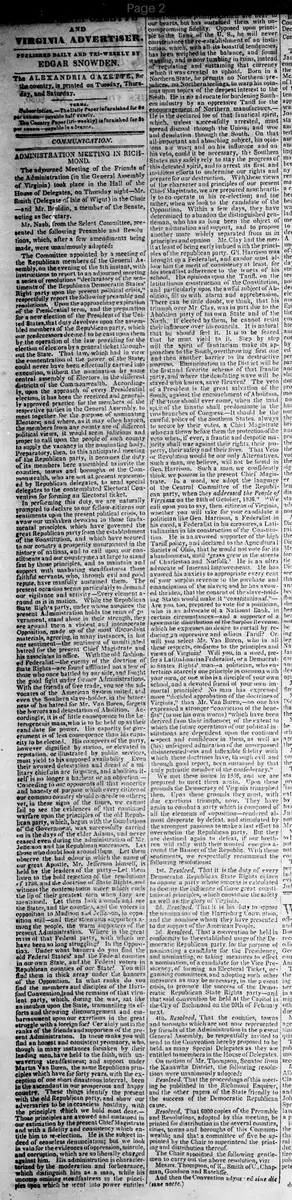
ADMINISTRATION MEETING IN RICHMOND.
The adjourned Meeting of the Friends of the Administration (in the General Assembly of Virginia) took place in the Hall of the House of Delegates, on Thursday night—Mr. Smith (Delegate of Isle of Wight) in the Chair—and Mr. Bouldin, a member of the Senate, acting as Secretary.
Mr. Nash, from the Select Committee, presented the following Preamble and Resolutions, which, after a few amendments being made, were unanimously adopted:
The Committee appointed by a meeting of the Republican members of the General Assembly, on the evening of the 5th instant, with instructions to report to an adjourned meeting a series of resolutions "declaratory of the sentiments of the Republican Democratic States' Rights party upon the present political crisis," respectfully report the following preamble and resolutions. Upon the approaching expiration of the Presidential term, and the preparation for a new election of the President of the United States, that duty devolves upon the assembled members of the Republican party, which our predecessors deemed to be cast upon them by the operation of the law providing for the election of electors by a general ticket throughout the State. That law, which had in view the concentration of the power of the State, could never have been effectually carried into execution, without the nomination by some central assembly of Electors in the different districts of the Commonwealth. Accordingly, upon the approach of every Presidential election, it has been the received and generally approved practice of the members of the respective parties in the General Assembly, to meet together for the purpose of nominating Electors; and where, as it may often happen, the members from any county are of different political views, it would seem judicious and proper to call upon the people of such county to supply the vacancy in the nominating body. Preparatory, then, to this anticipated meeting of the Republican party, it becomes the duty of its members here assembled to invite the counties, towns and boroughs of the Commonwealth, who are not at present represented by Republican delegates, to send special delegates to the contemplated Electoral Convention for forming an Electoral ticket. In performing this duty, we are naturally prompted to declare to our fellow-citizens our sentiments upon the present political crisis, to avow our unshaken devotion to those fundamental principles, which have governed the great Republican party from the establishment of the Constitution, and which have secured to our country a prosperity unsurpassed in the history of nations, and to call upon our constituents and our countrymen at large to stand fast by those principles, and to maintain and support with unabating steadfastness those faithful servants, who, through evil and good report, have manfully sustained them. The present occasion seems particularly to demand our vigilance and activity—Every element around us is in motion. While the Republican State Rights party, under whose auspices the present Administration holds the reins of government, stand alone in their strength, they see around them a violent and intemperate Opposition, made up of the most discordant materials, agreeing, in many instances, in but one sentiment—the sentiment of unmitigated hatred for the present Chief Magistrate and his associates in office. With the old fashioned Federalist—the enemy of the doctrine of State Rights—are found affiliated not a few of those who once battled by our side, and fought the good fight under former Administrations. With the friends of free trade, you see the advocates of the American System united, and even the Southern slave-holder, in the bitterness of his hatred for Mr. Van Buren, forgets the horrors and detestation of Abolition. Accordingly, it is of little consequence to the heterogeneous mass, who is to be held up as their candidate or power. His capacity for government is of less consequence than his capacity to be elected. His compeers of the party, however dignified by station, or elevated in reputation, or illustrated by public services, must yield to his supposed availability Even their avowed detestation and dread of a military chieftain are forgotten, and abolition itself is no longer a bugbear or an objection.— Conceding to our opponents all that sincerity and honesty of purpose which every citizen of our common country should concede to others: yet, in these signs of the times, we cannot fail to see the evidences of that continued warfare upon the principles of the old Republican party, which, begun with the foundations of the Government, was successfully carried on in the days of the elder Adams, and never ceased even during the administration of Mr. Jefferson and his Republican successors. Let those who doubt look around them. Let them observe the bad odour in which the name of our great Apostle, Mr. Jefferson himself, is held by the leaders of the party—Let them listen to the bold rejection of the resolutions of '98, and the doctrine of State Rights, and witness the contemptuous sneer which curls the lip of their greatest men when they are mentioned. Let them look around and see the States, and the counties, and the voters in opposition to Madison and Jefferson, in opposition still—and their strenuous supporters among the people, the warm supporters of the present Administration. Where is the great mass of that Federal party, with which we have been so long struggling? In the Opposition. Under what banners do you find the old Federal States? and the Federal counties in our own State, and the Federal voters in Republican counties of our State? You will find them in thick array under the banners of the Opposition. In what ranks do you find the members and disciples of the Hartford Convention, and the remains of that virulent party, which, during the war, sat like an incubus upon the State, trammelling its efforts and throwing discouragement and embarrassment upon our exertions in the great struggle with a foreign foe? Certainly not in the ranks of the friends and supporters of the present Administration. In these ranks you will find an honest and consistent yeomanry, who, though in many instances forsaken by their leading men, have held to the faith, with unwavering steadfastness; and support under Martin Van Buren, the same Republican principles which have for forty years, with the exception of one short disastrous interval, been in the ascendant in our prosperous and happy country. These things identify the present with the old Republican party, and show our adversaries to be in ceaseless hostility, with the principles which we hold most dear.— Those principles are avowed and sustained in our estimation by the present and with a fidelity and consistency which entitles him to re-election. He is the subject indeed of ceaseless denunciation; but we look in vain for the evidences of oppression, misrule, and corruption, which are so liberally charged against him. His administration is characterized by the moderation and forbearance, which distinguish him as a man, while his uncompromising steadfastness in the principles upon which he came into power entitles our hearts, but has sustained them with uncompromising fidelity. Opposed upon principle to the Bank of the U. S., he will never countenance the re-establishment of an institution which, with all its boastful tendencies has been weighed in the balance, and found wanting, and is now tumbling in ruins, instead of regulating and sustaining that currency which it was created to uphold. Born in a Northern State, he permits no Northern prejudices, no Northern feelings, to warp his opinions upon topics of the deepest interest to the South. He is no advocate for burdening Southern industry by an oppressive Tariff or the encouragement of Northern manufactures.— He is the declared foe of that fanatical spirit, which, unless successfully arrested, must spread discord through the Union; and woe and desolation through the South. On that all-important and absorbing subject, his opinions are wise; and on his influence and on his veto, could it be necessary, the Southern States may safely rely to slay the progress of this detested spirit, and to arrest its first and insidious efforts to undermine our rights and prepare for our destruction. With these views of the character and principles of our present Chief Magistrate, we are prepared most heartily to co-operate in his re-election; and the rather, when we look to the candidate of the Opposition. Within a few days, they have determined to abandon the distinguished gentleman, who has so long been the object of their admiration and support, and to propose another more widely separated from us in principles and opinion Mr. Clay had the merit at least of being early imbued with the principles of the republican party. Gen. Harrison was brought up a Federalist, and candor must allow him the merit of consistency at least, for his steadfast adherence to the tenets of his school. His opinions upon the Tariff, on the latitudinarian construction of the Constitution, and particularly upon the awful subject of Abolition, fill us with alarm and apprehension. There can be little doubt, we think, that his triumph over Mr Clay, was in part due to the Abolition party of his own State and of the North. If elected by them, he cannot resist their influence over his councils. It is natural that he should feel it. It is to be feared that he must yield to it. Step by step will the spirit of fanaticism make its approaches to the South, overthrowing first one and then another barrier to its destructive progress. Emancipation in the District will be the first and favorite scheme of that frantic party, and where the desolating wave will be stayed who knows, save Heaven? The veto of a President is the great salvation of the South, against the encroachment of Abolition, if the time should ever come, when the mad spirit of the fanatic shall predominate in the two branches of Congress.—It should be the careful, policy of the Southern States, always to secure by their votes, a Chief Magistrate who can throw before them the protection of the veto when, if ever, a frantic and despotic majority shall war against their rights, their property, their safety and their lives. That Veto or Revolution would be our only alternatives. Such a man, we believe, will not be found in Gen. Harrison. Such a man, we confidently think, we possess in the present Chief Magistrate. In a word, we adopt the language of the Central Committee of the Republican party, when they addressed the People of Virginia on the 24th of October, 1836. "We call upon you to say, then, citizens of Virginia, whether you will take for your candidate a politician like Gen. Harrison, a Federalist in his creed, a Federalist in his measures, a Latitudinarian in his construction of the Constitution. He is an avowed supporter of the high Tariff policy, and declared to the Agricultural Society of Ohio, that he would not vote for its abandonment, until grass grew in the streets of Charleston and Norfolk? He is an ultra advocate of Internal Improvements. He has avowed his anxiety to appropriate every cent of your surplus revenue to the purchase and emancipation of the slaves; and he has avowed the idea, that the consent of the slave-holding States would make it "constitutional."— Are you, too, prepared to vote for a politician, who is an advocate of a National Bank, in certain circumstances—and a supporter of a systematic distribution of the Surplus Revenue, which he expresses no desire to curtail by reducing an oppressive and odious Tariff? Or. will you select Mr. Van Buren, who in all these respects, conforms to the principles and views of Virginia? Will you, in a word, prefer a Latitudinarian Federalist, or a Democratic States Rights' man—a politician, who entertains scarcely one principle in common with your own, or one who is a disciple of your own school, and a devoted friend of your own immortal principles? No man has expressed more "decided approbation of the doctrines of Virginia," than Mr. Van Buren,—no one has expressed a stronger "conviction of the benefits" (to use his own words) "which have been derived from their influence; of the extent to which the future operations of our political institutions are dependent upon the continued respect and confidence in them, as well as (his) unfeigned admiration of the unsurpassed disinterestedness and inflexible fidelity with which these doctrines have, through evil and through good report, been sustained by that truly patriotic member of the confederacy." We met these issues in 1836, and we are prepared to meet them again. Upon these grounds the Democracy of Virginia triumphed then. Upon these grounds they must, with due exertions triumph, now. They have again to combat a party which is composed of all the elements of opposition—rendered almost desperate by defeat, and stimulated by the strongest passions to make a last effort to overwhelm the Republican party. But they are destined again to defeat, if our brethren will rally with their wonted energies around the Banner of the Republic. With these sentiments, we respectfully recommend the following resolutions:
Ist. Resolved, That it is the duty of every Democratic Republican State Rights citizen to oppose a party whose success is calculated to destroy the influence of those great constitutional principles, which constitute the safety as well as the glory of Virginia.
2d. Resolved, That it is his duty to oppose the nomination of the Harrisburg Convention and the nominee whom they have presented to the support of the American People.
3d. Resolved, That a convention be held in conformity to the established usage of the Democratic Republican party, for the purpose of nominating a candidate for the Presidency, and nominating, or taking measures to effect a nomination, of a candidate for the Vice Presidency, of forming an Electoral Ticket, organising committees, and adopting such other measures as may be necessary, in the present crisis, to promote the success of the Democratic Republican State Rights party—and that said convention be held at the Capitol in the City of Richmond on the 20th of February next.
4th. Resolved, That the counties, towns and boroughs which are not now represented by friends of the Administration in the present General Assembly, be respectfully invited to send to the Convention hereby proposed to be held, as many Special Delegates as they are entitled to members in the House of Delegates.
On motion of Mr. Thompson, Senator from the Kanawha District, the following resolutions were unanimously adopted:
Resolved, That the proceedings of this meeting be published in the Richmond Enquirer, and the other papers of the State friendly to the success of the Democratic Republican cause.
Resolved, That 5000 copies of the Preamble and Resolutions, adopted by this meeting, be printed for distribution in the several counties, cities, towns and boroughs of this Commonwealth; and that a committee of five be appointed by the Chair to superintend the printing and distribution thereof.
The Chair appointed the following gentlemen to carry out the above resolution, viz: Messrs. Thompson, of K., Smith of C., Chapman, Goodson and Ratcliffe.
And then the Convention adjourned sine die (sine nocte.)
What sub-type of article is it?
What themes does it cover?
What keywords are associated?
What entities or persons were involved?
Where did it happen?
Story Details
Key Persons
Location
Richmond, Virginia
Event Date
Thursday Night, Following The 5th Instant
Story Details
Adjourned meeting of Republican members in Virginia General Assembly adopts preamble and resolutions affirming support for Van Buren's re-election, denouncing opposition and Gen. Harrison as threat to state rights and anti-abolition stance, and calls for electoral convention on February 20 to nominate candidates and form ticket.