Thank you for visiting SNEWPapers!
Sign up free
The New York Herald
New York, New York County, New York
What is this article about?
In New York, thieves King and Newman quarrel over stolen gold chains, get arrested, and accuse Officer Whitehead of receiving burglary loot from William Street. Whitehead testifies he was undercover to catch them. Case adjourned before Justice Welsh.
Clipping
OCR Quality
Full Text
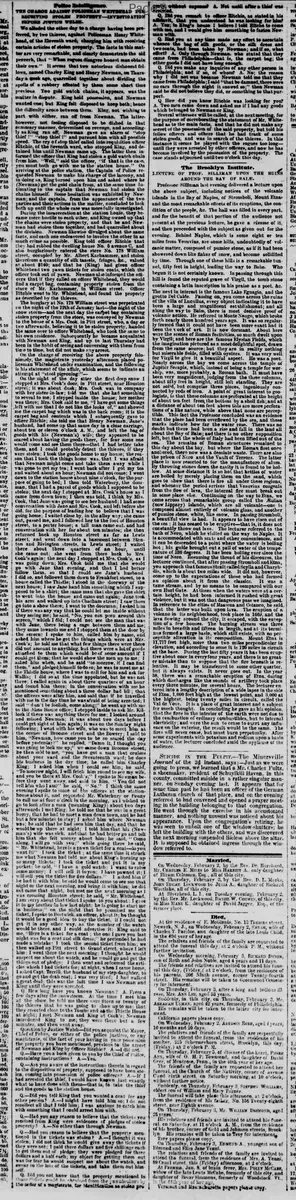
We alluded the other day to a charge having been preferred, by two thieves, against Policeman Henry Whitehead, of the Eleventh ward; charging him with receiving certain articles of stolen property. The facts in this matter are very remarkable, and clearly demonstrate the old proverb, that "When rogues disagree honest men obtain their own."
It seems that two notorious dishonest fellows, named Charley King and Henry Newman, on Thursday a week ago, quarrelled together about dividing the spoils of a robbery effected by them some short time previous. Two gold watch chains, it appears, was the matter in dispute. King held possession, and Newman wanted one; but King felt disposed to keep both; hence the difficulty arose between them. King, not wishing to part with either, ran off from Newman. The latter, however, not feeling disposed to be dished in that summary manner, determined on revenge, and accordingly as King ran off, Newman gave an alarm of "stop thief!" "stop thief!" and pursued him with all possible speed. The cry of stop thief called into requisition officer Ritchie, of the Seventh ward, who stopped King, and detained him until Newman came up. The latter then informed the officer that King had stolen a gold watch chain from him. "Well," said the officer, "if that is the case you must both go with me to the station house." On arriving at the police station, the Captain of Police requested Newman to make his charge of the larceny, and in doing so, King turned upon him and asked where he (Newman) got the gold chain from, at the same time intimating to the captain that Newman had stolen the chains himself. Some hesitation was exhibited by Newman; and the captain, from the appearance of the two parties and their actions in the matter, concluded to lock both up until the whole case was more fully investigated.
During the incarceration at the station house, they became more hostile to each other, and King owned up that the chains were stolen property, and that he and Newman had stolen them together, and had quarrelled about the division. Newman likewise divulged about the same facts, and each one endeavored to involve the other in as much crime as possible. King told officer Ritchie that they had robbed the dwelling house No. 5 avenue C, and also burglariously entered the store No. 178 William street, occupied by Mr. Albert Karhammer, and stolen therefrom a quantity of silk tassels, fringes, &c., valued at about $140; and that he (King) had given officer Whitehead two pawn tickets for stolen coats, which the officer took out of pawn. Newman also informed the officers that if they called on officer Whitehead, they would find a carpet bag, containing property stolen from the store of Mr. Karhammer, in William street.
Officer Ritchie went to Mr. Whitehead, and found the property as described by the thieves.
The burglary at No. 178 William street was perpetrated on the night of the 12th of January last—the night of the snow storm—and the next day the carpet bag containing stolen property from the store, was conveyed by Newman to the house of a Mrs. Cook, in Pitt street, who, a day or two afterwards, believing it to be stolen property, handed the same over to officer Whitehead, who took the same to his own residence. Subsequently he became acquainted with Newman and King, and up to last Thursday had been in the habit of seeing and conversing with them from time to time, but did not make any arrest.
On the charge of receiving the above property feloniously, the magistrate yesterday afternoon placed policeman Whitehead under examination, and the following is his statement of the affair, which seems to indicate an attempt at "stool pigeonning:"
On the night of the day after the first deep snow I stopped at Mrs. Cook's door, in Pitt street, near Houston street; it was about dusk; Mrs. Cook was in company with her sister-in-law; told me that she had something to reveal to me; I stepped inside the house; her mother was there; Mrs. Cook said to me, "I have got some things left with me that I do not like the looks of," and showed me the carpet bag which was in the back room: it is the carpet bag and contents which I subsequently gave to officer Ritchie; she told me that Henry Newman, Jane's husband, had come up that same day in a close carriage, about ten or eleven o'clock A. M., and left the bag of goods with his (Newman's) wife; they appeared to be scared about having the goods there, for fear some one would come and see them there—that I had better take them, and I could probably detect the thieves, if they were stolen; I took the goods home to my house; the reason that I took the things home was, that I was afraid that Newman might come and take them away while I was gone to get my tea; I went back after I got my tea and waited about an hour: Newman did not come: I went down to the station house about nine o'clock, for the purpose of going to bed; I then told Waterbury, the door man, that I had a parcel of goods which I supposed to be stolen: the next day I stopped at Mrs. Cook's house as I came from down town; I then was told, I think by Mrs. Cook, that Jane was going to see her husband; I had some conversation with Jane and Mrs. Cook, and left before she did, for the purpose of leading her to believe that I was going home; I waited close by, in the alley way; she came out, passed me, and I followed her to the foot of Houston street, to a porter house; a tall man came out, and had conversation with her for about ten minutes; she then returned back up Houston street as far as Lewis street, and went down into a basement between Stanton and Rivington streets, in Lewis street: I waited there about three quarters of an hour, until she came out; she went from there back to Mrs. Cook's again; the next day I stopped at Mrs. Cook's, as I was going down; Mrs. Cook told me that she would go with Jane that evening, and that I had better follow them, so that I could see Jane's husband; I did so, and followed them down to Frankfort street, to a house called the Thistle; I stood in the doorway of the next house; I saw Jane hand him something which I supposed to be a shirt; the same man that she gave the shirt to went into the house and came out again; Jane took his arm and walked up into Chatham street; I saw them go into a show there; I went to the doorman; I asked him if there was any way that he could let me inside without they seeing me; he said, "No, you can peep around this screen," which I did; I could not see the man that was with Jane, there being a cage between them and me; they came towards me and I stopped them at the door by the screen; I spoke to him, called him by name, and asked him where he got the things which were at Mrs. Cook's; he told me that what few things there were there did not amount to anything, but there were a lot of goods attached to them which would be of some amount if I could get them; that he would show the men up to me; I asked him when, and he said to-morrow, if I can find them, and pledged himself to do so: he was to meet me at the Thistle house, where I was to call for him and ask for Wallis; I did so at the time appointed, but he was not there: I called again in about three quarters of an hour and found him there; in the conversation with me he mentioned something about a three dollar bad bill: that the officers were after him, and said that if he travelled with me in the day time he was afraid of being arrested: I said "don't be foolish, come along;" he went up with me to the Ains House office: I stepped inside to ask Mr. Killock if there was anything there for me: I looked around and missed Newman; it was about two days before I could get sight of him again; it was on the Sunday night following; I went with his wife, who was to meet him at the corner of Broome street and the Bowery; I said to him, "Newman, how came you to be so scared the day before yesterday?" he replied, "Damn it, I thought you was going to lock me up;" we came down Broome street; he then said to me, you have got a man that cruises about your ward and the Seventeenth ward; he does his business in the day time; he called him Charley King; I asked him when I could see him; he said, "To-morrow night, I will fetch him round to see my wife, and you be there at Mrs. Cook's;" I spoke to Newman before they went away, and said to him, "You did not tell him who I am?" he said, "No." I think the same evening I spoke to some of the officers at the station-house about it, and requested Mr. Waterbury or Penny to call me at four o'clock in the morning, as I wished to go to look after a man (meaning King); about two days afterwards I met King; he told me that he was in a great hurry, that he had to meet a man down town, and he had but a few minutes to stay; I asked him where Newman was; he said that he had seen him that day, and that he would be up there at night; I told him that his (Newman's) wife was sick, and that he had better go and tell him that she felt uneasy about him; he said, "Come along, I will go with you;" while going there he said, "Mr. Whitehead, here is a pawn ticket for a coat—do you want it?" I took the ticket; at the same time it struck me what Newman had told me about King's burning up so many tickets; I took the ticket and put it in my pocket; he said, "I have a gold watch; I want to raise some money; I will sell it to you: I have pawned it; I will sell you the ticket for five dollars." I asked him if he had it with him he said he would come to see me that night or the next morning, and bring it with him; he did not come that night, but met me the next morning as I was crossing Houston street; he said, "Mr. Whitehead, I am sorry about that ticket I spoke to you about: I gave it to my brother in law last night; he is going to start me in business;" on the night that he promised me the ticket, I spoke to Bostwick, an officer, about it; he thought it would be a good idea to buy the ticket, if I could not get it in any other way, as the number of the watch would be there, and I could advertise it: King said to me, 'Here is a ticket for a coat; the one I gave you last night was for a coat and silk dress;' he pretended he had made a mistake; I took the second ticket from him; we then walked up Pitt street to Grand street, where I left him: I went there the next morning; I thought he would suspect me about the watch, and he would go and get the things out of pledge; I then went and redeemed the articles which I had tickets for; at night, when I came home, I asked Capt. Terrill, the husband of my step-daughter, to go and get the drab coat; I was very tired; I had walked a great deal: this was the last time I saw Newman and King until they were arrested.
Q. How long have you known Newman? A. From a few days after the snowstorm. At the time I met him at the show, he told me there were fifteen or twenty of the thieves that he was going to show up to me: that they resorted close to the Tombs and at the Thistle House at night: I met Newman and King at Cook's; Newman introduced King to me; they were there but a few minutes, and then went away.
Question by Justice Walsh—Did you acquaint the Mayor, Chief of Police, or either of the police justices, or any magistrate, of the fact of your having in your possession the property you have mentioned, previous to the arrest of Newman and King by Officer Ritchie? A.—I did not.
Q.—Have you a book given to you by the Chief of Police, containing instructions? A.—Yes.
Q.—Are you aware of the instructions therein in regard to the disposition of property, supposed to have been stolen, coming into possession of police officers? A.—If I had arrested the thief, I would have known just exactly what to have done with them—that is, to take the thief and the goods to the station house.
Q.—Did you tell King that you wanted a coat for any other person? A.—I might have told him so; I do not recollect all that I told him; I was anxious to catch him with something that I could arrest him with.
Q.—Had you any reason to believe that the ticket you received from King were evidences of pledges of stolen property? A.—No other than through Newman.
Q.—Had you reason to believe that the property mentioned in the tickets was stolen? A.—I thought it was stolen; I did not think he would give away the tickets if they were not; I paid three dollars and five shillings each to get them out of pledge; they were pledged for three dollars and a half each; my object for getting them out was for fear he would suspect me about the watch, and swear to the loss of the tickets, and take them out himself.
Q. Did you not know that the property mentioned in those tickets could be claimed from the pawnbrokers by the production of a magistrate's order, or to application at a station house?
Q. Did you remark to officer Ritchie, as stated in his affidavit, that you understood he was looking for him?
A. Yes; in King's house I believe I told Ritchie to come with me, and I would give him something to fasten Newman with.
Q. Had you at any time made any effort to ascertain whence the bag of silk goods, or the silk dress and two coats, had been taken by Newman; and if so, what effort? A. Only through Newman, who stated that they came from Philadelphia—that is, the carpet bag; the other goods I did not have long enough.
Q. Did you make any inquiries of any other person in Philadelphia; and if so, of whom? A. No; the reason why I did not was because Newman told me that they came from Philadelphia; I said "that be damned, there were no cars through the night it snowed so;" then Newman said he did not believe they did, or something to that purport.
Q. How did you know Ritchie was looking for you?
A. Two men came down and asked me if I had any goods which belonged to Newman or King.
Several witnesses will be called, at the next meeting, for the purpose of corroborating the statement of Mr. Whitehead as to the main facts, and that he did not make any secret of the possession of the said property, but told his fellow officers and others that he had track of some stolen goods, and was in search of the thieves. In this instance it seems he played with the rogues too long—until they were arrested by other officers, and now he has become involved by the possession of the property. The case stands adjourned until two o'clock this day.
What sub-type of article is it?
What themes does it cover?
What keywords are associated?
What entities or persons were involved?
Where did it happen?
Story Details
Key Persons
Location
New York City (Eleventh Ward, Seventh Ward, No. 178 William Street, Pitt Street, Houston Street)
Event Date
Night Of The 12th Of January Last (Snow Storm)
Story Details
Two thieves, Charley King and Henry Newman, quarrel over stolen gold watch chains, leading to their arrest. They accuse each other and implicate Policeman Henry Whitehead in receiving stolen property from a burglary at No. 178 William street. Whitehead claims he was investigating to catch the thieves by gaining their trust. The case is under examination by Justice Welsh.