Thank you for visiting SNEWPapers!
Sign up free
Juniata Sentinel And Republican
Mifflintown, Juniata County, Pennsylvania
What is this article about?
In a village, widow Betsey Bobbett flirts with wealthy Squire Wilkins, but her bachelor brother Ira, fearing displacement, sabotages by disheveling their home and tricking the Squire into measuring rooms alone, leading to his embarrassing discovery under the bed and Betsey's outraged reaction, thwarting the romance.
Clipping
OCR Quality
Full Text
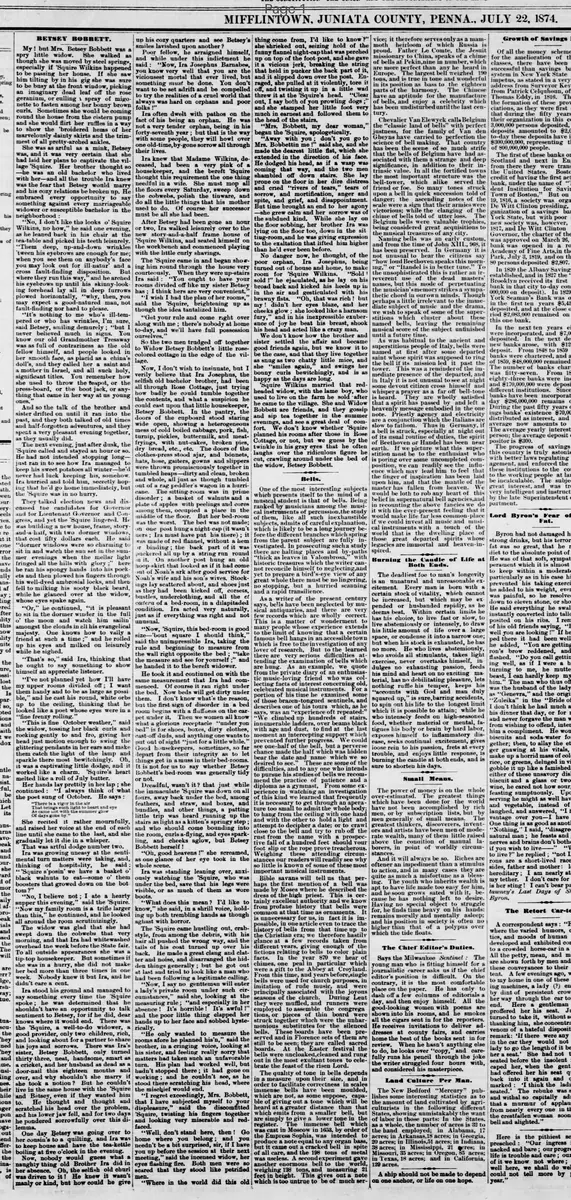
My! but Mrs. Betsey Bobbett was a spry little widow. She walked as though she was moved by steel springs especially if 'Squire Wilkins happened to be passing her house. If she saw him tilting by in his gig she was sure to be busy at the front window, picking an imaginary dead leaf off the rose geranium, or culling a spray of mignonette to fasten among her bonny brown curls. Sometimes she would be coming round the house from the cistern pump and she would flirt her ruffles in a way to show the 'broidered hems of her marvelously dainty skirts and the trimmest of all pretty-arched ankles.
She was as artful as a mink, Betsey was, and it was very certain that she had laid her plans to captivate the village 'Squire. Her brother thought so -he was an old bachelor who lived with her-and all the trouble Ira knew was the fear that Betsey would marry and his cozy relations be broken up. He embraced every opportunity to say something against every marriageable widower or susceptible bachelor in the neighborhood :
"No, I don't like tha looks o' Squire Wilkins, no how," he said one evening, as he leaned back in his chair at the tea-table and picked his teeth leisurely. "Them deep, up-and-down wrinkles tween his eyebrows are enough for me; when you see them on anybody's face you may look out for ill-natur' and a cross fault-finding disposition. But where they run this way," and he arched his eyebrows up until his skinny-looking forehead lay all in deep furrows plowed horizontally, "why, then, you may expect a good-natured man, not fault-finding nor hard to please."
"It's nothing to me who's ill-tempered or who has wrinkles, I'm sure," said Betsey, smiling demurely; "but I never believed much in signs. You know our old Grandmother Tressway was as full of contrariness as the old fellow himself, and people looked in her smooth face, as placid as a china doll's, and they called her a saint and a mother in Israel, and all such holy, significant titles. You remember how she used to throw the teapot, or the press-board, or the boot jack, or anything that came in her way at us young ones."
And so the talk of the brother and sister drifted on until it ran into the past, and they both talked of old times and half-forgotten adventures, and they spent a very pleasant evening together, as they usually did.
The next evening, just after dusk, the 'Squire called and stayed an hour or so. He had not intended stopping long-just ran in to see how Ira managed to keep his sweet potatoes all winter-he'd never had luck keeping his, somehow. Ira hurried and told him, secretly hoping that he'd go home immediately, but the 'Squire was in no hurry.
They talked election news and discussed the candidates for Governor and for Lieutenant Governor and Congress, and yet the 'Squire lingered. He was building a new house, frame, story and-a-half, with two dormer windows, that cost fifty dollars each. He said "dormer windows were so charming to sit in and watch the sun set in the summer evenings when the mellow light fringed all the hills with glory;" here he ran his spongy hands into his pockets and then plowed his fingers through his well-dyed ambrosial locks, and there fell to milking his sooty black beard, while he glanced over at the widow, whose eyes spake again.
"Or," he continued, "it is pleasant to sit in the dormer winder in the full o' the moon and watch him sailin amongst the clouds in all his evangelical majesty. One knows how to vally a friend at such a time;" and he rolled up his eyes and milked on leisurely while he sighed.
"That's so," said Ira, thinking that he ought to say something to show himself an appreciative listener.
"I've not planned yet how I'll have my upper rooms divided off; I want them handy and to be as large as possible," and he cast his round, white orbs up to the ceiling, thinking that he looked like a poet whose eyes were in a "fine frenzy rolling."
"This is fine October weather," said the widow, tossing her black curls and rocking gently to and fro, giving her head just motion enough to swing the glittering pendants in her ears and make them catch the light of the lamp and sparkle there most bewitchingly. Oh, it was a captivating little dodge, and it worked like a charm. 'Squire's heart melted like a roll of July butter.
Her hands lay prettily in her lap; she continued: "I always think of what the poet sung of October. He says:
"There is a vigor in the air
That brings such light to heart and eye
As came not with the summer glow
Of days gone by."
She recited it rather mournfully and raised her voice at the end of each line until she came to the last, and she gradually let it die in a whisper. That was artful dodge number two.
Ira was growing uneasy at the sentimental turn matters were taking, and, thinking of hospitality, he said: "'Squire s'posin' we have a basket o' black walnuts to eat-some o' them boosters that growed down on the bottom?"
"No, I believe not; I ate a hearty supper this evening," said the 'Squire.
"Now my family room is a trifle larger than this," he continued, and he looked all around the room scrutinizingly.
The widow was glad that she had swept down the cobwebs that very morning, and that Ira had whitewashed overhead the week before the State fair. To all outside appearances she was a tip-top housekeeper. But sometimes if she was in a hurry, she did not make her bed more than three times in one week. Nobody knew it but Ira, and he didn't care a cent.
Ira stood his ground and managed to say something every time the 'Squire spoke; he was determined that he shouldn't have an opportunity to talk sentiment to Betsey, for if he did, dear knows where it would end. There was the 'Squire, a well-to-do widower, a good provider, only two children, rich, and looking about for a partner to share his joys and sorrows. There was Ira's sister, Betsey Bobbett, only turned thirty-three, neat, handsome, smart as a cricket, and her husband as dead as a door-nail this eighteen months and over, and why shouldn't she marry if she took a notion? But he couldn't live in the same house with the 'Squire and Betsey, even if they wanted him to. He thought and thought and scratched his head over the problem, and his lower jaw fell, and for two days he pondered sorrowfully over this dilemma.
One day Betsey was going over to her cousin's to a quilting, and Ira was to keep house and have the tea-kettle boiling at five o'clock in the evening. Now, nobody would guess what a naughty thing old Brother Ira did in her absence. Oh, the selfish old churl was driven to it! He knew it wasn't manly or kind, but how could he give up his cozy quarters and see Betsey's smiles lavished upon another?
Poor fellow, he arraigned himself and while under this indictment he said: "Now, Ira Josephus Barnabee, you know very well that you are the viciousest mortal that ever lived, but something must be done. You don't want to be set adrift and be compelled to try the realities of a cruel world that always was hard on orphans and poor folks!"
Ira often dwelt with pathos on the fact of his being an orphan. He was not a very tender orphan, being in his forty-seventh year; but that is the way with some people, they will howl over one old-time, by-gone sorrow all through their lives.
Ira knew that Madame Wilkins, deceased, had been a very pink of a housekeeper, and the bereft "Squire thought this requirement the one thing needful in a wife. She must mop all the floors every Saturday, sweep down the cobwebs, polish the tinware, and do all the little things that his mother used to do. Of course her successor must be all she had been.
After Betsey had been gone an hour or two, Ira walked leisurely over to the new story-and-a-half frame house of 'Squire Wilkins, and seated himself on the workbench and commenced playing with the little curly shavings.
The 'Squire came in and began showing him round through the house very courteously. When they were up-stairs Ira said: "You ought to have your rooms divided off like my sister Betsey has: I think hers are very convenient."
"I wish I had the plan of her rooms," said the 'Squire, brightening up as though the idea tantalized him.
"Get your rule and come right over along with me; there's nobody at home to-day, and we'll have full possession ourselves."
So the two men trudged off together to Widow Betsey Bobbett's little rose-colored cottage in the edge of the village.
Now, I don't wish to insinuate, but I verily believe that Ira Josephus, the selfish old bachelor brother, had been all through Rose Cottage, just trying how badly he could tumble together the contents, and what a suspicion he could cast upon that little housekeeper, Betsey Bobbett. In the pantry, the doors of the cupboard stood staring wide open, showing a heterogeneous mess of cold boiled cabbage, pork, fish, turnip, pickles, buttermilk, and meat fryings, with nut-cakes, broken pies, dry bread, etc., etc. The doors of the clothes-press stood ajar, and bonnets, hats, hose, gaiters, gowns and slippers were thrown promiscuously together in tumbled heaps-dirty and clean, broken and whole, all just as though tumbled out of a rag peddler's wagon in a hurricane. The sitting-room was in prime disorder: a basket of walnuts and a plate of apples with peelings and cores among them, occupied a place in the middle of the floor. But her bed-room was the worst. The bed was not made: on one post hung a night-cap (it wasn't hers; Ira must have put his there); it was made of red flannel, without a hem or binding; the back part of it was puckered all up by a string run round in it. On another post hung an old hoop-skirt that looked as if it had come out of Noah's ark after good service for Noah's wife and his son's wives. Stockings lay scattered about, and shoes just as they had been kicked off, corsets, bustles, underclothing, and all the et cetera of a bed-room, in a dilapidated condition. Ira acted very naturally, just as if everything was right and not unusual.
"Now, 'Squire, this bed-room is good size-'bout square I should think," said the unimpressible Ira, taking the rule and beginning to measure from the wall right opposite the bed; "take the measure and see for yourself;" and he handed it to the bereft widower.
He took it and continued on with the same measurement that Ira had commenced. Of course it ran right under the bed. Now beds will get dirty under them. I don't know what's the reason, but the first sign of disorder in a bed-room begins with a fluffiness on the carpet under it. Then we women all know what a glorious receptacle "under your bed" is for shoes, boxes, dirty clothes, cast-off duds, and anything one wants to put out of sight "just for a little while." Good housekeepers, sometimes, so far depart from their integrity as to let things get in a muss in their bed-rooms. It is not for us to say whether Betsey Bobbett's bed-room was generally tidy or not.
Dreadful, wasn't it? that just while the immaculate 'Squire was down on all fours, away back under the bed, among feathers, and straw, and boxes, and bundles, and other things, a pattering little trip was heard running up the stairs as light as a kitten's springy step; and who should come bounding into the room, curls a-flying, and eyes sparkling, and cheeks aglow, but Betsey Bobbett herself!
"Oh, good heavens!" she screamed, as one glance of her eye took in the whole scene.
Ira was standing leaning over, anxiously watching the 'Squire, who was under the bed, save that his legs were visible, or as much of them as wore boots.
"What does this mean? I'd like to know," she said, in a shrill voice, holding up both trembling hands as though aghast with horror.
The 'Squire came hustling out, crab-style, from among the debris, with his hair all pushed the wrong way, and the tails of his coat turned up over his back. He made a great clang and clatter and noise, and disarranged the hidden things generally; but he got out at last and tried to look like a man who had been following a legitimate calling.
"Now, I say no gentleman will enter a lady's private room under such circumstances," said she, looking at the measuring rule; "and especially in her absence! It's horrible! It's awful!" and the poor little thing clapped her hands up to her face and sobbed hysterically.
"He only wanted to measure the rooms afore he planned his'n," said the brother, in a cringing voice, looking at his sister, and feeling really sorry that matters had taken such an unfavorable turn. His plan had worked well, but hadn't stopped there; it had gone on working: and he couldn't see, as he stood there scratching his head, where the mischief would end.
"I regret exceedingly, Mrs. Bobbett, that I have subjected myself to your displeasure," said the discomfited 'Squire, twisting his fingers together and looking very miserable and red-faced.
"Well, don't stand here, then! Go home where you belong; and you needn't be a bit surprised, sir, if I have you up before the session at their next meeting," said the incensed widow, her eyes flashing fire. Both men were so scared that they stood like petrified men.
"Where in the world did this old thing come from, I'd like to know?" she shrieked out, seizing hold of the funny flannel night-cap that was perched up on top of the foot-post, and she gave it a vicious jerk, breaking the string that held in pucker the back part of it, and it slipped down over the post. Enraged, she pulled at it violently, tore it off, and twisting it up in a little wad threw it at the Squire's head. "Clear out, I say both of you prowling dogs;" and she stamped her little foot very much in earnest and followed them to the head of the stairs.
"Mrs. Bobbett, my dear woman," began the 'Squire, apologetically.
"Away with you; don't you go to Mrs. Bobbettin' me!" said she, and she made the dearest little fist, which she extended in the direction of his face.
He dodged his head, as if a wasp was coming that way, and the two men shambled off down stairs. She lay prone on the floor in her dire distress and cried "rivers of tears," tears of sorrow, and mortification, anger and spite, and grief, and disappointment.
But time brought an end to her agony -she grew calm and her sorrow was of the subdued kind. While she lay on the floor sobbing, her brother Ira was lying on the floor too, down in the sitting-room, and he was giving expression to the exaltation that lifted him higher than he'd ever been before.
No danger now, he thought, of the poor orphan, Ira Josephus, being turned out of house and home, to make room for 'Squire Wilkins. "Sold! sold!" he ejaculated, as he lay on his broad back and kicked his heels up in the air and gesticulated with his brawny fists. "Oh, that was rich! but my! didn't her eyes blaze, and her cheeks glow: she looked like a handsome fury." and in his inexpressible exuberance of joy he beat his breast, shook his head and acted like a crazy man.
We don't know how the brother and sister settled the affair and became good friends again, but we know it to be the case, and that they live together as snug as two chatty little mice, and she "smiles again," and swings her bonny curls bewitchingly, and is as happy as the days are long.
Squire Wilkins married that red-headed widow, with the lame boy, who used to live on the farm he sold after he came to the village. She and Widow Bobbett are friends, and they gossip and sip tea together in the summer evenings, and see a great deal of comfort. We don't know whether 'Squire planned his rooms after those in Rose Cottage, or not, but we guess by the twinkle in his gray eyes that he often laughs over the ridiculous figure he cut, crawling around under the bed of the widow, Betsey Bobbett.
What sub-type of article is it?
What themes does it cover?
What keywords are associated?
What entities or persons were involved?
Where did it happen?
Story Details
Key Persons
Location
Village, Rose Cottage
Story Details
Widow Betsey flirts with Squire Wilkins to marry him, but brother Ira fears losing his home and dishevels the house, lures the Squire to measure rooms in her absence, leading to the Squire being caught under the messy bed; Betsey returns, erupts in fury, chases them out, thwarting the romance; Ira rejoices, they reconcile, Squire marries another.