Thank you for visiting SNEWPapers!
Sign up free
Editorial
March 14, 1856
The Liberator
Boston, Suffolk County, Massachusetts
What is this article about?
In The Liberator, William Lloyd Garrison defends the American Anti-Slavery Society against charges of infidelity from the Glasgow Chronicle, clarifying his participation in the 1853 Hartford Bible Convention, criticizing religious bigotry, and accusing the clergy of following public sentiment over moral principles.
Clipping
OCR Quality
98%
Excellent
Full Text
THE LIBERATOR.
BOSTON, MARCH 14, 1856.
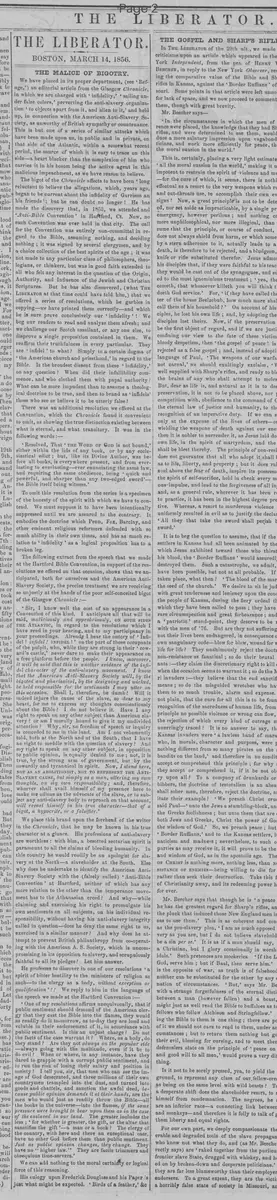
THE MALICE OF BIGOTRY.
We have placed in its proper department, (see 'Refuge,') an editorial article from the Glasgow Chronicle, in which we are charged with 'infidelity,' 'sailing under false colors,' perverting the anti-slavery organization 'to objects apart from it, and alien to it,' and held up, in connection with the American Anti-Slavery Society, as unworthy of British sympathy or countenance.
This is but one of a series of similar attacks which have been made upon us, in public and in private, on that side of the Atlantic, within a somewhat recent period, the source of which it is easy to trace on this side—a heart blacker than the complexion of him who carries it in his bosom being the active agent in this malicious impeachment, as we have reason to believe.
The bigot of the Chronicle affects to have been long reluctant to believe the allegations, which, years ago, began to be current about the infidelity of Garrison and his friends'; but he can doubt no longer! He has made the discovery that, in 1853, we attended and 'Anti-Bible Convention' in Hartford, Ct. Now, no such Convention was ever held in that city. The call for the Convention was entirely non-committal in regard to the Bible, assuming nothing, and deciding nothing; it was signed by several clergymen, and by a choice collection of the best spirits of the age; it was not made to any particular class of philosophers, theologians, or thinkers, but was in good faith extended to all who felt any interest in the question of the Origin, Authority, and Influence of the Jewish and Christian Scriptures. But he has also discovered, (what The Liberator at that time could have told him,) that we offered a series of resolutions, which he garbles in copying—we have printed them correctly—and which he is sure prove conclusively our 'infidelity'! We beg our readers to read and analyze them afresh; and we challenge our Scotch assailant, or any one else, to disprove a single proposition contained in them. We reaffirm their truthfulness in every particular. They are 'infidel' to what? Simply to a certain dogma of 'the American church and priesthood,' in regard to the Bible. Is the broadest dissent from these 'infidelity,' on any question? When did their infallibility commence, and who clothed them with papal authority?
What can be more impudent than to assume a theological doctrine to be true, and then to brand as 'infidels' those who see or believe it to be utterly false?
There was an additional resolution we offered at the Convention, which the Chronicle found it convenient to omit, as showing the true distinction existing between what is eternal, and what transitory. It was in the following words:-
Resolved, That The Word of God is not bound, either within the lids of any book, or by any ecclesiastical edict; but, like its Divine Author, was before all books, is everywhere present, and from everlasting to everlasting—ever enunciating the same law, and requiring the same obedience, being 'quick and powerful, and sharper than any two-edged sword'—the Bible itself being witness.
To omit this resolution from the series is a specimen of the honesty of the spirit with which we have to contend. We must suppose it to have been intentionally suppressed until we are assured to the contrary. It embodies the doctrine which Penn, Fox, Barclay, and other eminent religious reformers defended with so much ability in their own times, and has as much relation to 'infidelity' as a logical proposition has to a broken leg.
The following extract from the speech that we made at the Hartford Bible Convention, in support of the resolutions we offered on that occasion, shows that we anticipated, both for ourselves and the American Anti-Slavery Society, the precise treatment we are receiving so unjustly at the hands of the poor self-conceited bigot of the Glasgow Chronicle:-
Sir, I know well the cost of an appearance in a Convention of this kind. I anticipate all that will be said, maliciously and opprobriously, on BOTH SIDES THE ATLANTIC, in regard to the resolutions which I have read in your hearing, and to my participancy in your proceedings. Already I hear the outcry of 'Infidel! infidel! INFIDEL!' on the part of those occupants of the pulpit, who, while they are strong in their 'coward's castle,' never dare to make their appearance on a free platform before the people. I know, moreover, it will be said that this is another evidence of the infidel character of the anti-slavery movement. I know that the American Anti-Slavery Society will, by the bigoted and pharisaical, by the designing and wicked, be held responsible for the sentiments I may utter on this occasion. Shall I, therefore, be dumb? Will it indeed injure the cause of the slave, so dear to my heart, for me to express my thoughts conscientiously about the Bible? I do not believe it. Have I any right to speak on any other subject than American slavery? or am I morally bound to give it my undivided attention? Why, sir, no freedom of speech or inquiry is conceded to me in this land. Am I not vehemently told, both at the North and at the South, that I have no right to meddle with the question of slavery? And my right to speak on any other subject, in opposition to public opinion, is equally denied to me; not, it is true, by the strong arm of government, but by the cowardly and tyrannical in spirit. Now, I stand here, NOT AS AN ABOLITIONIST, NOT TO REPRESENT THE ANTI-SLAVERY CAUSE, but simply as a man, uttering my own thoughts, on my own responsibility; and, therefore, whoever shall avail himself of my presence here to make me odious as the advocate of the slave, or to subject any anti-slavery body to reproach on that account, will reveal himself in his true character—that of a bigot, a hypocrite, or a falsifier.
We place this brand upon the forehead of the writer in the Chronicle, that he may be known in his true character at a glance. His professions of anti-slavery are worthless: with him, a besotted sectarian spirit is paramount to all the claims of bleeding humanity. In this country he would readily be an apologist for slavery at the North—a slaveholder at the South. Else why does he undertake to identify the American Anti-Slavery Society with the (falsely called) 'Anti-Bible Convention' at Hartford, neither of which has any more relation to the other than the temperance movement has to the Athanasian creed? And why—while claiming and exercising his right to promulgate his own sentiments on all subjects, on his individual responsibility, without having his anti-slavery integrity called in question—does he deny the same right to us, exercised in a similar manner? And why does he attempt to prevent British philanthropy from co-operating with the American A. S. Society, which is uncompromising in its opposition to slavery, and scrupulously faithful to all its pledges? Let him answer.
He professes to discover in one of our resolutions 'a spirit of bitter hostility to the ministers of religion as such—to the clergy as a body, without exception or qualification'!! We reply to him in the language of the speech we made at the Hartford Convention:
One of my resolutions affirms unequivocally, that if public sentiment should demand of the American clergy that they cast the Bible into the flames, they would as readily do it to-morrow, as to-day they are loud and voluble in their endorsement of it, in accordance with public sentiment. Is this an unjust charge? Do not the facts of the case warrant it? Where, as a body, do they stand? Are they not always on the popular side—always going with the multitude, even if it be to do evil? When or where, in any instance, have they dared to grapple with a corrupt public sentiment, and to run the risk of losing their salary and position in society? I tell you, sir, that men who can see the image of God desecrated, and three millions of their own countrymen trampled into the dust, and turned into goods and chattels, and sanction the awful deed, because public opinion demands it at their hands, are the men who would just as readily throw the Bible—all the books in the universe—into the flames, if the same pressure were brought to bear upon them as in the case of the enslaved in our land. The greater includes the less; for whether is greater, the gift, or the altar that sanctifies the gift'—a man or a book? The clergy of the country, with here and there an exceptional case, have no other God before them than public sentiment. Just as public opinion changes, they change. They have no "higher law."
They are facile trimmers and obsequious time-servers.'
We can add nothing to the moral certainty or logical force of this reasoning.
His eulogy upon Frederick Douglass and his Paper is just what might be expected. Birds of a feather,' &c.
BOSTON, MARCH 14, 1856.
THE MALICE OF BIGOTRY.
We have placed in its proper department, (see 'Refuge,') an editorial article from the Glasgow Chronicle, in which we are charged with 'infidelity,' 'sailing under false colors,' perverting the anti-slavery organization 'to objects apart from it, and alien to it,' and held up, in connection with the American Anti-Slavery Society, as unworthy of British sympathy or countenance.
This is but one of a series of similar attacks which have been made upon us, in public and in private, on that side of the Atlantic, within a somewhat recent period, the source of which it is easy to trace on this side—a heart blacker than the complexion of him who carries it in his bosom being the active agent in this malicious impeachment, as we have reason to believe.
The bigot of the Chronicle affects to have been long reluctant to believe the allegations, which, years ago, began to be current about the infidelity of Garrison and his friends'; but he can doubt no longer! He has made the discovery that, in 1853, we attended and 'Anti-Bible Convention' in Hartford, Ct. Now, no such Convention was ever held in that city. The call for the Convention was entirely non-committal in regard to the Bible, assuming nothing, and deciding nothing; it was signed by several clergymen, and by a choice collection of the best spirits of the age; it was not made to any particular class of philosophers, theologians, or thinkers, but was in good faith extended to all who felt any interest in the question of the Origin, Authority, and Influence of the Jewish and Christian Scriptures. But he has also discovered, (what The Liberator at that time could have told him,) that we offered a series of resolutions, which he garbles in copying—we have printed them correctly—and which he is sure prove conclusively our 'infidelity'! We beg our readers to read and analyze them afresh; and we challenge our Scotch assailant, or any one else, to disprove a single proposition contained in them. We reaffirm their truthfulness in every particular. They are 'infidel' to what? Simply to a certain dogma of 'the American church and priesthood,' in regard to the Bible. Is the broadest dissent from these 'infidelity,' on any question? When did their infallibility commence, and who clothed them with papal authority?
What can be more impudent than to assume a theological doctrine to be true, and then to brand as 'infidels' those who see or believe it to be utterly false?
There was an additional resolution we offered at the Convention, which the Chronicle found it convenient to omit, as showing the true distinction existing between what is eternal, and what transitory. It was in the following words:-
Resolved, That The Word of God is not bound, either within the lids of any book, or by any ecclesiastical edict; but, like its Divine Author, was before all books, is everywhere present, and from everlasting to everlasting—ever enunciating the same law, and requiring the same obedience, being 'quick and powerful, and sharper than any two-edged sword'—the Bible itself being witness.
To omit this resolution from the series is a specimen of the honesty of the spirit with which we have to contend. We must suppose it to have been intentionally suppressed until we are assured to the contrary. It embodies the doctrine which Penn, Fox, Barclay, and other eminent religious reformers defended with so much ability in their own times, and has as much relation to 'infidelity' as a logical proposition has to a broken leg.
The following extract from the speech that we made at the Hartford Bible Convention, in support of the resolutions we offered on that occasion, shows that we anticipated, both for ourselves and the American Anti-Slavery Society, the precise treatment we are receiving so unjustly at the hands of the poor self-conceited bigot of the Glasgow Chronicle:-
Sir, I know well the cost of an appearance in a Convention of this kind. I anticipate all that will be said, maliciously and opprobriously, on BOTH SIDES THE ATLANTIC, in regard to the resolutions which I have read in your hearing, and to my participancy in your proceedings. Already I hear the outcry of 'Infidel! infidel! INFIDEL!' on the part of those occupants of the pulpit, who, while they are strong in their 'coward's castle,' never dare to make their appearance on a free platform before the people. I know, moreover, it will be said that this is another evidence of the infidel character of the anti-slavery movement. I know that the American Anti-Slavery Society will, by the bigoted and pharisaical, by the designing and wicked, be held responsible for the sentiments I may utter on this occasion. Shall I, therefore, be dumb? Will it indeed injure the cause of the slave, so dear to my heart, for me to express my thoughts conscientiously about the Bible? I do not believe it. Have I any right to speak on any other subject than American slavery? or am I morally bound to give it my undivided attention? Why, sir, no freedom of speech or inquiry is conceded to me in this land. Am I not vehemently told, both at the North and at the South, that I have no right to meddle with the question of slavery? And my right to speak on any other subject, in opposition to public opinion, is equally denied to me; not, it is true, by the strong arm of government, but by the cowardly and tyrannical in spirit. Now, I stand here, NOT AS AN ABOLITIONIST, NOT TO REPRESENT THE ANTI-SLAVERY CAUSE, but simply as a man, uttering my own thoughts, on my own responsibility; and, therefore, whoever shall avail himself of my presence here to make me odious as the advocate of the slave, or to subject any anti-slavery body to reproach on that account, will reveal himself in his true character—that of a bigot, a hypocrite, or a falsifier.
We place this brand upon the forehead of the writer in the Chronicle, that he may be known in his true character at a glance. His professions of anti-slavery are worthless: with him, a besotted sectarian spirit is paramount to all the claims of bleeding humanity. In this country he would readily be an apologist for slavery at the North—a slaveholder at the South. Else why does he undertake to identify the American Anti-Slavery Society with the (falsely called) 'Anti-Bible Convention' at Hartford, neither of which has any more relation to the other than the temperance movement has to the Athanasian creed? And why—while claiming and exercising his right to promulgate his own sentiments on all subjects, on his individual responsibility, without having his anti-slavery integrity called in question—does he deny the same right to us, exercised in a similar manner? And why does he attempt to prevent British philanthropy from co-operating with the American A. S. Society, which is uncompromising in its opposition to slavery, and scrupulously faithful to all its pledges? Let him answer.
He professes to discover in one of our resolutions 'a spirit of bitter hostility to the ministers of religion as such—to the clergy as a body, without exception or qualification'!! We reply to him in the language of the speech we made at the Hartford Convention:
One of my resolutions affirms unequivocally, that if public sentiment should demand of the American clergy that they cast the Bible into the flames, they would as readily do it to-morrow, as to-day they are loud and voluble in their endorsement of it, in accordance with public sentiment. Is this an unjust charge? Do not the facts of the case warrant it? Where, as a body, do they stand? Are they not always on the popular side—always going with the multitude, even if it be to do evil? When or where, in any instance, have they dared to grapple with a corrupt public sentiment, and to run the risk of losing their salary and position in society? I tell you, sir, that men who can see the image of God desecrated, and three millions of their own countrymen trampled into the dust, and turned into goods and chattels, and sanction the awful deed, because public opinion demands it at their hands, are the men who would just as readily throw the Bible—all the books in the universe—into the flames, if the same pressure were brought to bear upon them as in the case of the enslaved in our land. The greater includes the less; for whether is greater, the gift, or the altar that sanctifies the gift'—a man or a book? The clergy of the country, with here and there an exceptional case, have no other God before them than public sentiment. Just as public opinion changes, they change. They have no "higher law."
They are facile trimmers and obsequious time-servers.'
We can add nothing to the moral certainty or logical force of this reasoning.
His eulogy upon Frederick Douglass and his Paper is just what might be expected. Birds of a feather,' &c.
What sub-type of article is it?
Slavery Abolition
Moral Or Religious
Social Reform
What keywords are associated?
Religious Bigotry
Infidelity Charges
Bible Convention
Anti Slavery Defense
Clergy Criticism
Hartford Convention
American Church
What entities or persons were involved?
Glasgow Chronicle
American Anti Slavery Society
William Lloyd Garrison
Frederick Douglass
Editorial Details
Primary Topic
Defense Against Charges Of Infidelity Linking Anti Slavery To Bible Criticism
Stance / Tone
Defensive Critique Of Religious Bigotry
Key Figures
Glasgow Chronicle
American Anti Slavery Society
William Lloyd Garrison
Frederick Douglass
Key Arguments
No Anti Bible Convention Held In Hartford In 1853
Resolutions Challenge Church Dogma On Bible Without Denying God's Word
Omission Of Key Resolution Shows Dishonesty
Anticipated Backlash From Participation In Bible Convention
Clergy Prioritize Public Sentiment Over Moral Principles
Bigotry Undermines Anti Slavery Cooperation