Thank you for visiting SNEWPapers!
Sign up free
The Daily Advertiser
New York, New York County, New York
What is this article about?
This continued article from the Virginia Independent Chronicle, dated March 28, 1788, defends the proposed U.S. Constitution against Richard Henry Lee's objections. It argues a Bill of Rights is unnecessary and risky, affirms security of jury trials and press freedom, justifies the need for inferior courts established by Congress, and counters fears of Northern states imposing oppressive commercial laws on Southern states.
Merged-components note: Merging the two sequential parts of the continued letter to the editor, as indicated by '[Continued from Thursday's Paper.]' and '[To be continued.]'.
Clipping
OCR Quality
Full Text
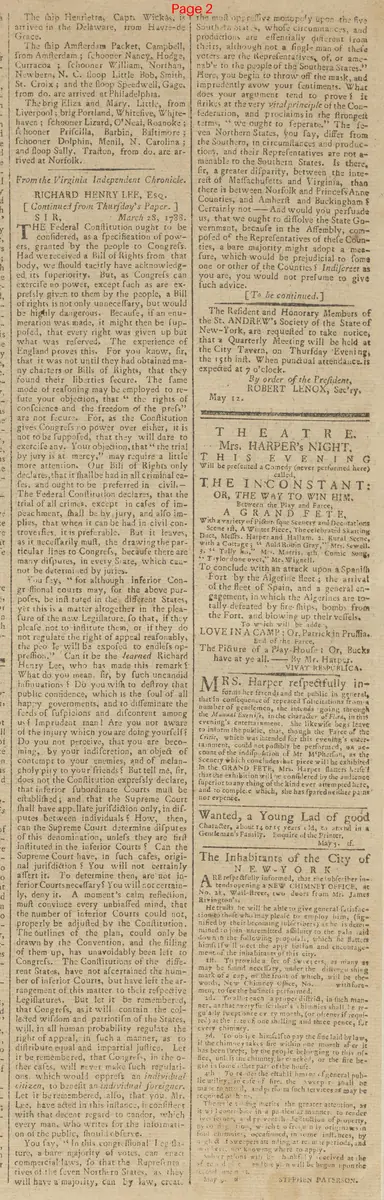
RICHARD HENRY LEE, Esq.
[Continued from Thursday's Paper.]
SIR,
March 28, 1788.
THE Federal Constitution ought to be considered, as a specification of powers, granted by the people to Congress. Had we received a Bill of Rights from that body, we should tacitly have acknowledged its superiority. But, as Congress can exercise no power, except such as are expressly given to them by the people, a Bill of Rights is not only unnecessary, but would be highly dangerous. Because, if an enumeration was made, it might then be supposed, that every right was given up but what was reserved. The experience of England proves this. For you know, sir, that it was not until they had obtained many charters or Bills of Rights, that they found their liberties secure. The same mode of reasoning may be employed to refute your objection, that "the rights of conscience and the freedom of the press" are not secure. For, as the Constitution gives Congress no power over either, it is not to be supposed, that they will dare to exercise any. Your objection, that "the trial by jury is at mercy," may require a little more attention. (Our Bill of Rights only declares, that it shall be had in all criminal cases, and ought to be preferred in civil.-
The Federal Constitution declares, that the trial of all crimes, except in cases of impeachment, shall be by jury, and also implies, that when it can be had in civil controversies, it is preferable. But it leaves, as it necessarily must, the drawing the particular lines to Congress, because there are many disputes, in every State, which cannot be determined by juries.
You say, "for although inferior Congressional courts may, for the above purposes, be instituted in the different States, yet this is a matter altogether in the pleasure of the new Legislature, so that, if they please not to institute them, or if they do not regulate the right of appeal reasonably, the people will be exposed to endless oppression." Can it be the learned Richard Henry Lee, who has made this remark! What do you mean, sir, by such uncandid insinuations? Do you wish to destroy that public confidence, which is the soul of all happy governments, and to disseminate the seeds of suspicions and discontent among us? Imprudent man! Are you not aware of the injury which you are doing yourself? Do you not perceive, that you are becoming, by your indiscretion, an object of contempt to your enemies, and of melancholy pity to your friends? But tell me, sir, does not the Constitution expressly declare, that inferior subordinate Courts must be established; and that the Supreme Court shall have appellate jurisdiction only, in disputes between individuals: How, then, can the Supreme Court determine disputes of this denomination, unless they are first instituted in the inferior Courts? Can the Supreme Court have, in such cases, original jurisdiction? You will not certainly assert it. To determine then, are not inferior Courts necessary? You will not certainly, deny it. A moment's calm reflection, must convince every unbiased mind, that the number of inferior Courts could not, properly be adjusted by the Constitution. The outlines of the plan, could only be drawn by the Convention, and the filling of them up, has unavoidably been left to Congress. The Constitutions of the different States, have not ascertained the number of inferior Courts, but have left the arrangement of this matter to their respective Legislatures. But let it be remembered, that Congress, as it will contain the collected wisdom and patriotism of the States, will, in all human probability regulate the right of appeal, in such a manner, as to distribute equal and impartial justice. Let it be remembered, that Congress, in the other cases, will never make such regulations, which would oppress an individual citizen, to benefit an individual foreigner. Let it be remembered, also, that you, Mr. Lee, have acted in this instance, as consistent with that decent regard to candor, which every man, who writes for the information of the public, should observe.
You say, "In this congressional Legislature, a bare majority of votes, can enact commercial laws, so that the Representatives of the seven Northern States, as they will have a majority, can by law, create--
the most oppressive monopoly upon the five Southern States, whose circumstances, and productions are essentially different from theirs, although not a single man of these voters are the Representatives, of, or amenable to the people of the Southern States."
Here, you begin to throw off the mask, and imprudently avow your sentiments. What does your argument tend to prove? it strikes at the very vital principle of the Confederation, and proclaims in the strongest terms, "we ought to separate." The seven Northern States, you say, differ from the Southern, in circumstances and productions, and their Representatives are not amenable to the Southern States. Is there, sir, a greater disparity, between the interest of Massachusetts and Virginia, than there is between Norfolk and Princess Anne Counties, and Amherst and Buckingham? Certainly not-- And would you persuade us, that we ought to dissolve the State Government, because in the Assembly, composed of the Representatives of these Counties, a bare majority might adopt a measure, which would be prejudicial to some one or other of the Counties! Indiscreet as you are, you would not presume to give such advice.
[To be continued.]
What sub-type of article is it?
What themes does it cover?
What keywords are associated?
What entities or persons were involved?
Letter to Editor Details
Recipient
Richard Henry Lee, Esq.
Main Argument
the federal constitution specifies limited powers to congress, making a bill of rights unnecessary and dangerous; it secures jury trials and other rights without explicit enumeration, requires inferior courts for judicial efficiency, and majority rule in commerce does not justify separation as similar dynamics exist within states.
Notable Details