Thank you for visiting SNEWPapers!
Sign up free
Twin City Herald
Minneapolis, Robbinsdale, Hennepin County, Minnesota
What is this article about?
This editorial critiques the notion of 'recovery' a decade into the Great Depression, arguing that the wealthy ('Mr. Organized Greed') have suffered no real losses while the poor continue to struggle. It praises philanthropists in the Twin Cities and condemns greed using biblical references, teasing future sections on other social classes.
Merged-components note: Continuation of the editorial 'WHAT RECOVERY?' from page 1 to page 3.
Clippings
1 of 2
OCR Quality
Full Text
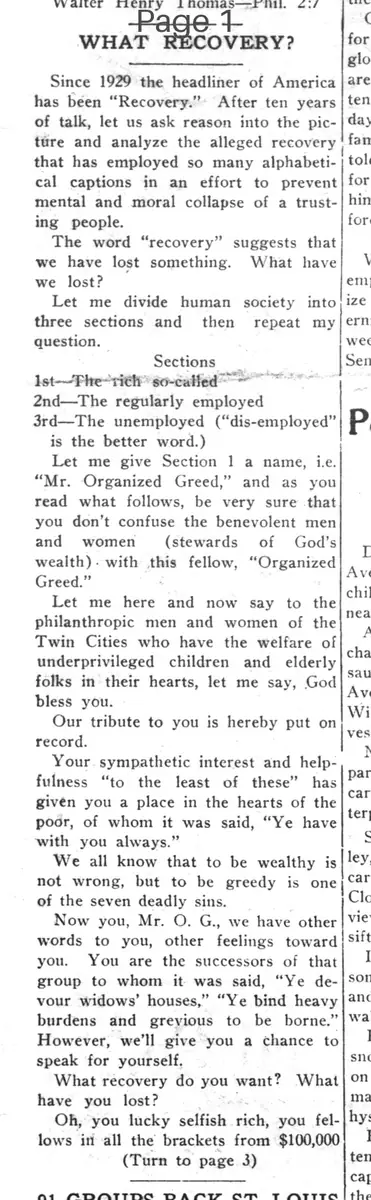
Since 1929 the headliner of America has been "Recovery." After ten years of talk, let us ask reason into the picture and analyze the alleged recovery that has employed so many alphabetical captions in an effort to prevent mental and moral collapse of a trusting people.
The word "recovery" suggests that we have lost something. What have we lost?
Let me divide human society into three sections and then repeat my question.
Sections
1st---The rich so-called
2nd The regularly employed
3rd The unemployed ("dis-employed" is the better word.)
Let me give Section 1 a name, i.e. "Mr. Organized Greed," and as you read what follows, be very sure that you don't confuse the benevolent men and women (stewards of God's wealth) with this fellow, "Organized Greed."
Let me here and now say to the philanthropic men and women of the Twin Cities who have the welfare of underprivileged children and elderly folks in their hearts, let me say, God bless you.
Our tribute to you is hereby put on record.
Your sympathetic interest and helpfulness "to the least of these" has given you a place in the hearts of the poor, of whom it was said, "Ye have with you always."
We all know that to be wealthy is not wrong, but to be greedy is one of the seven deadly sins.
Now you, Mr. O. G., we have other words to you, other feelings toward you. You are the successors of that group to whom it was said, "Ye devour widows' houses," "Ye bind heavy burdens and grievous to be borne."
However, we'll give you a chance to speak for yourself.
What recovery do you want? What have you lost?
Oh, you lucky selfish rich, you fellows in all the brackets from $100,000
(Turn to page 3)
WHAT RECOVERY?
(Continued from page 1)
on to the millions, you moneyed group,
what have you lost? Answer us.
Has the temperature in your home
been below 70 degrees these past win-
ter months? Have you had to put up
your car this winter to save gas? How
many 25 cent cigars have you had to
cut out? How many big feeds have
you lost at the club? How deep have
you cut your budget?
Answer, you comfortable rich.
Oh, yes, you perhaps did let one of
your maids go so you wouldn't have to
cut out your Old Madeira, but you
ought to be horse whipped for that.
Winter is the very time your maid
needed her little pay envelope and it
was unchristian in you to let her out.
Perhaps we ought to remind you,
Mr. O. G., that your $1,000 pew in that
fashionable church implies that you
swear allegiance to Him who said, "In-
asasmuch as we did it not to the least of
these, ye did it not to me," and brought
down to date, one of "the least" was
your defenseless servant girl.
So we ask, what recovery are you
making so much fuss about, all this
alphabetical noise? We've got a lot
more questions we'd like to ask you to
answer: but my column is too short
at this end, and frankly, we think the
above questions will hold you.
Next week-What Recovery does
Section 2 want?
What sub-type of article is it?
What keywords are associated?
What entities or persons were involved?
Editorial Details
Primary Topic
Critique Of Recovery For The Wealthy During The Great Depression
Stance / Tone
Strongly Critical Of Greed Among The Rich, Supportive Of Philanthropy
Key Figures
Key Arguments