Thank you for visiting SNEWPapers!
Sign up free
Atlanta Daily World
Atlanta, Fulton County, Georgia
What is this article about?
Dr. Jesse Leach, NMA president, defies resignation demands over 1928 liquor conviction, invoking association constitution to affirm his election amid upcoming New York convention controversy.
Merged-components note: Continuation of story about Dr. Jesse Leondas Leach from page 1 to page 6.
Clippings
1 of 2
OCR Quality
Full Text
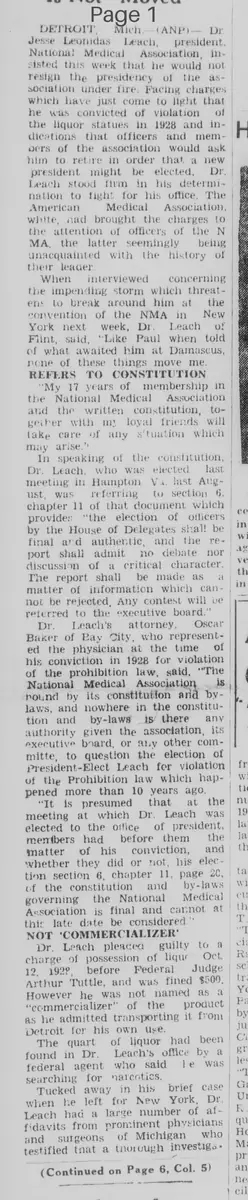
The American Medical Association, white, had brought the charges to the attention of officers of the NMA, the latter seemingly being unacquainted with the history of their leader.
When interviewed concerning the impending storm which threatens to break around him at the convention of the NMA in New York next week, Dr. Leach of Flint, said, "Like Paul when told of what awaited him at Damascus, none of these things move me."
REFERS TO CONSTITUTION
"My 17 years of membership in the National Medical Association and the written constitution, together with my loyal friends will take care of any situation which may arise."
In speaking of the constitution, Dr. Leach, who was elected last meeting in Hampton, Va., last August, was referring to section 6, chapter 11 of that document which provides "the election of officers by the House of Delegates shall be final and authentic, and the report shall admit no debate nor discussion of a critical character. The report shall be made as a matter of information which cannot be rejected. Any contest will be referred to the executive board."
Dr. Leach's attorney, Oscar Baker of Bay City, who represented the physician at the time of his conviction in 1928 for violation of the prohibition law, said, "The National Medical Association is bound by its constitution and by-laws, and nowhere in the constitution and by-laws is there any authority given the association, its executive board, or any other committee, to question the election of President-Elect Leach for violation of the Prohibition law which happened more than 10 years ago."
"It is presumed that at the meeting at which Dr. Leach was elected to the office of president, members had before them the matter of his conviction, and whether they did or not, his election section 6, chapter 11, page 20, of the constitution and by-laws governing the National Medical Association is final and cannot at this late date be considered."
NOT 'COMMERCIALIZER'
Dr. Leach pleaded guilty to a charge of possession of liquor Oct. 12, 1928, before Federal Judge Arthur Tuttle, and was fined $500. However he was not named as a "commercializer" of the product as he admitted transporting it from Detroit for his own use.
The quart of liquor had been found in Dr. Leach's office by a federal agent who said he was searching for narcotics.
Tucked away in his brief case when he left for New York, Dr. Leach had a large number of affidavits from prominent physicians and surgeons of Michigan who testified that a thorough investigation...
(Continued on Page 6, Col. 5)
Dr. Leach (Continued from Page 1)
investigation of the charge against Leach was made at the time, but decided there was no cause for action.
There is also an affidavit from Senator Arthur H. Vandenberg.
Most of the Detroit members of the National Medical Association who will attend the convention, would not express themselves on the question. However, most of them were frank in stating that practically every member of the association was aware of the charges last summer when Leach was elected to the office.
What sub-type of article is it?
What themes does it cover?
What keywords are associated?
What entities or persons were involved?
Where did it happen?
Story Details
Key Persons
Location
Detroit, Mich.; Flint; New York; Hampton, Va.; Bay City
Event Date
1928 (Conviction); Last August (Election); This Week (Current Events); Next Week (Convention)
Story Details
Dr. Jesse Leondas Leach, president of the National Medical Association, faces calls to resign due to a 1928 conviction for possessing liquor, revealed by the American Medical Association. He refuses, citing the NMA constitution that makes his election final, supported by his attorney and affidavits from prominent physicians.