Thank you for visiting SNEWPapers!
Sign up free
Literary
July 1, 1831
Morning Star
Limerick, York County, Maine
What is this article about?
Excerpt from Gleig's History of the Bible explaining the biblical plagues on Egypt as judgments against idolatry, tailored to Egyptian gods, and defending the Israelites' borrowing of jewels as compensation for bondage.
Clipping
OCR Quality
98%
Excellent
Full Text
From Gleig's History of the Bible.
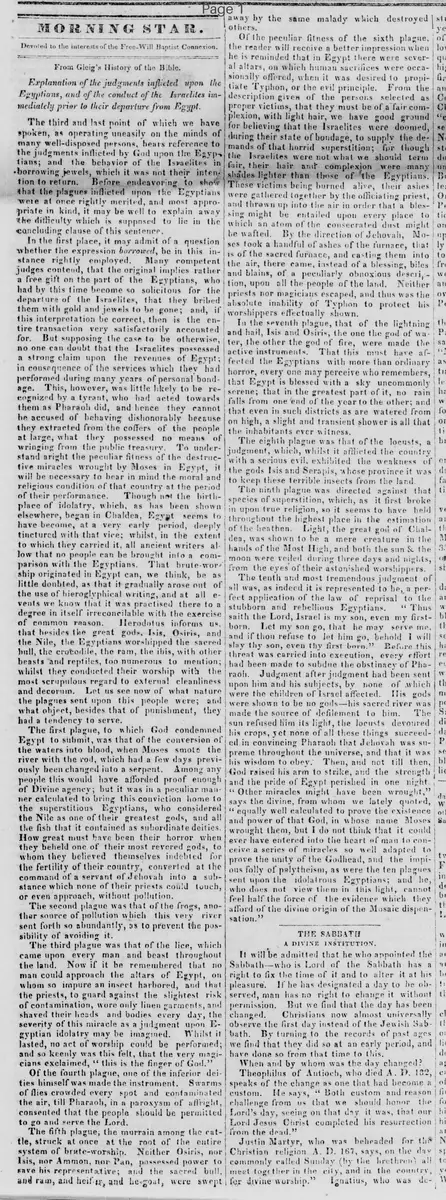
Explanation of the judgments inflicted upon the Egyptians, and of the conduct of the Israelites immediately prior to their departure from Egypt.
The third and last point of which we have spoken, as operating uneasily on the minds of many well-disposed persons, bears reference to the judgments inflicted by God upon the Egyptians; and the behavior of the Israelites in borrowing jewels, which it was not their intention to return. Before endeavoring to show that the plagues inflicted upon the Egyptians were at once rightly merited, and most appropriate in kind, it may be well to explain away the difficulty which is supposed to lie in the concluding clause of this sentence.
In the first place, it may admit of a question whether the expression borrowed, be in this instance rightly employed. Many competent judges contend, that the original implies rather a free gift on the part of the Egyptians, who had by this time become so solicitous for the departure of the Israelites, that they bribed them with gold and jewels to be gone; and, if this interpretation be correct, then is the entire transaction very satisfactorily accounted for. But supposing the case to be otherwise, no one can doubt that the Israelites possessed a strong claim upon the revenues of Egypt; in consequence of the services which they had performed during many years of personal bondage. This, however, was little likely to be recognized by a tyrant, who had acted towards them as Pharaoh did, and hence they cannot be accused of behaving dishonorably because they extracted from the coffers of the people at large, what they possessed no means of wringing from the public treasury. To understand aright the peculiar fitness of the destructive miracles wrought by Moses in Egypt, it will be necessary to bear in mind the moral and religious condition of that country at the period of their performance. Though not the birthplace of idolatry, which, as has been shown elsewhere, began in Chaldea, Egypt seems to have become, at a very early period, deeply tinctured with that vice: whilst, in the extent to which they carried it, all ancient writers allow that no people can be brought into a comparison with the Egyptians. That brute-worship originated in Egypt can, we think, be as little doubted, as that it gradually arose out of the use of hieroglyphical writing, and at all events we know that it was practised there to a degree in itself irreconcilable with the exercise of common reason. Herodotus informs us, that besides the great gods, Isis, Osiris, and the Nile, the Egyptians worshipped the sacred bull, the crocodile, the ram, the ibis, with other beasts and reptiles, too numerous to mention; whilst they conducted their worship with the most scrupulous regard to external cleanliness and decorum. Let us see now of what nature the plagues sent upon this people were; and what object, besides that of punishment, they had a tendency to serve.
The first plague, to which God condemned Egypt to submit, was that of the conversion of the waters into blood, when Moses smote the river with the rod, which had a few days previously been changed into a serpent. Among any people this would have afforded proof enough of Divine agency; but it was in a peculiar manner calculated to bring this conviction home to the superstitious Egyptians, who considered the Nile as one of their greatest gods, and all the fish that it contained as subordinate deities. How great must have been their horror when they beheld one of their most revered gods, to whom they believed themselves indebted for the fertility of their country, converted at the command of a servant of Jehovah into a substance which none of their priests could touch, or even approach, without pollution.
The second plague was that of the frogs, another source of pollution which this very river sent forth so abundantly, as to prevent the possibility of avoiding it.
The third plague was that of the lice, which came upon every man and beast throughout the land. Now if it be remembered that no man could approach the altars of Egypt, on whom so impure an insect harbored, and that the priests, to guard against the slightest risk of contamination, wore only linen garments, and shaved their heads and bodies every day, the severity of this miracle as a judgment upon Egyptian idolatry may be imagined. Whilst it lasted, no act of worship could be performed: and so keenly was this felt, that the very magicians exclaimed, "this is the finger of God."
Of the fourth plague, one of the inferior deities himself was made the instrument. Swarms of flies crowded every spot and contaminated the air, till Pharaoh, in a paroxysm of affright consented that the people should be permitted to go and serve the Lord.
The fifth plague; the murrain among the cattle. struck at once at the root of the entire system of brute-worship. Neither Osiris, nor Isis, nor Ammon, nor Pan, possessed power to save his representative; and the sacred bull, and ram, and heifer, and he-goat, were swept away by the same malady which destroyed others.
Of the peculiar fitness of the sixth plague, the reader will receive a better impression when he is reminded that in Egypt there were several altars, on which human sacrifices were occasionally offered, when it was desired to propitiate Typhon, or the evil principle. From the description given of the persons selected as proper victims, that they must be of a fair complexion, with light hair, we have good ground for believing that the Israelites were doomed, during their state of bondage, to supply the demands of that horrid superstition; or though the Israelites were not what we should term fair, their hair and complexion were many shades lighter than those of the Egyptians. These victims being burned alive, their ashes were gathered together by the officiating priest, and thrown up into the air in order that a blessing might be entailed upon every place to which an atom of the consecrated dust might be wafted. By the direction of Jehovah, Moses took a handful of ashes of the furnace, that is of the sacred furnace, and casting them into the air, there came, instead of a blessing, boils and blains, of a peculiarly obnoxious description, upon all the people of the land. Neither priests nor magicians escaped, and thus was the absolute inability of Typhon to protect his worshippers effectually shown.
In the seventh plague, that of the lightning and hail, Isis and Osiris, the one the god of water, the other the god of fire, were made the active instruments. That this must have affected the Egyptians with more than ordinary horror, every one may perceive who remembers, that Egypt is blessed with a sky uncommonly serene; that in the greatest part of it, no rain falls from one end of the year to the other; and that even in such districts as are watered from on high, a slight and transient shower is all that the inhabitants ever witness.
The eighth plague was that of the locusts, a judgment, which, whilst it afflicted the country with a serious evil, exhibited the weakness of the gods Isis and Serapis, whose province it was to keep these terrible insects from the land.
The ninth plague was directed against that species of superstition, which, as it first broke in upon true religion, so it seems to have held throughout the highest place in the estimation of the heathen. Light, the great god of Chaldea, was shown to be a mere creature in the hands of the Most High, and both the sun & the moon were veiled during three days and nights, from the eyes of their astonished worshippers.
The tenth and most tremendous judgment of all was, as indeed it is represented to be, a perfect application of the law of reprisal to the stubborn and rebellious Egyptians. "Thus saith the Lord, Israel is my son, even my first-born. Let my son go, that he may serve me, and if thou refuse to let him go, behold I will slay thy son, even thy first-born." Before this threat was carried into execution, every effort had been made to subdue the obstinacy of Pharaoh. Judgment after judgment had been sent upon him and his subjects, by none of which were the children of Israel affected. His gods were shown to be no gods-his sacred river was made the source of defilement to him. The sun refused him its light, the locusts devoured his crops, yet none of all these things succeeded in convincing Pharaoh that Jehovah was supreme throughout the universe, and that it was his wisdom to obey. Then, and not till then, God raised his arm to strike, and the strength and the pride of Egypt perished in one night.
"Other miracles might have been wrought," says the divine, from whom we lately quoted. "equally well calculated to prove the existence and power of that God, in whose name Moses wrought them, but I do not think that it could ever have entered into the heart of man to conceive a series of miracles so well adapted to prove the unity of the Godhead, and the impious folly of polytheism, as were the ten plagues sent upon the idolatrous Egyptians; and he, who does not view them in this light, cannot feel half the force of the evidence which they afford of the divine origin of the Mosaic dispensation."
Explanation of the judgments inflicted upon the Egyptians, and of the conduct of the Israelites immediately prior to their departure from Egypt.
The third and last point of which we have spoken, as operating uneasily on the minds of many well-disposed persons, bears reference to the judgments inflicted by God upon the Egyptians; and the behavior of the Israelites in borrowing jewels, which it was not their intention to return. Before endeavoring to show that the plagues inflicted upon the Egyptians were at once rightly merited, and most appropriate in kind, it may be well to explain away the difficulty which is supposed to lie in the concluding clause of this sentence.
In the first place, it may admit of a question whether the expression borrowed, be in this instance rightly employed. Many competent judges contend, that the original implies rather a free gift on the part of the Egyptians, who had by this time become so solicitous for the departure of the Israelites, that they bribed them with gold and jewels to be gone; and, if this interpretation be correct, then is the entire transaction very satisfactorily accounted for. But supposing the case to be otherwise, no one can doubt that the Israelites possessed a strong claim upon the revenues of Egypt; in consequence of the services which they had performed during many years of personal bondage. This, however, was little likely to be recognized by a tyrant, who had acted towards them as Pharaoh did, and hence they cannot be accused of behaving dishonorably because they extracted from the coffers of the people at large, what they possessed no means of wringing from the public treasury. To understand aright the peculiar fitness of the destructive miracles wrought by Moses in Egypt, it will be necessary to bear in mind the moral and religious condition of that country at the period of their performance. Though not the birthplace of idolatry, which, as has been shown elsewhere, began in Chaldea, Egypt seems to have become, at a very early period, deeply tinctured with that vice: whilst, in the extent to which they carried it, all ancient writers allow that no people can be brought into a comparison with the Egyptians. That brute-worship originated in Egypt can, we think, be as little doubted, as that it gradually arose out of the use of hieroglyphical writing, and at all events we know that it was practised there to a degree in itself irreconcilable with the exercise of common reason. Herodotus informs us, that besides the great gods, Isis, Osiris, and the Nile, the Egyptians worshipped the sacred bull, the crocodile, the ram, the ibis, with other beasts and reptiles, too numerous to mention; whilst they conducted their worship with the most scrupulous regard to external cleanliness and decorum. Let us see now of what nature the plagues sent upon this people were; and what object, besides that of punishment, they had a tendency to serve.
The first plague, to which God condemned Egypt to submit, was that of the conversion of the waters into blood, when Moses smote the river with the rod, which had a few days previously been changed into a serpent. Among any people this would have afforded proof enough of Divine agency; but it was in a peculiar manner calculated to bring this conviction home to the superstitious Egyptians, who considered the Nile as one of their greatest gods, and all the fish that it contained as subordinate deities. How great must have been their horror when they beheld one of their most revered gods, to whom they believed themselves indebted for the fertility of their country, converted at the command of a servant of Jehovah into a substance which none of their priests could touch, or even approach, without pollution.
The second plague was that of the frogs, another source of pollution which this very river sent forth so abundantly, as to prevent the possibility of avoiding it.
The third plague was that of the lice, which came upon every man and beast throughout the land. Now if it be remembered that no man could approach the altars of Egypt, on whom so impure an insect harbored, and that the priests, to guard against the slightest risk of contamination, wore only linen garments, and shaved their heads and bodies every day, the severity of this miracle as a judgment upon Egyptian idolatry may be imagined. Whilst it lasted, no act of worship could be performed: and so keenly was this felt, that the very magicians exclaimed, "this is the finger of God."
Of the fourth plague, one of the inferior deities himself was made the instrument. Swarms of flies crowded every spot and contaminated the air, till Pharaoh, in a paroxysm of affright consented that the people should be permitted to go and serve the Lord.
The fifth plague; the murrain among the cattle. struck at once at the root of the entire system of brute-worship. Neither Osiris, nor Isis, nor Ammon, nor Pan, possessed power to save his representative; and the sacred bull, and ram, and heifer, and he-goat, were swept away by the same malady which destroyed others.
Of the peculiar fitness of the sixth plague, the reader will receive a better impression when he is reminded that in Egypt there were several altars, on which human sacrifices were occasionally offered, when it was desired to propitiate Typhon, or the evil principle. From the description given of the persons selected as proper victims, that they must be of a fair complexion, with light hair, we have good ground for believing that the Israelites were doomed, during their state of bondage, to supply the demands of that horrid superstition; or though the Israelites were not what we should term fair, their hair and complexion were many shades lighter than those of the Egyptians. These victims being burned alive, their ashes were gathered together by the officiating priest, and thrown up into the air in order that a blessing might be entailed upon every place to which an atom of the consecrated dust might be wafted. By the direction of Jehovah, Moses took a handful of ashes of the furnace, that is of the sacred furnace, and casting them into the air, there came, instead of a blessing, boils and blains, of a peculiarly obnoxious description, upon all the people of the land. Neither priests nor magicians escaped, and thus was the absolute inability of Typhon to protect his worshippers effectually shown.
In the seventh plague, that of the lightning and hail, Isis and Osiris, the one the god of water, the other the god of fire, were made the active instruments. That this must have affected the Egyptians with more than ordinary horror, every one may perceive who remembers, that Egypt is blessed with a sky uncommonly serene; that in the greatest part of it, no rain falls from one end of the year to the other; and that even in such districts as are watered from on high, a slight and transient shower is all that the inhabitants ever witness.
The eighth plague was that of the locusts, a judgment, which, whilst it afflicted the country with a serious evil, exhibited the weakness of the gods Isis and Serapis, whose province it was to keep these terrible insects from the land.
The ninth plague was directed against that species of superstition, which, as it first broke in upon true religion, so it seems to have held throughout the highest place in the estimation of the heathen. Light, the great god of Chaldea, was shown to be a mere creature in the hands of the Most High, and both the sun & the moon were veiled during three days and nights, from the eyes of their astonished worshippers.
The tenth and most tremendous judgment of all was, as indeed it is represented to be, a perfect application of the law of reprisal to the stubborn and rebellious Egyptians. "Thus saith the Lord, Israel is my son, even my first-born. Let my son go, that he may serve me, and if thou refuse to let him go, behold I will slay thy son, even thy first-born." Before this threat was carried into execution, every effort had been made to subdue the obstinacy of Pharaoh. Judgment after judgment had been sent upon him and his subjects, by none of which were the children of Israel affected. His gods were shown to be no gods-his sacred river was made the source of defilement to him. The sun refused him its light, the locusts devoured his crops, yet none of all these things succeeded in convincing Pharaoh that Jehovah was supreme throughout the universe, and that it was his wisdom to obey. Then, and not till then, God raised his arm to strike, and the strength and the pride of Egypt perished in one night.
"Other miracles might have been wrought," says the divine, from whom we lately quoted. "equally well calculated to prove the existence and power of that God, in whose name Moses wrought them, but I do not think that it could ever have entered into the heart of man to conceive a series of miracles so well adapted to prove the unity of the Godhead, and the impious folly of polytheism, as were the ten plagues sent upon the idolatrous Egyptians; and he, who does not view them in this light, cannot feel half the force of the evidence which they afford of the divine origin of the Mosaic dispensation."
What sub-type of article is it?
Essay
What themes does it cover?
Religious
Moral Virtue
What keywords are associated?
Plagues Of Egypt
Israelites Bondage
Egyptian Idolatry
Moses Miracles
Divine Judgments
What entities or persons were involved?
From Gleig's History Of The Bible
Literary Details
Title
Explanation Of The Judgments Inflicted Upon The Egyptians, And Of The Conduct Of The Israelites Immediately Prior To Their Departure From Egypt.
Author
From Gleig's History Of The Bible
Subject
Judgments On Egyptians And Israelites' Borrowing Jewels
Key Lines
"This Is The Finger Of God."
"Thus Saith The Lord, Israel Is My Son, Even My First Born. Let My Son Go, That He May Serve Me, And If Thou Refuse To Let Him Go, Behold I Will Slay Thy Son, Even Thy First Born."
"Other Miracles Might Have Been Wrought," Says The Divine, From Whom We Lately Quoted. "Equally Well Calculated To Prove The Existence And Power Of That God, In Whose Name Moses Wrought Them, But I Do Not Think That It Could Ever Have Entered Into The Heart Of Man To Conceive A Series Of Miracles So Well Adapted To Prove The Unity Of The Godhead, And The Impious Folly Of Polytheism, As Were The Ten Plagues Sent Upon The Idolatrous Egyptians; And He, Who Does Not View Them In This Light, Cannot Feel Half The Force Of The Evidence Which They Afford Of The Divine Origin Of The Mosaic Dispensation."