Thank you for visiting SNEWPapers!
Sign up free
Alexandria Gazette
Alexandria, Alexandria County, District Of Columbia
What is this article about?
The Orange and Alexandria Railroad Company defends its refusal to interchange freight cars with the Virginia Central Railroad at Gordonsville, citing inadequate equipment due to Lynchburg extension work. It counters criticism from the Charlottesville Advocate, highlighting fair rates and benefits to Alexandria's trade over Richmond's.
Clipping
OCR Quality
Full Text
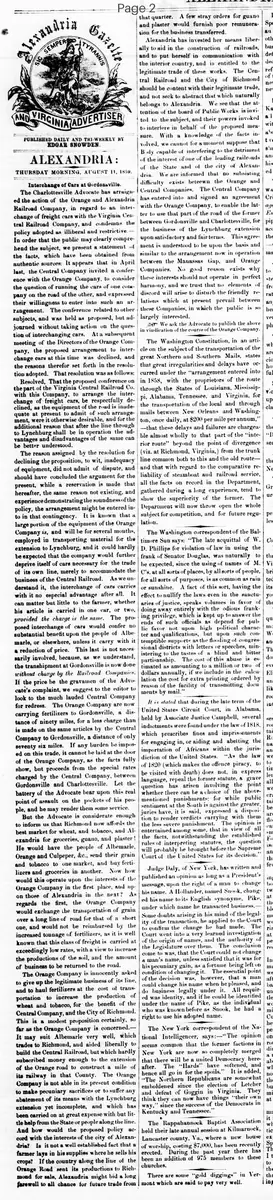
The Charlottesville Advocate has arraigned the action of the Orange and Alexandria Railroad Company, in regard to an interchange of freight cars with the Virginia Central Railroad Company, and condemns the policy adopted as illiberal and restrictive. In order that the public may clearly comprehend the subject, we present a statement of the facts, which have been obtained from authentic sources: It appears that in April last, the Central Company invited a conference with the Orange Company, to consider the question of running the cars of one company on the road of the other, and expressed their willingness to enter into such an arrangement. The conference related to other subjects, and was held as proposed, but adjourned without taking action on the question of interchanging cars. At a subsequent meeting of the Directors of the Orange Company, the proposed arrangement to interchange cars at this time was declined, and the reasons therefor set forth in the resolution adopted. That resolution was as follows:
Resolved, That the proposed conference on the part of the Virginia Central Railroad Co. with this Company, to arrange the interchange of freight cars, be respectfully declined, as the equipment of the road is inadequate at present to admit of such arrangement, were it otherwise desirable, and for the additional reason that after the line through to Lynchburg shall be in operation the advantages and disadvantages of the same can be better understood.
The reason assigned by the resolution for declining the proposition, to wit, inadequacy of equipment, did not admit of dispute, and should have concluded the argument for the present, while a reservation is made that hereafter, the same reason not existing, and experience demonstrating the soundness of the policy, the arrangement might be entered into in that contingency. It is known that a large portion of the equipment of the Orange Company is, and will be for several months, employed in transporting material for the extension to Lynchburg, and it could hardly be expected that the company would further deprive itself of cars necessary for the trade of its own line, merely to accommodate the business of the Central Railroad. As we understand it, the interchange of cars carries with it no especial advantage after all. It can matter but little to the farmer, whether his article is carried in one car, or two, provided the charge is the same. The proposed interchange of cars would confer no substantial benefit upon the people of Albemarle, or elsewhere, unless it carry with it a reduction of price. This last is not necessarily involved, because, as we understand, the transhipment at Gordonsville is now done without charge by the Railroad Companies. If the price be the grievance of the Advocate's complaint, we suggest to the editor to look to the much lauded Central Company for redress. The Orange Company are now carrying fertilizers to Gordonsville, a distance of ninety miles, for a less charge than is made on the same articles by the Central Company to Gordonsville, a distance of only seventy-six miles. If any burden be imposed on this trade, it cannot be laid at the door of the Orange Company, as the facts fully show, but proceeds from the special rates charged by the Central Company, between Gordonsville and Charlottesville. Let the battery of the Advocate bear upon this real point of assault on the pockets of his people, and he may render them some service. But the Advocate is considerate enough to inform us that Richmond now affords the best market for wheat, and tobacco, and Alexandria for groceries, guano, and plaster! He would have the people of Albemarle, Orange and Culpeper, &c., send their grain and tobacco to one market, and buy fertilizers and groceries in another. Now how would this operate upon the interests of the Orange Company in the first place, and upon those of Alexandria in the next? As regards the first, the Orange Company would exchange the transportation of grain over a long line of road for that of a short one, and would not be reimbursed by the increased tonnage of fertilizers, as it is well known that this class of freight is carried at exceedingly low rates, with a view to increase the productions of the soil, and the amount of business to be returned to the road. The Orange Company is innocently asked to give up the legitimate business of its line, and to haul fertilizers at the cost of transportation to increase the production of wheat and tobacco, for the benefit of the Central Company, and the City of Richmond. This is a modest proposition certainly, so far as the Orange Company is concerned. It may suit Albemarle very well, which trades to Richmond, and aided liberally to build the Central Railroad, but which hardly subscribed money enough to the extension of the Orange road to construct a mile of its railway in that County. The Orange Company is not able in its present condition to make pecuniary sacrifices or to suffer any abatement of its means with the Lynchburg extension yet incomplete, and which has been carried on at great expense with but little help from the State or people along the line. And how would the proposed policy accord with the interests of the city of Alexandria? Is it not a well established fact that a farmer lays in his supplies where he sells his crops? If the country along the line of the Orange Road sent its productions to Richmond for sale, Alexandria might bid a long farewell to all chance for future trade from that quarter. A few stray orders for guano and plaster would furnish poor remuneration for the business transferred. Alexandria has invested her means liberally to aid in the construction of railroads, and to put herself in communication with the interior country, and is entitled to the legitimate trade of these works. The Central Railroad and the City of Richmond should be content with their legitimate trade, and not seek to abstract that which naturally belongs to Alexandria. We see that the attention of the board of Public Works is invited to the subject, and their powers invoked to interfere in behalf of the proposed measure. With a knowledge of the facts involved, we cannot for a moment suppose that Body capable of interfering to the detriment of the interest of one of the leading railroads of the State and of the city of Alexandria. We are informed that no subsisting difficulty exists between the Orange and Central Companies. The Central Company has entered into and signed an agreement with the Orange Company, to enable the latter to use that part of the road of the former between Gordonsville and Charlottesville, for the business of the Lynchburg extension upon satisfactory and fair terms. This agreement is understood to be upon the basis and similar to the arrangement now in operation between the Manassas Gap, and Orange Companies. No good reason exists why these interests should not operate in perfect harmony, and we trust that no elements of discord will arise to disturb the friendly relations which at present prevail between these Companies, in which the public is so largely interested.
We ask the Advocate to publish the above in vindication of the course of the Orange Company.
What sub-type of article is it?
What themes does it cover?
What keywords are associated?
Where did it happen?
Story Details
Location
Gordonsville
Event Date
April Last
Story Details
The Virginia Central Railroad proposed interchanging freight cars with the Orange and Alexandria Railroad at Gordonsville, but the latter declined due to inadequate equipment from Lynchburg extension work. The article defends this decision against the Charlottesville Advocate's criticism, emphasizing fair rates, trade benefits to Alexandria, and existing agreements for harmony.