Thank you for visiting SNEWPapers!
Sign up free
The Democratic Whig
Columbus, Lowndes County, Mississippi
What is this article about?
In April 1843, 105 Amsterdam merchants petition US diplomat Christopher Hughes at The Hague, decrying US states' repudiation of loans, appealing to American honor and recalling Dutch aid to the Revolution, urging federal action to restore credit and compensate bondholders.
Merged-components note: The first component introduces a foreign memorial on repudiation, and the second provides the full text of that memorial, forming a single news story.
Clippings
1 of 2
OCR Quality
Full Text
REPUDIATION ABROAD.
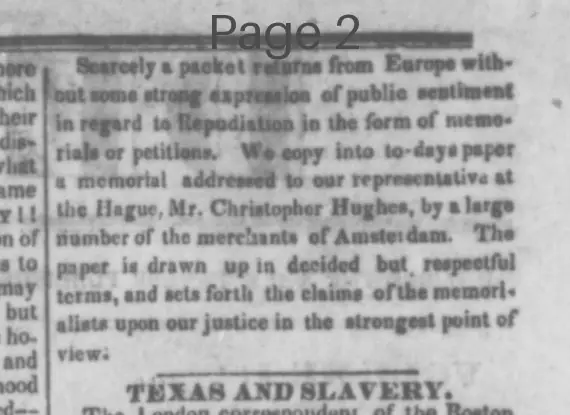
We copy from the American the following translation of a paper addressed to our Minister at the Hague by a great number of the merchants of Amsterdam. These documents are valuable as showing the settled sentiment of influential men abroad concerning the refusal of some of our States to pay their debts. The sense of our national honor must be dead if these appeals to our justice and integrity awaken no worthy response.
To Christopher Hughes, Esq. Charge d'Affaires of the United States of America at the Hague,
Sir: We, the undersigned, bondholders of North American loans, negotiated of late years or secured upon stocks issued by several States of the Union, confidently take the liberty to invoke your kind intercession in our behalf.
You are well aware that the engagements entered into on issuing these loans have not been fulfilled, that the payment of interest has been suspended; that resolutions passed by some of these States have rendered the securities almost valueless; that general losses have been sustained; whilst every endeavor to effect a remedy to this deplorable state of things has hitherto proved fruitless.
Under these circumstances, we consider ourselves justified in making a public appeal to the known sense of honor of the American people, and in bringing our complaint before the General Government of a nation, which until now, has always felt and recognized the high importance of public faith and credit.
The deep sense of our grievances has, we are happy to say, met with sympathy in the United States, where it has even been publicly acknowledged. The doctrine of repudiation, although embraced in some quarters, has excited the just indignation of the majority of the population. Men in elevated stations have openly declared that whatever the calamity of the times or the malpractices and dilapidations of the banks and public officers, at whatever disappointments attendant on too sanguine expectations, nothing can sanction such a doctrine. The inviolability of engagements, which having no tribunal to enforce them are to be considered the more sacred as being placed under the protection of the national honor and public faith, has been warmly advocated in your country itself.
We, however, do not hesitate boldly to express our opinion, that a mere acknowledgement of rights or obligations can never suffice to retrieve the shaken credit of the States, nor to dispel our just grounds of complaint. By such acknowledgement we may be emboldened to press our case calmly but earnestly, and feel ourselves justified in soliciting redress, but by their mere acknowledgement the American people can never be considered in the eyes of the world as having wiped away the stain which has been suffered to attach to its name.
Do not, however, suppose, sir, that we the undersigned memorialists, shall presume to point out the resources that might be made available, or to suggest the measures that might, perhaps, be resorted to. We simply allow ourselves to put this question, whether, with such unbounded means at their command, with the great energy of the people, and in a case of such general and paramount interest, it can really be so wholly impracticable to retrieve the national credit from its present state of prostration. We are even bold to ask whether the only compensation offered for the injuries we had sustained, is to consist in a mere acknowledgement of our rights, unaccompanied by the slightest effort to meet our claims or tranquillize our anxieties.
As Hollanders, we may be allowed to cast a retrospective look upon the first period of the independence of your nation, and to call to mind that our countrymen did not remain aloof spectators of the struggle, nor indifferent to the rising fortunes of the States. Long before the credit of the youthful States was founded upon what might be considered a solid basis, their capital was made subservient to the development and support of its prosperity. Between the years 1782 and 1791, more than thirty millions of money were obtained here and loaned to the States in addition to which further considerable advances, for the same object, were made to your countrymen. Shall then the assistance formerly proffered be counted nothing? and shall it be said that the good faith observed in the fulfillment of former engagements, on the strength of which the loans in after times were so readily granted, was a mere delusion? and finally, can the American nation have forgotten the assistance in which their rise and existence are materially owing? Will they not endeavor, by all possible means, to avoid the appearance that the services rendered could be met with ingratitude.
In conclusion we would observe, sir, that very few years have elapsed since the last loans were contracted—the national honor was still untarnished—confidence in the United States was unshaken—a decided preference was shown for investments secured by the resources and public honor of your people—and their stock offered, as it was thought, the best security. Not a doubt was admitted of the continued course of their prosperity—the object of loans contracted was to promote that prosperity—and accordingly capitals already profitably invested in other quarters were transferred in these new loans: but with a brief space the plighted promises were broken—the value of the securities pledged for the loans dwindled away into nothing, and even the dividends remained unpaid. We ask now sir, have not the State Creditors, who are sufferers by these loans, a more particular claim upon sympathy and support?
These feelings and these hopes sir, we most earnestly entreat, you will be pleased to communicate to the General Government of the Union and to that of the several States. We join our voices to those of the numerous sufferers in an adjacent country, who have also addressed the Representative of the Union: soliciting his good offices in the transmission of their representations and the furtherance of their wishes. These good offices have not been withheld, and we, the undersigned, feel firmly persuaded that from you, sir, our expectation will likewise meet with ready acquiescence.
Enabled as you are, sir, by your station to judge of the impression produced in this country by the events alluded to, and to appreciate the disastrous consequence they have entailed upon so many of our countrymen, we cannot but hope and believe that you will not refuse the weight of your influence, on which we place the utmost reliance, in every proper quarter and whenever it can be available, in promoting our just claims.
We are, sir, your most obedient humble servants,
Signed by 105 Individuals and Firms.
Amsterdam, April, 1843.
What sub-type of article is it?
What themes does it cover?
What keywords are associated?
What entities or persons were involved?
Where did it happen?
Story Details
Key Persons
Location
Amsterdam, The Hague
Event Date
April 1843
Story Details
Merchants of Amsterdam, bondholders of US state loans, address a memorial to Christopher Hughes, US Charge d'Affaires at The Hague, protesting the suspension of interest payments and repudiation by some US states, appealing to American national honor, recalling Dutch financial support during the American Revolution, and urging the US government to restore credit and provide redress.