Thank you for visiting SNEWPapers!
Sign up free
Gazette Of The United States
New York, New York County, New York
What is this article about?
Biographical sketch of Benjamin Franklin, from journeyman printer to leader of the American Revolution and pioneer in electricity. Highlights his early London visit, scientific inventions, writings on utility, linguistic prowess, social demeanor, peace efforts with England, and international acclaim upon his death.
Clipping
OCR Quality
Full Text
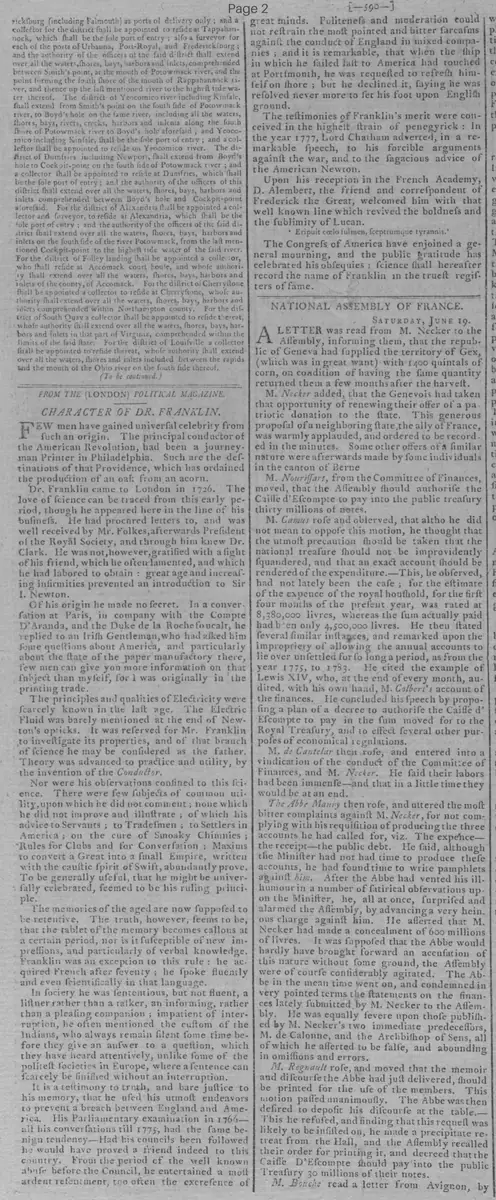
CHARACTER OF DR. FRANKLIN.
Few men have gained universal celebrity from such an origin. The principal conductor of the American Revolution, had been a journeyman Printer in Philadelphia. Such are the destinations of that Providence, which has ordained the production of an oak from an acorn.
Dr. Franklin came to London in 1726. The love of science can be traced from this early period, though he appeared here in the line of his business. He had procured letters to, and was well received by Mr. Folkes, afterwards President of the Royal Society, and through him knew Dr. Clarke. He was not, however, gratified with a sight of his friend, which he often lamented, and which he had labored to obtain: great age and increasing infirmities prevented an introduction to Sir I. Newton.
Of his origin he made no secret. In a conversation at Paris, in company with the Comte D'Aranda, and the Duke de la Rochefoucauld, he replied to an Irish Gentleman, who had asked him some questions about America, and particularly about the state of the paper manufactory there, "Few men can give you more information on that subject than myself, for I was originally in the printing trade."
The principles and qualities of Electricity were scarcely known in the last age. The Electric Fluid was barely mentioned at the end of Newton's Opticks. It was reserved for Mr. Franklin to investigate its properties, and of that branch of science he may be considered as the father.
Theory was advanced to practice and utility, by the invention of the Conductor.
Nor were his observations confined to this science. There were few subjects of common utility, upon which he did not comment; none which he did not improve and illustrate; of which his advice to Servants; to Tradesmen; to Settlers in America; on the cure of Smoky Chimneys; Rules for Clubs and for Conversation; Maxims to convert a Great into a small Empire, written with the caustic spirit of Swift, abundantly prove.
To be generally useful, that he might be universally celebrated, seemed to be his ruling principle.
The memories of the aged are now supposed to be retentive. The truth, however, seems to be, that the tablet of the memory becomes callous at a certain period, nor is it susceptible of new impressions, and particularly of verbal knowledge.
Franklin was an exception to this rule: he acquired French after seventy; he spoke fluently and even scientifically in that language.
In society he was sententious, but not fluent, a listener rather than a talker, an informing, rather than a pleasing companion; impatient of interruption, he often mentioned the custom of the Indians, who always remain silent some time before they give an answer to a question, which they have heard attentively, unlike some of the politest societies in Europe, where a sentence can scarcely be finished without an interruption.
It is a testimony to truth, and bare justice to his memory, that he used his utmost endeavors to prevent a breach between England and America. His Parliamentary examination in 1766—all his conversations till 1775, had the same benign tendency—Had his councils been followed he would have proved a friend indeed to this country. From the period of the well known abuse before the Council, he entertained a most ardent resentment, too often the excrescence of great minds. Politeness and moderation could not restrain the most pointed and bitter sarcasms against the conduct of England in mixed companies; and it is remarkable, that when the ship in which he sailed last to America had touched at Portsmouth, he was requested to refresh himself on shore; but he declined it, saying he was resolved never more to set his foot upon English ground.
The testimonies of Franklin's merit were conceived in the highest strain of panegyric: In the year 1777, Lord Chatham adverted, in a remarkable speech, to his forcible arguments against the war, and to the sagacious advice of the American Newton.
Upon his reception in the French Academy, D'Alembert, the friend and correspondent of Frederick the Great, welcomed him with that well known line which revived the boldness and the sublimity of Lucan.
Eripuit coelo fulmen, sceptrumque tyrannis.
The Congress of America have enjoined a general mourning, and the public gratitude has celebrated his obsequies; science shall hereafter record the name of Franklin in the truest registers of fame.
What sub-type of article is it?
What themes does it cover?
What keywords are associated?
What entities or persons were involved?
Where did it happen?
Story Details
Key Persons
Location
London, Philadelphia, Paris, America, Portsmouth
Event Date
1726, 1766, 1775, 1777
Story Details
Biographical account of Benjamin Franklin's rise from a journeyman printer in Philadelphia to a key figure in the American Revolution, pioneer in electricity with the invention of the lightning conductor, prolific writer on practical subjects, exceptional learner of languages in old age, peacemaker between England and America until personal resentment, and recipient of international praise.