Thank you for visiting SNEWPapers!
Sign up free
Lynchburg Virginian
Lynchburg, Virginia
What is this article about?
A passenger recounts the inaugural voyage of the Lynchburg Packet Boat from Lynchburg to Richmond on the James River, starting February 11, describing scenery, villages, natural wonders like volcanic rocks and falls, and a close call at Rock Castle.
Clipping
OCR Quality
Full Text
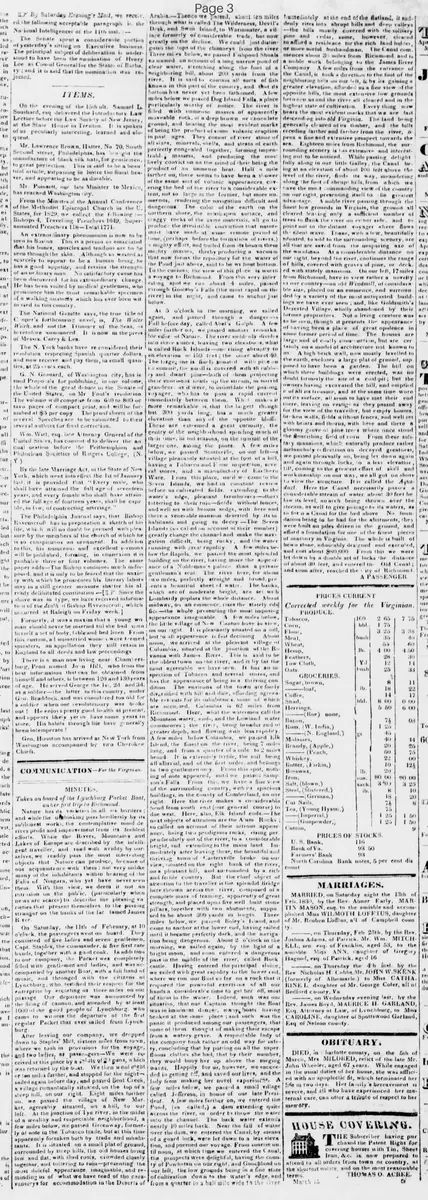
MINUTES. Taken on board of the Lynchburg Packet Boat, on her first trip to Richmond.
Nature has its varieties in all its borders and while the unthinking pass heedlessly by its sublunest works, the contemplative mind derives profit and improvement from its feeblest efforts. While the Rivers, Mountains and Lakes of Europe are described by the intelligent traveller, and read with avidity by ourselves, we readily pass the most interesting objects that Nature can produce, because of our acquaintance with them : not very unlike many of the inhabitants within hearing of the Falls of Niagara, who yet have never seen them.
With this view, we deem it not an intrusion on the public, (particularly when news are scarce) to describe the pleasing varieties that present themselves to the passing stranger on the banks of the far famed James River
On Saturday, the 11th of February, at 10 o'clock, the passengers went on board. They consisted of five ladies and seven gentlemen, Capt. Staples, the commander, & five first rate hands, together with a good cook. In addition to our company, the Packet was completely filled with gentlemen and ladies, and was accompanied by another Boat, with a full band of music, and thronged with the citizens of Lynchburg, who, testified their respect for the enterprise by escorting us three miles on our passage
Our departure was announced by the firing of cannon, and attended by at least 1000 of the good people of Lynchburg, who came to witness the departure of the first regular Packet that ever sailed from Lynchburg.
After leaving our company, we dropped down to Staples' Mill, sixteen miles from town, where we took in provisions for the voyage, and two ladies, as passengers-We were received at this place by a salute of 2 guns, which was returned by the boat.
We then went eight or ten miles further, and stopped for the night— sailed again before day, and passed Bent Creek, a village romantically situated, on the top of a steep hill, on our right. Eight miles further on, we passed the village of New Market, agreeably situated, on a hill, to our left.
At the junction of Tye river, in the midst of a wealthy and respectable neighborhood, a few miles below, we passed Greenway, formerly of note in the Tobacco trade, but at this time apparently forsaken both by trade and inhabitants. It is situated on a small plat of ground, surrounded by steep hills, the old houses being low and flat, with shed roofs, crowded closely together, and tottering to ruin-presenting the most doleful appearance, imaginable, and reminding us of what we have read of the caravanseries for accommodation in the Deserts of Arabia.
-Thence we passed, about ten miles through what is called The Wilderness, Devil's Desk, and Swin Island, to Warminster, a village formerly of considerable trade, but now greatly on the decline. We could just distinguish the tops of the chimneys from the river
Three miles below, we passed Fishpond Shoals so named on account of a long narrow pond of clear water, stretching along the foot of a neighboring hill, about 200 yards from the river. It is said to contain all sorts of fish known in this part of the country, and that its bottom has never yet been fathomed.
A few miles below we passed Dog Island Falls, a place particularly worthy of notice. The river is filled with immense masses of apparently moveable rock, of a deep brown or chocolate ground, and bearing the most evident marks of being the product of some volcanic eruption in past ages. They consist of river stone of all sizes, minerals, shells, and strata of earth perfectly congealed together, forming impenetrable masses, and producing the most lively conviction on the mind of their being the product of an immense heat.
Half a mile farther on, there seems to have been a shower of the same sort of volcanic appearances, covering the bed of the river to a considerable extent, not so large as the former, but more numerous, rendering the navigation difficult and dangerous. The color of the earth on the northern shore, the misshapen surface, and craggy rocks of the same materials, all go to produce the irresistible conviction that nature must have made at some remote period of time, (perhaps before the formation of rivers.) a mighty effort, and hurled from its bosom these mighty masses, thereby producing a vacuum that now forms the repository for the water of the Pond just above, said to be without bottom. To the curious, the view of this place is worth a voyage to Richmond.
From this very interesting spot we run about 4 miles, passed through Goosby's Falls (the most rapid on the river) in the night, and came to anchor just below. At 5 o'clock in the morning, we sailed again, and passed through 'dangerous Fall before day, called Abel's Gulph.
A few miles further on, we passed another remarkable color of Nature. The river suddenly divides into three sluices, leaving two elevations, what is called Rock Islands-one rising abruptly to an elevation of 150 feet; the other about 40. The largest one is finely situated with pine on its summit, the smallest covered with shrubbery and dwarf pines-both of them projecting their enormous heads up the stream, in horrid grandeur, as it were, to intimidate the passing voyager, who has to pass a rapid current immediately between them. What makes it more remarkable is, that the largest though but 300 yards long, has a much greater elevation than any of the opposite bluffs. These are esteemed a great curiosity, the gentry of the neighborhood spending much of their time, in hot seasons, on the summit of the larger one, among the pines.
A few miles below, we passed Scottsville, on our left-a village pleasantly situated at the foot of a hill having a Tobacco and Flour inspection, several stores, and a manufactory of Earthen Ware.
From this place, until we came to the Seven Islands, we had in constant review before us cultivated fields, extending to the water's edge, pleasant farmhouses-others tottering to their ruin-fields without fences and well set with broom sedge, with here and there a venerable mansion deserted by its inhabitants and going to decay
-The Seven Islands (so called on account of their number) greatly change the channel and make the navigation difficult, being rocky, and the water running with great rapidity.
A few miles below the Rapids, we passed the most splendid building on the river, having more the appearance of a Noble-man's palace than a private gentleman's seat. The river here, for about two miles, perfectly straight and broad, presents a beautiful sheet of water. The banks, which are of moderate height, are set with Lombardy poplars the whole distance. About midway, on an eminence, rises the stately edifice-the whole presenting the most imposing appearance imaginable.
A few miles below, the little village of New Canton hove in view, on our right It is pleasantly situated on a hill, but to all appearance is fast declining
About noon, we arrived at the pleasant village of Columbia, situated at the junction of the Rivanna with James River. 'This is said to be the oldest town on the river, and is by far the most agreeable we have seen. It has an inspection of Tobacco and several stores, and has the appearance of being in a thriving condition The environs of the town are finely diversified with hill and dale, affording agreeable retreats for its inhabitants, some of which are occupied. Columbia is 62 miles from Richmond.
Hence, what the watermen call the Mountain water, ends, and the Lowland water commences; the river, being broader and of greater depth, and flowing with less rapidity.
A few miles below Columbia, we passed Elk Island, the finest on the river, being 7 miles long, and from a quarter of a mile to 2 miles broad It is extremely fertile, the soil being all alluvial, and of the first order, and belongs to two gentlemen only.
From this spot, nothing of note appeared, until we passed Sampson's Falls. From this, we have a fine view of the surrounding country, with its spacious buildings, in the county of Cumberland, on our right. Here the river makes a considerable bend from south east (our general course) to due west. Here, also, Elk Island ends.
-The next objects of attention are the Alum Rocks : so called on account of their nitrous appearance, being two prodigious rocks, rising perpendicularly out of the river, to a considerable height, and extending to the main land
Immediately after leaving these, the beautiful and thriving town of Cartersville broke on our view, situated on the right bank of the river, on a pleasant hill, and surrounded by a rich and fertile country But the chief object of attention to the traveller is the splendid Bridge here thrown across the river, composed of a complete mass of framing, apparently of great strength, and placed upon five well built stone pillars, together with two abutments, supposed to be about 300 yards in length
Three miles below, we passed Bouldin's Island, and came to anchor at the lower end, having sailed until it became perfectly dark, and the navigation being dangerous. 'About 2 o'clock in the morning, we sailed again, by the light of a bright moon, and soon entered a dangerous pass in the middle of the river, called Rock Castle.
Having entered the principal sluice we sailed with great rapidity to the lower end, where we run our Boat so far on a rock that it required the powerful exertions of all our hands a considerable time to get her off, most of them in the water. Indeed, such was our situation, that our Captain thought the Boat was in imminent danger, many boats having broken at the same place ; and such was the panic it produced among our passengers, that some of them thought of making their escape from a watery grave. A respectable lady of the company took rather an odd way for safety, concluding that by putting on all the superfluous clothes she had, that by their number, they would buoy her up above the surging waves, Happily for us, however, we succeeded in getting off, and saved our lives, and the lady from making her novel experiment,
A few miles below, we passed a small village called Jefferson, in honor of our late President.
A few miles farther on, we entered the Pond, (so called,) a dam extending quite across the river, in order to throw the water into the channel. The back water extends nearly 10 miles back. Near the fall of water over the dam, we entered the Canal, by means of a guard lock, were let down to a less elevation, and pursued our voyage.
From sunrise until noon, at which time we entered the Canal the prospects were delightful, having the county of Powhatan on our right, and Goochland on our left, the low grounds being in a fine state of cultivation down to the water's edge, and from a quarter to a half mile wide to the river
Immediately at the end of the flatland, it suddenly rises into abrupt hills and deep valleys --the hills mostly covered with the solitary pine and cedar, some, however, cleared to afford a residence for the rich land holder, or more useful husbandman.
The Canal commences about 30 miles from Richmond, and is a noble work belonging to the James River Company
A few miles from the entrance of the Canal, it took a direction to the foot of the neighboring hills on our left, & by its gaining a greater elevation, afforded us a fine view of the opposite hills, the most extensive low grounds between us and the river all cleared and in the highest state of cultivation.
Every thing now bears the most evident marks that we are fast descending into old Virginia. The land being generally cleared of its timber, and the hills receding farther and farther from the river, Opens a fine and extensive prospect towards the sea.
Eighteen miles from Richmond, the surrounding scenery is too extensive and interesting not to be noticed. While passing delightfully along in our little Galley, the Canal being at an elevation of about 100 feet above the level of the river, finds its way, meandering along the foot of abrupt hills, from which we have the most commanding view of the country on our right, presenting itself to the greatest advantage. A noble river passing through the finest low grounds in Virginia, the ground all cleared leaving only a sufficient number of trees to flank the river on either side, and to point out to the distant voyager where flows the silent wave. These, with a few, beautifully situated, to add to the surrounding scenery, are all that are saved from the unsparing axe of the woodman
At a considerable distance on our right, beyond the river, continues the range of hills, covered with groves of pine, or decked with stately mansions. On our left, 17 miles from Richmond, have in view rather a novelty in our country-an old Windmill, of considerable size, placed on an eminence, and surrounded by a variety of the most antiquated buildings we have ever seen ; and, like Goldsmith's Deserted Village, wholly abandoned by their former proprietors. Not a living creature was to be seen, though it presents the appearance of having been a place of great opulence in some former period of time. The houses are large and of costly construction, but are certainly on a model of architecture not known to us. A high brick wall, now mostly levelled to the earth, encloses a large plat of ground, supposed to have been a garden. The hill on which these buildings were erected, was no doubt formerly the site of a coal-pit; but the owners having excavated the hill, and emptied it of all its treasure, and at the same time worn out its surface, all seem to have met their end there, leaving no vestige as they passed away for the view of the traveller, but empty houses, broken walls, fields without fences, and well set with briars and thorns, with here and there a gloomy grove of pine trees where once stood the flourishing field of corn
From these solitary mansions, which naturally produce rather melancholy reflections on decayed greatness, we passed pleasantly on, being let down again and again through locks, to a less elevation, till, coming to the greatest effort of skill and workmanship on our way, we all got on shore to view the structure
It is called the Aqueduct. Here the Canal necessarily passes a considerable stream of water, about 30 feet below its level, an arch being thrown over the stream, as well to give passage to its waters, as to form a Canal for the bed above No foundation being to be had for the abutments, they were built on piles driven in the ground, and afford a foundation for one of the finest pieces of masonry in Virginia. The whole is built of hewn stone, admirably designed and executed, and cost about $50,000
From this we were let down by a double set of locks the distance of about 30 feet, and entered the Old Canal: and soon after, reached the city of Richmond.
A PASSENGER
What sub-type of article is it?
What themes does it cover?
What keywords are associated?
What entities or persons were involved?
Where did it happen?
Story Details
Key Persons
Location
James River, From Lynchburg To Richmond, Virginia
Event Date
Saturday, The 11th Of February
Story Details
The inaugural trip of the Lynchburg Packet Boat down the James River features descriptions of villages like New Market and Columbia, natural features including Dog Island Falls with volcanic rocks, Rock Islands, and the Canal's Aqueduct; encounters a grounding incident at Rock Castle but arrives safely in Richmond.