Thank you for visiting SNEWPapers!
Sign up free
Letter to Editor
October 23, 1802
Rhode Island Republican
Newport, Newport County, Rhode Island
What is this article about?
In Newport, October 21, 1802, Jacob Richardson counters Cleland Kinlock's published deposition by detailing their private conversations about letters purportedly written by Rutledge in a disguised hand, delivered by a white girl, and accusations against Mr. Ellery, aiming to clarify the truth for the public.
Clipping
OCR Quality
98%
Excellent
Full Text
Newport, Oct. 21st 1802.
Mr. Editor,
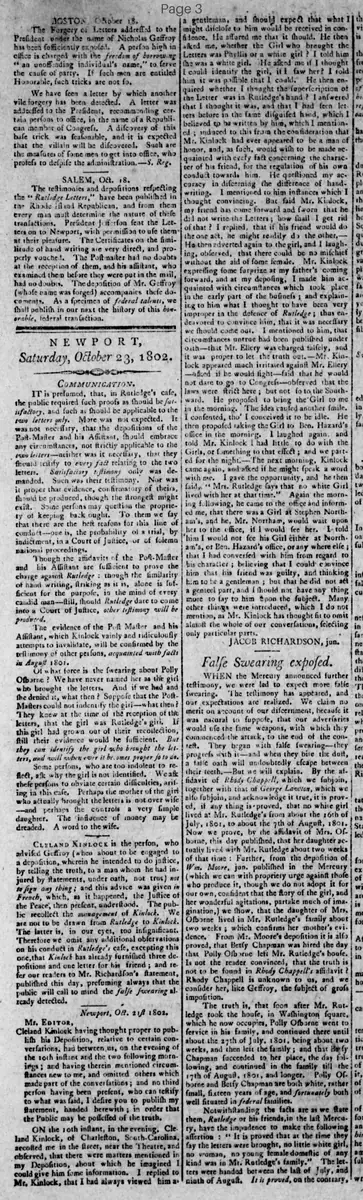
Cleland Kinlock having thought proper to publish his Deposition, relative to certain conversations had between us, on the evening of the 10th instant and the two following mornings; and having therein mentioned circumstances new to me, and omitted others which made part of the conversations; and no third person having been present, who can testify to what was said, I desire you to publish my statement, handed herewith; in order that the Public may be posed of the truth.
ON the 10th instant, in the evening. Cleland Kinlock, of Charleston, South-Carolina, accosted me in the street, near the Theatre, and observed, that there were matters mentioned in my Deposition, about which he imagined I could give him some information. I replied to Mr. Kinlock, that I had always viewed him as a gentleman, and would expect that what I might disclose to him would be received in confidence. He assured me that it should. "He then asked me, whether the Girl who brought the Letters was Phyllis or a white girl? I told him she was a white girl. He asked me if I thought I could identify the girl, if I saw her? I told him it was possible that I could. He then enquired whether I thought the superscription of the Letter was in Rutledge's hand? I answered that I thought it was, and that I had seen letters before in the same disguised hand, which I believed to be written by him, which I mentioned; induced to this from the consideration that Mr. Kinlock had ever appeared to be a man of honor, and, as such, would wish to be made acquainted with every fact concerning the character of his friend, for the regulation of his own conduct towards him. He questioned my accuracy in discerning the difference of hand-writing. I mentioned to him instances which I thought convincing. But said Mr. Kinlock, my friend has come forward and sworn that he did not write the Letters; how shall I get rid of that? I replied, that if his friend would do the one act, he might readily do the other.— He then adverted again to the girl, and I laughing, observed, that there could be no mischief without the aid of some female. Mr. Kinlock expressing some surprise at my father's coming forward, and at my deposing, I made him acquainted with circumstances which took place in the early part of the business; and explaining to him what I thought to have been very improper in the defence of Rutledge; thus endeavored to convince him, that it was necessary we should come out. I mentioned to him, that circumstances untrue had been published under Oath that Mr. Ellery was charged falsely, and it was proper to let the truth out.—Mr. Kinlock appeared much irritated against Mr. Ellery—asked if he would fight—said that he would not dare to go to Congress—observed that the laws were strict here; but not so to the Southward. He proposed to bring the Girl to me in the morning. The idea caused another smile. I consented, tho' I conceived it to be idle. He then proposed taking the Girl to Ben. Hazard's office in the morning. I laughed again, and told Mr. Kinlock I had little to do with the Girls, or something to that effect: and we parted for the night.—The next morning, Kinlock came again, and asked if he might speak a word with me. I gave the opportunity, and he then said, "Mrs. Rutledge says that no white Girl lived with her at that time." Again the morning following, he came to the office and informed me, that there was a Girl at Stephen Northam's, and he, Mr. Northam, would wait upon her to the office, if I would see her. I told him I would not see his Girl either at Northam's, or Ben. Hazard's office, or any where else: that I had conversed with him from regard to his character; believing that I could convince him that his friend was guilty, and thinking him to be a gentleman; but that he did not act a genteel part, and I should not have any thing more to say to him upon the object. Many other things were introduced, which I do not mention, as Mr. Kinlock has thought fit to omit almost the whole of our conversations, selecting only particular parts.
JACOB RICHARDSON, jun.
Mr. Editor,
Cleland Kinlock having thought proper to publish his Deposition, relative to certain conversations had between us, on the evening of the 10th instant and the two following mornings; and having therein mentioned circumstances new to me, and omitted others which made part of the conversations; and no third person having been present, who can testify to what was said, I desire you to publish my statement, handed herewith; in order that the Public may be posed of the truth.
ON the 10th instant, in the evening. Cleland Kinlock, of Charleston, South-Carolina, accosted me in the street, near the Theatre, and observed, that there were matters mentioned in my Deposition, about which he imagined I could give him some information. I replied to Mr. Kinlock, that I had always viewed him as a gentleman, and would expect that what I might disclose to him would be received in confidence. He assured me that it should. "He then asked me, whether the Girl who brought the Letters was Phyllis or a white girl? I told him she was a white girl. He asked me if I thought I could identify the girl, if I saw her? I told him it was possible that I could. He then enquired whether I thought the superscription of the Letter was in Rutledge's hand? I answered that I thought it was, and that I had seen letters before in the same disguised hand, which I believed to be written by him, which I mentioned; induced to this from the consideration that Mr. Kinlock had ever appeared to be a man of honor, and, as such, would wish to be made acquainted with every fact concerning the character of his friend, for the regulation of his own conduct towards him. He questioned my accuracy in discerning the difference of hand-writing. I mentioned to him instances which I thought convincing. But said Mr. Kinlock, my friend has come forward and sworn that he did not write the Letters; how shall I get rid of that? I replied, that if his friend would do the one act, he might readily do the other.— He then adverted again to the girl, and I laughing, observed, that there could be no mischief without the aid of some female. Mr. Kinlock expressing some surprise at my father's coming forward, and at my deposing, I made him acquainted with circumstances which took place in the early part of the business; and explaining to him what I thought to have been very improper in the defence of Rutledge; thus endeavored to convince him, that it was necessary we should come out. I mentioned to him, that circumstances untrue had been published under Oath that Mr. Ellery was charged falsely, and it was proper to let the truth out.—Mr. Kinlock appeared much irritated against Mr. Ellery—asked if he would fight—said that he would not dare to go to Congress—observed that the laws were strict here; but not so to the Southward. He proposed to bring the Girl to me in the morning. The idea caused another smile. I consented, tho' I conceived it to be idle. He then proposed taking the Girl to Ben. Hazard's office in the morning. I laughed again, and told Mr. Kinlock I had little to do with the Girls, or something to that effect: and we parted for the night.—The next morning, Kinlock came again, and asked if he might speak a word with me. I gave the opportunity, and he then said, "Mrs. Rutledge says that no white Girl lived with her at that time." Again the morning following, he came to the office and informed me, that there was a Girl at Stephen Northam's, and he, Mr. Northam, would wait upon her to the office, if I would see her. I told him I would not see his Girl either at Northam's, or Ben. Hazard's office, or any where else: that I had conversed with him from regard to his character; believing that I could convince him that his friend was guilty, and thinking him to be a gentleman; but that he did not act a genteel part, and I should not have any thing more to say to him upon the object. Many other things were introduced, which I do not mention, as Mr. Kinlock has thought fit to omit almost the whole of our conversations, selecting only particular parts.
JACOB RICHARDSON, jun.
What sub-type of article is it?
Persuasive
Informative
Investigative
What themes does it cover?
Crime Punishment
Politics
Press Freedom
What keywords are associated?
Deposition Dispute
Rutledge Letters
Handwriting Identification
White Girl Messenger
Cleland Kinlock
Jacob Richardson
Mr Ellery
Newport Conversations
What entities or persons were involved?
Jacob Richardson, Jun.
Mr. Editor
Letter to Editor Details
Author
Jacob Richardson, Jun.
Recipient
Mr. Editor
Main Argument
jacob richardson provides his detailed account of conversations with cleland kinlock to counter kinlock's selective deposition, asserting the truth about rutledge's involvement in writing disguised letters delivered by a white girl and false charges against mr. ellery.
Notable Details
Conversations About Identifying A White Girl Messenger
Dispute Over Rutledge's Handwriting On Letter Superscription
Kinlock's Irritation Toward Mr. Ellery And Suggestions Of Confrontation
Offers To Bring The Girl To Richardson Or Hazard's Office