Thank you for visiting SNEWPapers!
Sign up free
The Virginia Gazette
Richmond, Williamsburg, Richmond County, Virginia
What is this article about?
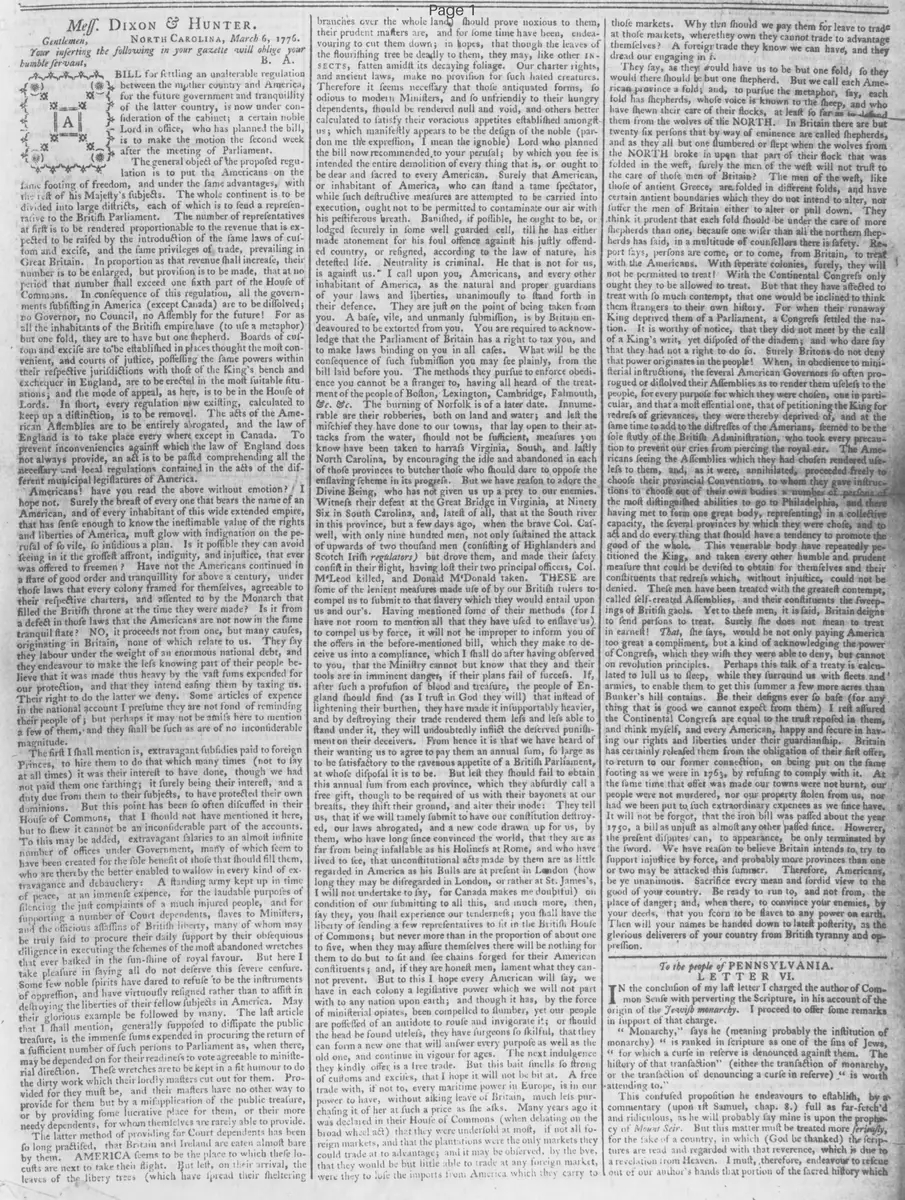
Letter dated March 6, 1776, from North Carolina, opposing a rumored British bill to dissolve American colonial governments, integrate colonies into British Parliament with limited representation, and impose English laws, viewing it as an assault on American liberties. Calls for unified resistance against British tyranny, citing recent battles and critiquing British fiscal policies.
Merged-components note: Image overlaps spatially with the letter_to_editor and precedes it in reading order, indicating it is likely an illustrative or header element belonging to this component.
Clipping
OCR Quality
Full Text
Gentlemen,
North Carolina, March 6, 1776.
Your inserting the following in your gazette will oblige your humble servant,
B. A.
BILL for settling an unalterable regulation between the mother country and America, for the future government and tranquillity of the latter country, is now under consideration of the cabinet; a certain noble Lord in office, who has planned the bill, is to make the motion the second week after the meeting of Parliament.
The general object of the proposed regulation is to put the Americans on the same footing of freedom, and under the same advantages, with the rest of his Majesty's subjects. The whole continent is to be divided into large districts, each of which is to send a representative to the British Parliament. The number of representatives at first is to be rendered proportionable to the revenue that is expected to be raised by the introduction of the same laws of custom and excise, and the same privileges of trade, prevailing in Great Britain. In proportion as that revenue shall increase, their number is to be enlarged, but provision is to be made, that at no period that number shall exceed one sixth part of the House of Commons. In consequence of this regulation, all the governments subsisting in America (except Canada) are to be dissolved; no Governor, no Council, no Assembly for the future! For as all the inhabitants of the British empire have (to use a metaphor) but one fold, they are to have but one shepherd. Boards of custom and excise are to be established in places thought the most convenient, and courts of justice, possessing the same powers within their respective jurisdictions with those of the King's bench and exchequer in England, are to be erected in the most suitable situations; and the mode of appeal, as here, is to be in the House of Lords. In short, every regulation now existing, calculated to keep up a distinction, is to be removed. The acts of the American Assemblies are to be entirely abrogated, and the law of England is to take place every where except in Canada. To prevent inconveniencies against which the law of England does not always provide, an act is to be passed comprehending all the necessary and local regulations contained in the acts of the different municipal legislatures of America.
Americans! have you read the above without emotion? I hope not. Surely the breast of every one that bears the name of an American, and of every inhabitant of this wide extended empire, that has sense enough to know the inestimable value of the rights and liberties of America, must glow with indignation on the perusal of so vile, so insidious a plan. Is it possible they can avoid seeing in it the grossest affront, indignity, and injustice, that ever was offered to freemen? Have not the Americans continued in a state of good order and tranquillity for above a century, under those laws that every colony framed for themselves, agreeable to their respective charters, and assented to by the Monarch that filled the British throne at the time they were made? Is it from a defect in those laws that the Americans are not now in the same tranquil state? NO, it proceeds not from one, but many causes, originating in Britain, none of which relate to us. They say they labour under the weight of an enormous national debt, and they endeavour to make the less knowing part of their people believe that it was made thus heavy by the vast sums expended for our protection, and that they intend easing them by taxing us. Their right to do the latter we deny. Some articles of expense in the national account I presume they are not fond of reminding their people of; but perhaps it may not be amiss here to mention a few of them, and they shall be such as are of no inconsiderable magnitude.
The first I shall mention is, extravagant subsidies paid to foreign Princes, to hire them to do that which many times (not to say at all times) it was their interest to have done, though we had not paid them one farthing; it surely being their interest, and a duty due from them to their subjects, to have protected their own dominions. But this point has been so often discussed in their House of Commons, that I should not have mentioned it here, but to show it cannot be an inconsiderable part of the accounts. To this may be added, extravagant salaries to an almost infinite number of offices under Government, many of which seem to have been created for the sole benefit of those that should fill them, who are thereby the better enabled to wallow in every kind of extravagance and debauchery: A standing army kept up in time of peace, at an immense expense, for the laudable purposes of silencing the just complaints of a much injured people, and for supporting a number of Court dependents, slaves to Ministers, and the officious assassins of British liberty, many of whom may be truly said to procure their daily support by their obsequious diligence in executing the schemes of the most abandoned wretches that ever basked in the sun-shine of royal favour. But here I take pleasure in saying all do not deserve this severe censure. Some few noble spirits have dared to refuse to be the instruments of oppression, and have virtuously resigned rather than to assist in destroying the liberties of their fellow subjects in America. May their glorious example be followed by many. The last article that I shall mention, generally supposed to dissipate the public treasure, is the immense sums expended in procuring the return of a sufficient number of such persons to Parliament as, when there, may be depended on for their readiness to vote agreeable to ministerial direction. These wretches are to be kept in a fit humour to do the dirty work which their lordly masters cut out for them. Provided for they must be, and their masters have no other way to provide for them but by a misapplication of the public treasure, or by providing some lucrative place for them, or their more needy dependents, for whom themselves are rarely able to provide. The latter method of providing for Court dependents has been so long practised, that Britain and Ireland are eaten almost bare by them. AMERICA seems to be the place to which these locusts are next to take their flight. But lest, on their arrival, the leaves of the liberty trees (which have spread their sheltering branches over the whole land) should prove noxious to them, their prudent masters are, and for some time have been, endeavouring to cut them down; in hopes, that though the leaves of the flourishing tree be deadly to them, they may, like other INSECTS, fatten amidst its decaying foliage. Our charter rights, and ancient laws, make no provision for such hated creatures. Therefore it seems necessary that those antiquated forms, so odious to modern Ministers, and so unfriendly to their hungry dependents, should be rendered null and void, and others better calculated to satisfy their voracious appetites established amongst us; which manifestly appears to be the design of the noble (pardon me the expression, I mean the ignoble) Lord who planned the bill now recommended to your perusal; by which you see is intended the entire demolition of every thing that is, or ought to be dear and sacred to every American. Surely that American, or inhabitant of America, who can stand a tame spectator, while such destructive measures are attempted to be carried into execution, ought not to be permitted to contaminate our air with his pestiferous breath. Banished, if possible, he ought to be, or lodged securely in some well guarded cell, till he has either made atonement for his foul offence against his justly offended country, or resigned, according to the law of nature, his detested life. Neutrality is criminal. He that is not for us, is against us. I call upon you, Americans, and every other inhabitant of America, as the natural and proper guardians of your laws and liberties, unanimously to stand forth in their defence. They are just on the point of being taken from you. A base, vile, and unmanly submission, is by Britain endeavoured to be extorted from you. You are required to acknowledge that the Parliament of Britain has a right to tax you, and to make laws binding on you in all cases. What will be the consequence of such submission you may see plainly, from the bill laid before you. The methods they pursue to enforce obedience you cannot be a stranger to, having all heard of the treatment of the people of Boston, Lexington, Cambridge, Falmouth, &c. &c. The burning of Norfolk is of a later date. Innumerable are their robberies, both on land and water; and lest the mischief they have done to our towns, that lay open to their attacks from the water, should not be sufficient, measures you know have been taken to harass Virginia, South, and lastly North Carolina, by encouraging the idle and abandoned in each of those provinces to butcher those who should dare to oppose the enslaving scheme in its progress. But we have reason to adore the Divine Being, who has not given us up a prey to our enemies. Witness their defeat at the Great Bridge in Virginia, at Ninety Six in South Carolina, and, latest of all, that at the South river in this province, but a few days ago, when the brave Col. Caswell, with only nine hundred men, not only sustained the attack of upwards of two thousand men (consisting of Highlanders and Scotch Irish regulators) but drove them, and made their safety consist in their flight, having lost their two principal officers, Col. McLeod killed, and Donald McDonald taken. THESE are some of the lenient measures made use of by our British rulers to compel us to submit to that slavery which they would entail upon us and ours. Having mentioned some of their methods (for I have not room to mention all that they have used to enslave us) to compel us by force, it will not be improper to inform you of the offers in the before-mentioned bill, which they make to deceive us into a compliance, which I shall do after having observed to you, that the Ministry cannot but know that they and their tools are in imminent danger, if their plans fail of success. If, after such a profusion of blood and treasure, the people of England should find (as I trust in God they will) that instead of lightening their burthen, they have made it insupportably heavier, and by destroying their trade rendered them less and less able to stand under it, they will undoubtedly inflict the deserved punishment on their deceivers. From hence it is that we have heard of their wanting us to agree to pay them an annual sum, so large as to be satisfactory to the ravenous appetite of a British Parliament, at whose disposal it is to be. But lest they should fail to obtain this annual sum from each province, which they absurdly call a free gift, though to be required of us with their bayonets at our breasts, they shift their ground, and alter their mode: They tell us, that if we will tamely submit to have our constitution destroyed, our laws abrogated, and a new code drawn up for us, by them, who have long since convinced the world, that they are as far from being infallible as his Holiness at Rome, and who have lived to see, that unconstitutional acts made by them are as little regarded in America as his Bulls are at present in London (how long they may be disregarded in London, or rather at St. James's, I will not undertake to say, for Canada makes me doubtful) on condition of our submitting to all this, and much more, then, say they, you shall experience our tenderness; you shall have the liberty of sending a few representatives to sit in the British House of Commons; but never more than in the proportion of about one to five, when they may assure themselves there will be nothing for them to do but to sit and see chains forged for their American constituents; and, if they are honest men, lament what they cannot prevent. But to this I hope every American will say, we have in each colony a legislative power which we will not part with to any nation upon earth; and though it has, by the force of ministerial opiates, been compelled to slumber, yet our people are possessed of an antidote to rouse and invigorate it; or should the head be found useless, they have surgeons so skilful, that they can form a new one that will answer every purpose as well as the old one, and continue in vigour for ages. The next indulgence they kindly offer is a free trade. But this bait smells so strong of customs and excises, that I hope it will not be bit at. A free trade with, if not to, every maritime power in Europe, is in our power to have, without asking leave of Britain, much less purchasing it of her at such a price as she asks. Many years ago it was declared in their House of Commons (when debating on the broad wheel act) that they were undersold at most, if not all foreign markets, and that the plantations were the only markets they could trade at to advantage; and it may be observed, by the bye, that they would be but little able to trade at any foreign market, were they to lose the imports from America which they carry to those markets. Why then should we pay them for leave to trade at those markets, where they own they cannot trade to advantage themselves? A foreign trade they know we can have, and they dread our engaging in F.
They say, as they would have us to be but one fold; so they would there should be but one shepherd. But we call each American province a fold; and, to pursue the metaphor, say, each fold has shepherds, whose voice is known to the sheep, and who have shewn their care of their flocks, at least so far as to feed them from the wolves of the NORTH. In Britain there are but twenty six persons that by way of eminence are called shepherds, and as they all but one slumbered or slept when the wolves from the NORTH broke in upon that part of their flock that was folded in the west, surely the men of the west will not trust to the care of those men of Britain? The men of the west, like those of ancient Greece, are folded in different folds, and have certain ancient boundaries which they do not intend to alter, nor suffer the men of Britain either to alter or pull down. They think it prudent that each fold should be under the care of more shepherds than one, because one wiser than all the northern shepherds has said, in a multitude of counsellors there is safety. Report says, persons are come, or to come, from Britain, to treat with the Americans. With separate colonies, surely, they will not be permitted to treat! With the Continental Congress only ought they to be allowed to treat. But that they have affected to treat with so much contempt, that one would be inclined to think them strangers to their own history. For when their runaway King deprived them of a Parliament, a Congress settled the nation. It is worthy of notice, that they did not meet by the call of a King's writ, yet disposed of the diadem; and who dare say that they had not a right to do so. Surely Britons do not deny that power originates in the people! When, in obedience to ministerial instructions, the several American Governors so often prorogued or dissolved their Assemblies as to render them useless to the people, for every purpose for which they were chosen, one in particular, and that a most essential one, that of petitioning the King for redress of grievances, they were thereby deprived of, and at the same time to add to the distress of the Americans, seemed to be the sole study of the British Administration, who took every precaution to prevent our cries from piercing the royal ear. The Americans seeing the Assemblies which they had chosen rendered useless to them, and, as it were, annihilated, proceeded freely to choose their provincial Conventions, to whom they gave instructions to choose out of their own bodies a number of persons of the most distinguished abilities to go to Philadelphia, and there having met to form one great body, representing, in a collective capacity, the several provinces by which they were chose, and to act and do every thing that should have a tendency to promote the good of the whole. This venerable body have repeatedly petitioned the King, and taken every other humble and prudent measure that could be devised to obtain for themselves and their constituents that redress which, without injustice, could not be denied. These men have been treated with the greatest contempt, called self-created Assemblies, and their constituents the sweepings of British gaols. Yet to these men, it is said, Britain deigns to send persons to treat. Surely she does not mean to treat in earnest! That, she says, would be not only paying America too great a compliment, but a kind of acknowledging the power of Congress, which they wish they were able to deny, but cannot on revolution principles. Perhaps this talk of a treaty is calculated to lull us to sleep, while they surround us with fleets and armies, to enable them to get this summer a few more acres than Bunker's hill contains. Be their designs ever so base (for any thing that is good we cannot expect from them) I rest assured the Continental Congress are equal to the trust reposed in them, and think myself, and every American, happy and secure in having our rights and liberties under their guardianship. Britain has certainly released them from the obligation of their first offer, to return to our former connection, on being put on the same footing as we were in 1763, by refusing to comply with it. At the same time that offer was made our towns were not burnt, our people were not murdered, nor our property stolen from us, nor had we been put to such extraordinary expenses as we since have. It will not be forgot, that the iron bill was passed about the year 1750, a bill as unjust as almost any other passed since. However, the present disputes can, to appearance, be only terminated by the sword. We have reason to believe Britain intends to try to support injustice by force, and probably more provinces than one or two may be attacked this summer. Therefore, Americans, be ye unanimous. Sacrifice every mean and sordid view to the good of your country. Be ready to run to, and not from, the place of danger; and, when there, to convince your enemies, by your deeds, that you scorn to be slaves to any power on earth. Then will your names be handed down to latest posterity, as the glorious deliverers of your country from British tyranny and oppression.
What sub-type of article is it?
What themes does it cover?
What keywords are associated?
What entities or persons were involved?
Letter to Editor Details
Author
B. A.
Recipient
Messrs. Dixon & Hunter
Main Argument
the proposed british bill to dissolve american colonial governments, impose english laws, and grant limited representation in parliament is an insidious plan to enslave americans; colonists must resist unifiedly to defend their liberties and reject submission to british taxation and control.
Notable Details