Thank you for visiting SNEWPapers!
Sign up free
Rutland Herald
Rutland, Rutland County, Vermont
What is this article about?
An editorial defends Gen. William Henry Harrison against accusations from Van Buren supporters that he voted in Ohio's legislature to sell poor white men into slavery. It explains the vote concerned punishing petty criminals via servitude as an alternative to whipping or jail, includes Harrison's explanatory letters, and highlights similar laws in New York under Van Buren allies. It critiques partisan slander and includes a Boston Courier piece on Tory cant phrases.
Merged-components note: Sequential components defending Harrison against political slander and discussing cant phrases in politics; merged into single coherent editorial on Whig campaign themes.
Clipping
OCR Quality
Full Text
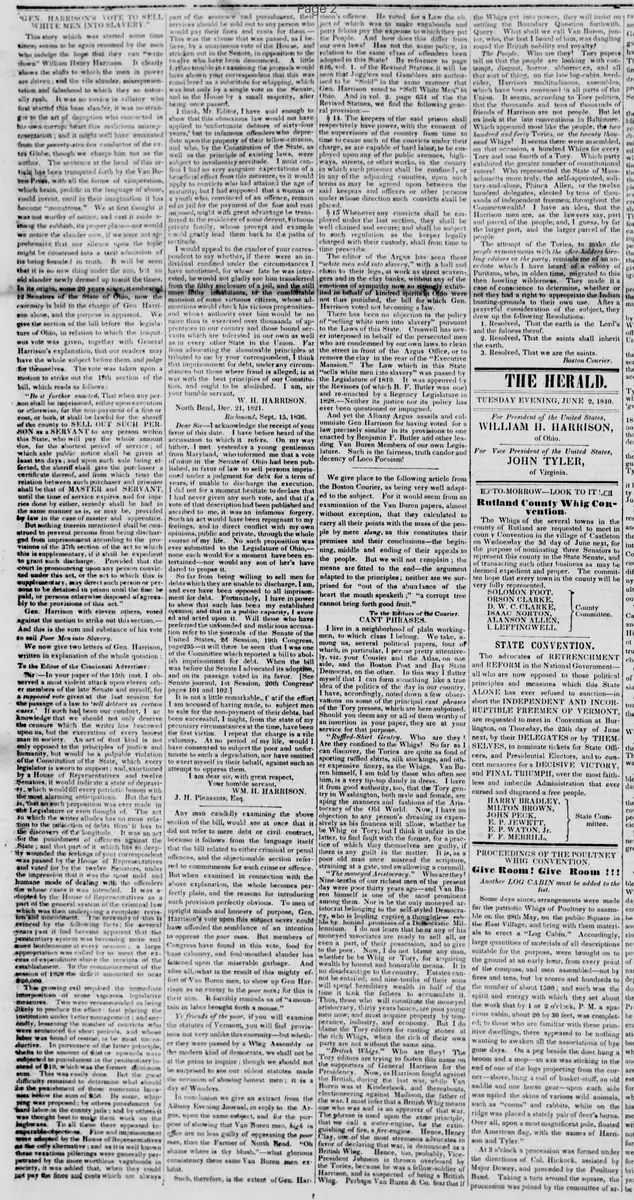
This story which was started some time since seems to be again resumed by the men who indulge the hope that they can "write down" William Henry Harrison. It clearly shows the shifts to which the men in power are driven: and the vile slander, misrepresentation and falsehood to which they so naturally run. It was no novice in villainy who first started this base slander. It was no stranger to the art of deception who concocted in his own corrupt heart this malicious misrepresentation: and it might well have emanated from the poverty-stricken conductor of the extra Globe, though we charge him not as the author. The sentence at the head of this article has been trumpeted forth by the Van Buren Press, with all the forms of vituperation, which brain, prolific in the language of abuse, could invent, until in their imagination it has become "monstrous." We at first thought it was not worthy of notice, and cast it aside among the rubbish, its proper place—nor would we notice the slander now, if we were not apprehensive that our silence upon the topic might be construed into a tacit admission of its being founded in truth. It will be seen that it is no new thing under the sun, but an old slander newly dressed up to suit the times. In its origin, some 20 years since, it embraced 19 Senators of the State of Ohio, now the enormity is laid to the charge of Gen. Harrison alone, and the purpose is apparent. We give the section of the bill before the legislature of Ohio, in relation to which the iniquitous vote was given, together with General Harrison's explanation, that our readers may have the whole subject before them, and judge for themselves. The vote was taken upon a motion to strike out the 18th section of the bill, which reads as follows:
"Be it further enacted, That when any person shall be imprisoned, either upon execution or otherwise, for the non-payment of a fine or cost, or both, it shall be lawful for the sheriff of the county to SELL SUCH PERSON as a SERVANT to any person within this State, who will pay the whole amount due, for the shortest period of service; of which sale public notice shall be given at least ten days; and upon such sale being effected, the sheriff shall give the purchaser a certificate thereof, and from which time the relation between such purchaser and prisoner shall be that of MASTER and SERVANT, until the time of service expires and for injuries done by either, remedy shall be had in the same manner as is, or may be, provided by law in the case of master and apprentice. But nothing therein mentioned shall be construed to prevent persons from being discharged from imprisonment according to the provisions of the 37th section of the act to which this is supplementary, if it shall be expedient to grant such discharge. Provided that the court in pronouncing upon any person convicted under this act, or the act to which this is supplementary, may direct such person or persons to be detained in prison until the fine be paid, or persons otherwise disposed of agreeably to the provisions of this act."
Gen. Harrison with eleven others, voted against the motion to strike out this section. And this is the sum and substance of his vote to sell Poor Men into Slavery.
We now give two letters of Gen. Harrison, written in explanation of the whole question:
To the Editor of the Cincinnati Advertiser:
Sir:—In your paper of the 15th inst. I observed a most violent attack upon eleven other members of the late Senate and myself, for a supposed vote given at the last session for the passage of a law to 'sell debtors in certain cases.' If such had been our conduct, I acknowledge that we should not only deserve the censure which the writer has bestowed upon us, but the execration of every honest man in society. An act of that kind is not only opposed to the principles of justice and humanity, but would be a palpable violation of the Constitution of the State, which every legislator is sworn to support; and, sanctioned by a House of Representatives and twelve Senators, it would indicate a state of depravity, which would fill every patriotic bosom with the most alarming anticipations. But the fact is, that so such proposition was ever made in the Legislature or even thought of. The act to which the writer alludes has no more relation to the collection of debts than it has to the discovery of the longitude. It was an act for the punishment of offences against the State; and that part of it which has so deeply wounded the feelings of your correspondent was passed by the House of Representatives and voted for by the twelve Senators, under the impression that it was the most mild and humane mode of dealing with the offenders for whose cases it was intended. It was adopted by the House of Representatives as a part of the general system of the criminal law which was then undergoing a complete revision and amendment. The necessity of this is evinced by the following facts; for several years past it had become apparent that the penitentiary system was becoming more and more burdensome at every session; a large appropriation was called for to meet the excess of expenditure above the receipts of the establishment. In the commencement of the session of 1820 the deficit amounted to near $20,000.
This growing evil required the immediate imposition of some vigorous legislative measures. Two were recommended as being likely to produce the effect: first placing the institution under better management: and secondly, lessening the number of convicts who were sentenced for short periods, and whose labor was found of course, to be most unproductive. In pursuance of the latter principle, thefts to the amount of $5 or upwards were subjected to punishment in the penitentiary instead of $10, which was the former minimum sum. This was easily done. But the great difficulty remained to determine what should be the punishment of those numerous larcenies below the sum of $5. By some, whipping was proposed; by others punishment by hard labor in the county jails; and by others it was thought best to make them work on the highways. To all these there appeared insuperable objections. Fine and imprisonment were adopted by the House of Representatives as the only alternative; and as it is well known these vexatious pilferings were generally perpetrated by the more worthless vagabonds in society, it was added that, when they could not pay the fines and costs which are always part of the sentence and punishment, their services should be sold out to any person who would pay their fines and costs for them. This was the clause that was passed, as I believe, by a unanimous vote of the House, and stricken out in the Senate, in opposition to the twelve who have been denounced. A little further trouble in examining the journals would have shown your correspondent that this was considered as a substitute for whipping, which was lost only by a single vote in the Senate, and in the House by a small majority, after being once passed. I think, Mr. Editor, I have said enough to show that this obnoxious law would not have applied to 'unfortunate debtors of sixty-four years,' but to infamous offenders who depredate upon the property of their fellow-citizens, and who, by the Constitution of the State, as well as the principle of existing laws, were subject to involuntary servitude. I must confess I had no very sanguine expectations of a beneficial effect from this measure, as it would apply to convicts who had attained the age of maturity; but I had supposed that a woman or a youth who, convicted of an offence, remained in jail for the payment of the fine and cost imposed, might with great advantage be transferred to the residence of some decent, virtuous private family, whose precept and example would greatly lead them back to the paths of rectitude.
I would appeal to the candor of your correspondent to say whether, if there were an individual confined under the circumstances I have mentioned, for whose fate he was interested, he would not gladly see him transferred from the filthy enclosure of a jail, and the still more filthy inhabitants, to the comfortable mansion of some virtuous citizen, whose admonitions would check his vicious propensities—and whose authority over him would be no more than is exercised over thousands of apprentices in our country and those bound servants which are tolerated in our own as well as in every other State in the Union. Far from advocating the abominable principles attributed to me by your correspondent, I think that imprisonment for debt, under any circumstances but those where fraud is alleged, is at war with the best principles of our Constitution, and ought to be abolished. I am, sir, your humble servant,
W. H. HARRISON.
North Bend, Dec. 21, 1821.
Richmond, Sept. 15, 1836
Dear Sir—I acknowledge the receipt of your favor of this date. I have before heard of the accusation to which it refers. On my way hither, I met yesterday a young gentleman from Maryland, who informed me that a vote of mine in the Senate of Ohio had been published, in favor of law to sell persons imprisoned under a judgment for debt for a term of years, if unable to discharge the execution. I did not for a moment hesitate to declare that I had never given any such vote, and that if a vote of that description had been published and ascribed to me, it was an infamous forgery. Such an act would have been repugnant to my feelings, and in direct conflict with my own opinions, public and private, through the whole course of my life. No such proposition was ever submitted to the Legislature of Ohio,—none such would for a moment have been entertained—nor would any son of hers have dared to propose it. So far from being willing to sell men for debts which they are unable to discharge, I am, and ever have been opposed to all imprisonment for debt. Fortunately, I have it in my power to show that such has been my established opinion; and that in a public capacity, I avowed and acted upon it. Will those who have preferred the unfounded and malicious accusation refer to the journals of the Senate of the United States, 2d Session, 19th Congress, page 35—it will there be seen that I was one of the Committee which reported a bill to abolish imprisonment for debt. When the bill was before the Senate I advocated its adoption, and on its passage voted in its favor. [See Senate journal, 1st Session, 20th Congress, pages 101 and 102.]
It is not a little remarkable, that if the effort I am accused of having made, to subject men to sale for the non-payment of their debts, had been successful, I might, from the state of my pecuniary circumstances at the time, have been the first victim. I repeat the charge is a vile calumny. At no period of my life, would I have consented to subject the poor and unfortunate to such a degradation, nor have omitted to exert myself in their behalf, against such an attempt to oppress them.
I am dear sir, with great respect,
Your humble servant,
WM. H. HARRISON.
J. H. Pleasants, Esq.
Any man candidly examining the above section of the bill, would see at once that it did not refer to mere debt or civil contract, because it follows from the language itself that the bill related to either criminal or penal offences, and the objectionable section referred to commitments for such crime or offence. But when examined in connection with the above explanation, the whole becomes perfectly plain, and the reasons for introducing such provision perfectly obvious. To men of upright minds and honesty of purpose, Gen. Harrison's vote upon this subject never could have afforded the semblance of an intention to oppress the poor man. But members of Congress have found in this vote, food for base calumny, and foul-mouthed slander has fattened upon the miserable garbage. And after all, what is the result of this mighty effort of Van Buren men, to show up Gen. Harrison as an enemy to the poor man: for this is their aim. It forcibly reminds us of "a mountain in labor brought forth a mouse."
Ye friends of the poor, if you will examine the statutes of Vermont you will find provisions not very unlike this enormity—but whether they were passed by a Whig Assembly or the modern kind of democrats, we shall not be at the pains to inquire; though we should not be surprised to see our oldest statutes made the occasion of abusing honest men: it is a day of Wonders.
In conclusion we give an extract from the Albany Evening Journal, in reply to the Argus, upon the same subject, and for the purpose of showing that Van Buren men, high in office are no less guilty of oppressing the poor man, than the Farmer of North Bend. "Oh shame where is thy blush,"—what glorious consistency these same Van Buren men exhibit.
Such, therefore, is the extent of Gen. Harrison's offence. He voted for a Law the object of which was to make vagabonds and petty felons pay the expense to which they put the People. And how does this differ from our own laws! Has not the same policy, in relation to the same class of offenders been adopted in this State! By reference to page 616, vol. 1. of the Revised Statutes, it will be seen that Jugglers and Gamblers are authorized to be "Sold" in the same manner that Gen. Harrison voted to "Sell White Men" in Ohio. And in vol. 2. page 634 of the Revised Statutes, we find the following general provision:-
§14. The keepers of the said prison shall respectively have power, with the consent of the supervisors of the county from time to time to cause such of the convicts under their charge, as are capable of hard labor, to be employed upon any of the public avenues, highways, streets, or other works, in the county in which such prisoner shall be confined, or in any of the adjoining counties, upon such terms as may be agreed upon between the said keepers and officers or other persons under whose direction such convicts shall be placed.
§15. Whenever any convicts shall be employed under the last section, they shall be well chained and secure: and shall be subject to such regulation as the keeper legally charged with their custody, shall from time to time prescribe.
The editor of the Argus has seen these "white men sold into slavery," with a ball and chain to their legs, at work as street scavengers and in the clay banks, without any of the emotions of sympathy now so strongly exhibited in behalf of kindred spirits in Ohio were not thus punished, the bill for which Gen. Harrison voted not becoming a law.
There has been no objection to the policy of "selling white men into slavery" pursuant to the Laws of this State, Croswell has never interposed in behalf of the persecuted men who are condemned by our own laws, to clean the street in front of the Argus Office, or to remove the clay in the rear of the "Executive Mansion." The Law which in this State "sells white men into slavery" was passed by the Legislature of 1819. It was approved by the Revisors (of which B. F. Butler was one) and re-enacted by a Regency Legislature in 1828.—Neither its justice nor its policy has ever been questioned or impugned.
And yet the Albany Argus assails and calumniate Gen Harrison for having voted for a law precisely similar in its provisions to one enacted by Benjamin F. Butler and other leading Van Buren Members of our own Legislature. Such is the fairness, truth candor and decency of Loco Focoism!
We give place to the following article from the Boston Courier, as being very well adapted to the subject. For it would seem from an examination of the Van Buren papers, almost without exception, that they calculated to carry all their points with the mass of the people by mere slang, as this constitutes their premises and their conclusions—the beginning, middle and ending of their appeals to the people. But we will not complain; the means are fitted to the end—the argument adapted to the principles; neither are we surprised for "out of the abundance of the heart the mouth speaketh;" "a corrupt tree cannot bring forth good fruit."
To the Editors of the Courier.
CANT PHRASES.
I live in a neighborhood of plain working-men, to which class I belong. We take, among us, several political papers, four of which, in particular, I peruse pretty attentively, viz. your Courier and the Atlas, on one side, and the Boston Post and Bay State Democrat, on the other. In this way I flatter myself that I can form something like a true idea of the politics of the day in our country. I have, accordingly, noted down a few observations on some of the principal cant phrases of the Tory presses, which are here subjoined. Should you deem any or all of them worthy of an insertion in your paper, they are at your service for that purpose.
"Ruffled-Shirt Gentry." Who are they? Are they confined to the Whigs? So far as I can discover, the Tories are quite as fond of sporting ruffled shirts, silk stockings, and other expensive finery, as the Whigs. Van Buren himself, I am told by those who often see him, is a very tip-top dandy in dress. I have it from good authority, too, that the Tory gentry in Washington, both male and female, are aping the manners and fashions of the Aristocracy of the Old World. Now, I have no objection to any person's dressing as expensively as his finances will allow, whether he be Whig or Tory; but I think it unfair in the latter, to find fault with the former, for a practice of which they themselves are guilty, if there is any guilt in the matter. It is, as a poor old man once misread the scripture, straining at a gnat, and swallowing a camel.
"The moneyed Aristocracy." Who are they? Nine-tenths of our richest men of the present day were poor thirty years ago—and Van Buren himself is one of the most prominent among them. Nor is he the only moneyed aristocrat belonging to the self-styled Democracy, who is leading captive a thoughtless rabble by honied promises of a Democratic Millennium. I do not learn that he or any of his moneyed associates are ready to sell all, or even a part, of their possessions, and to give to the poor. Now, I do not blame any man, whether he be Whig or Tory, for acquiring wealth by honest and honorable means. It is no disadvantage to the country. Estates cannot be entailed; and nine-tenths of their sons will spend hereditary wealth in half of the time it took the fathers to accumulate it. Thus, those who will constitute the moneyed aristocracy, thirty years hence, are poor young men now; and must acquire property by temperance, industry, and economy. But I do blame the Tory editors for casting stones at the rich Whigs, when the rich of their own party are not without the same sins.
"British Whigs." Who are they? The Tory editors are trying to fasten this name on the supporters of General Harrison for the Presidency. Now, as Harrison fought against the British, during the last war, while Van Buren was at Kinderhook, and thereabouts, electioneering against Madison, the father of the war, I must infer that a British Whig means one who was and is an approver of that war. The phrase is used upon the same principle, that we call a water-engine, for the extinguishing of fire, a fire-engine. Hence, Henry Clay, one of the most strenuous advocates in favor of declaring that war, is denounced as a British Whig. Hence, too, probably, Vice-President Johnson is thrown overboard by the Tories, because he was a fellow-soldier of Harrison, and is suspected of being a British Whig. Perhaps Van Buren & Co. fear that if the Whigs get into power, they will insist on settling the Boundary Question forthwith.
Query. What shall we call Van Buren, junior, who, the last I heard of him, was dangling round the British nobility and royalty?
The People. Who are they? Tory papers tell us that the people are looking with contempt, disgust, horror, abhorrence, and all that sort of thing, on the late log-cabin, hard cider, Harrison multitudinous assemblies which have been convened in all parts of the Union. It seems, according to Tory politics, that the thousands and tens of thousands of friends of Harrison are not people. But let us look at the late conventions in Baltimore. Which appeared most like the people, the four hundred and forty Tories, or the twenty thousand Whigs! It seems there were assembled, on that occasion, a hundred Whigs for every Tory and one fourth of a Tory. Which party exhibited the greater number of constitutional voters? Who represented the State of Massachusetts more truly: the self-appointed, solitary-and-alone, Phineas Allen, or the twelve hundred delegates, elected by tens of thousands of independent freemen: throughout the Commonwealth? I have an idea, that the Harrison men are, as the lawyers say, part and parcel of the people; and, I guess, by far the larger part, and the larger parcel of the people.
The attempt of the Tories, to make the people synonymous with the office-holders, hireling editors or the party, reminds me of an anecdote which I have heard of a colony of Puritans, who, in olden time, migrated to this then howling wilderness. They made it a case of conscience to determine, whether or not they had a right to appropriate the Indian hunting-grounds to their own use. After a prayerful consideration of the subject, they drew up the following Resolutions:
1. Resolved, That the earth is the Lord's and the fulness thereof.
2. Resolved, That the saints shall inherit the earth.
3. Resolved, That we are the saints.
Boston Courier.
What sub-type of article is it?
What keywords are associated?
What entities or persons were involved?
Editorial Details
Primary Topic
Defense Against Accusation Of Voting To Sell Poor Men Into Servitude
Stance / Tone
Strongly Defensive Of Harrison, Critical Of Van Buren Slander
Key Figures
Key Arguments