Thank you for visiting SNEWPapers!
Sign up free
Editorial
March 19, 1792
National Gazette
Philadelphia, Philadelphia County, Pennsylvania
What is this article about?
Brutus critiques the U.S. funding system in this editorial, arguing it creates a wealthy faction dependent on the Treasury Department, leading to increased federal power, new taxes, and erosion of state sovereignty and republican principles. Written for the National Gazette, dated March 17.
Clipping
OCR Quality
95%
Excellent
Full Text
For the NATIONAL GAZETTE.
BRUTUS, No. II.
On the FUNDING SYSTEM.
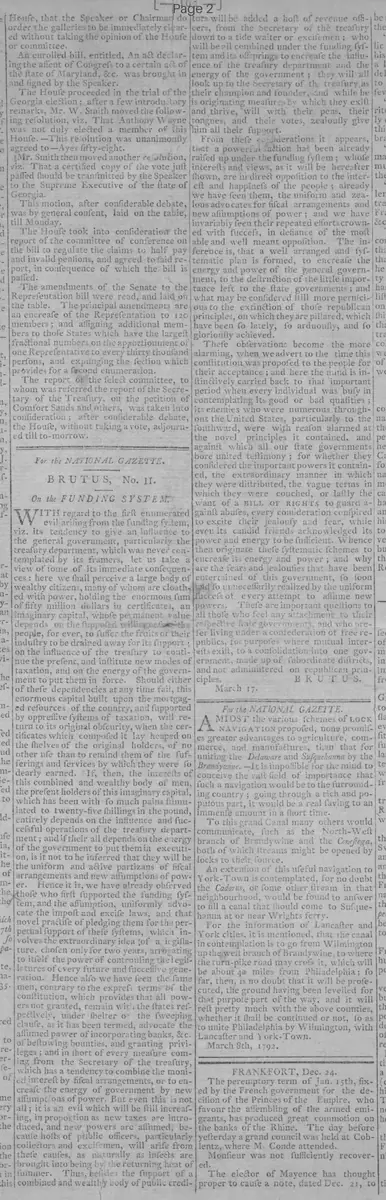
With regard to the first enumerated evil arising from the funding system, viz. its tendency to give an influence to the general government, particularly the treasury department, which was never contemplated by its framers, let us take a view of some of its immediate consequences: here we shall perceive a large body of wealthy citizens, many of whom are clothed with power, holding the enormous sum of fifty million dollars in certificates, an imaginary capital, whose permanent value depends on the supposed willingness of the people, for ever, to suffer the fruits of their industry to be drained away for its support; on the influence of the treasury to continue the present, and institute new modes of taxation, and on the energy of the government to put them in force. Should either of these dependencies at any time fail, this enormous capital built upon the mortgaged resources of the country, and supported by oppressive systems of taxation, will return to its original obscurity, when the certificates which composed it lay heaped on the shelves of the original holders, of no other use than to remind them of the sufferings and services by which they were so dearly earned. If, then, the interests of this combined and wealthy body of men, the present holders of this imaginary capital, which has been with so much pains stimulated to twenty-five shillings in the pound, entirely depends on the influence and successful operations of the treasury department; and if their all depends on the energy of the government to put them in execution, is it not to be inferred that they will be the uniform and active partisans of fiscal arrangements and new assumptions of power.
Hence it is, we have already observed those who first supported the funding system, and the assumption, uniformly advocate the impost and excise laws, and that novel practice of pledging them for the perpetual support of these systems, which involves the extraordinary idea of a legislature, chosen only for two years, arrogating to itself the power of controlling the legislatures of every future and successive generation. Hence also we have seen the same men, contrary to the express terms of the constitution, which provides that all powers not granted, remain with the states respectively, under shelter of the sweeping clause, as it has been termed, advocate the assumed power of incorporating banks, &c. of bestowing bounties, and granting privileges; and in short of every measure coming from the Secretary of the treasury, which has a tendency to combine the monied interest by fiscal arrangements, or to increase the energy of government by new assumptions of power. But even this is not all; it is an evil which will be still increasing, in proportion as new taxes are introduced, and new powers are assumed, because hosts of public officers, particularly collectors and excisemen, will arise from these causes, as naturally as insects are brought into being by the returning heat of summer. Thus, besides the support of a combined and wealthy body of public creditors will be added a host of revenue officers, from the Secretary of the treasury down to a tide waiter or exciseman; who will be all combined under the funding system and its offsprings to increase the influence of the treasury department and the energy of the government; they will all look up to the Secretary of the treasury as their champion and founder, and while he is originating measures by which they exist and thrive, will with their pens, their tongues, and their votes, zealously give him all their support.
From these considerations it appears, that a powerful faction had been already raised up under the funding system; whose interests and views, as it will be hereafter shown, are in direct opposition to the interest and happiness of the people; already we have seen them, the uniform and zealous advocates for fiscal arrangements and new assumptions of power; and we have invariably seen their repeated efforts crowned with success, in defiance of the most able and well meant opposition. The inference is, that a well arranged and systematic plan is formed, to increase the energy and power of the general government, to the destruction of the little importance left to the state governments; and what may be considered still more pernicious to the extinction of those republican principles, on which they are pillared, which have been so lately, so arduously, and so gloriously achieved.
These observations become the more alarming, when we advert to the time this constitution was proposed to the people for their acceptance; and here the mind is instinctively carried back to that important period when every individual was busy in contemplating its good or bad qualities; its enemies who were numerous throughout the United States, particularly to the southward, were with reason alarmed at the novel principles it contained, and against which all our state governments bore united testimony; for whether they considered the important powers it contained, the extraordinary manner in which they were distributed, the vague terms in which they were couched, or lastly the want of a BILL OF RIGHTS to guard against abuses, every consideration conspired to excite their jealousy and fear, while even its candid friends acknowledged its power and energy to be sufficient. Whence then originate these systematic schemes to increase its energy and power; and why are the fears and jealousies that have been entertained of this government, so soon and so unnecessarily realized by the uniform success of every attempt to assume new powers. These are important questions to all those who feel any attachment to their respective state governments, and who prefer living under a confederation of free republics, for purposes where mutual interests exist, to a consolidation into one government, made up of subordinate districts, and not administered on republican principles.
BRUTUS.
March 17.
BRUTUS, No. II.
On the FUNDING SYSTEM.
With regard to the first enumerated evil arising from the funding system, viz. its tendency to give an influence to the general government, particularly the treasury department, which was never contemplated by its framers, let us take a view of some of its immediate consequences: here we shall perceive a large body of wealthy citizens, many of whom are clothed with power, holding the enormous sum of fifty million dollars in certificates, an imaginary capital, whose permanent value depends on the supposed willingness of the people, for ever, to suffer the fruits of their industry to be drained away for its support; on the influence of the treasury to continue the present, and institute new modes of taxation, and on the energy of the government to put them in force. Should either of these dependencies at any time fail, this enormous capital built upon the mortgaged resources of the country, and supported by oppressive systems of taxation, will return to its original obscurity, when the certificates which composed it lay heaped on the shelves of the original holders, of no other use than to remind them of the sufferings and services by which they were so dearly earned. If, then, the interests of this combined and wealthy body of men, the present holders of this imaginary capital, which has been with so much pains stimulated to twenty-five shillings in the pound, entirely depends on the influence and successful operations of the treasury department; and if their all depends on the energy of the government to put them in execution, is it not to be inferred that they will be the uniform and active partisans of fiscal arrangements and new assumptions of power.
Hence it is, we have already observed those who first supported the funding system, and the assumption, uniformly advocate the impost and excise laws, and that novel practice of pledging them for the perpetual support of these systems, which involves the extraordinary idea of a legislature, chosen only for two years, arrogating to itself the power of controlling the legislatures of every future and successive generation. Hence also we have seen the same men, contrary to the express terms of the constitution, which provides that all powers not granted, remain with the states respectively, under shelter of the sweeping clause, as it has been termed, advocate the assumed power of incorporating banks, &c. of bestowing bounties, and granting privileges; and in short of every measure coming from the Secretary of the treasury, which has a tendency to combine the monied interest by fiscal arrangements, or to increase the energy of government by new assumptions of power. But even this is not all; it is an evil which will be still increasing, in proportion as new taxes are introduced, and new powers are assumed, because hosts of public officers, particularly collectors and excisemen, will arise from these causes, as naturally as insects are brought into being by the returning heat of summer. Thus, besides the support of a combined and wealthy body of public creditors will be added a host of revenue officers, from the Secretary of the treasury down to a tide waiter or exciseman; who will be all combined under the funding system and its offsprings to increase the influence of the treasury department and the energy of the government; they will all look up to the Secretary of the treasury as their champion and founder, and while he is originating measures by which they exist and thrive, will with their pens, their tongues, and their votes, zealously give him all their support.
From these considerations it appears, that a powerful faction had been already raised up under the funding system; whose interests and views, as it will be hereafter shown, are in direct opposition to the interest and happiness of the people; already we have seen them, the uniform and zealous advocates for fiscal arrangements and new assumptions of power; and we have invariably seen their repeated efforts crowned with success, in defiance of the most able and well meant opposition. The inference is, that a well arranged and systematic plan is formed, to increase the energy and power of the general government, to the destruction of the little importance left to the state governments; and what may be considered still more pernicious to the extinction of those republican principles, on which they are pillared, which have been so lately, so arduously, and so gloriously achieved.
These observations become the more alarming, when we advert to the time this constitution was proposed to the people for their acceptance; and here the mind is instinctively carried back to that important period when every individual was busy in contemplating its good or bad qualities; its enemies who were numerous throughout the United States, particularly to the southward, were with reason alarmed at the novel principles it contained, and against which all our state governments bore united testimony; for whether they considered the important powers it contained, the extraordinary manner in which they were distributed, the vague terms in which they were couched, or lastly the want of a BILL OF RIGHTS to guard against abuses, every consideration conspired to excite their jealousy and fear, while even its candid friends acknowledged its power and energy to be sufficient. Whence then originate these systematic schemes to increase its energy and power; and why are the fears and jealousies that have been entertained of this government, so soon and so unnecessarily realized by the uniform success of every attempt to assume new powers. These are important questions to all those who feel any attachment to their respective state governments, and who prefer living under a confederation of free republics, for purposes where mutual interests exist, to a consolidation into one government, made up of subordinate districts, and not administered on republican principles.
BRUTUS.
March 17.
What sub-type of article is it?
Constitutional
Economic Policy
Partisan Politics
What keywords are associated?
Funding System
Treasury Influence
Federal Power
State Rights
Public Creditors
Assumption Of Power
Fiscal Arrangements
What entities or persons were involved?
Treasury Department
Secretary Of The Treasury
Public Creditors
State Governments
Editorial Details
Primary Topic
Critique Of The Funding System And Its Tendency To Increase Federal Power
Stance / Tone
Opposition To Funding System And Centralization Of Power
Key Figures
Treasury Department
Secretary Of The Treasury
Public Creditors
State Governments
Key Arguments
Funding System Creates Influence For General Government Beyond Framers' Intent
Wealthy Certificate Holders Depend On Treasury And Taxation, Becoming Partisans For Fiscal Measures
Supporters Advocate Impost, Excise Laws, Bank Incorporation, And New Powers Contrary To Constitution
System Raises Revenue Officers Who Support Treasury Influence
Forms Faction Opposing People's Interests, Aiming To Destroy State Governments And Republican Principles
Realizes Fears From Constitution's Adoption By Assuming New Powers