Thank you for visiting SNEWPapers!
Sign up free
Toledo Union Journal
Toledo, Lucas County, Ohio
What is this article about?
President Truman signed the anti-union Hobbs' Bill into law on July 12, 1946, despite objections from AFL and CIO leaders, imposing fines up to $10,000 and 20-year sentences for obstructing interstate commerce through robbery or extortion. The bill stemmed from a 1942 Supreme Court decision and aimed at union practices in New York.
Clipping
OCR Quality
Full Text
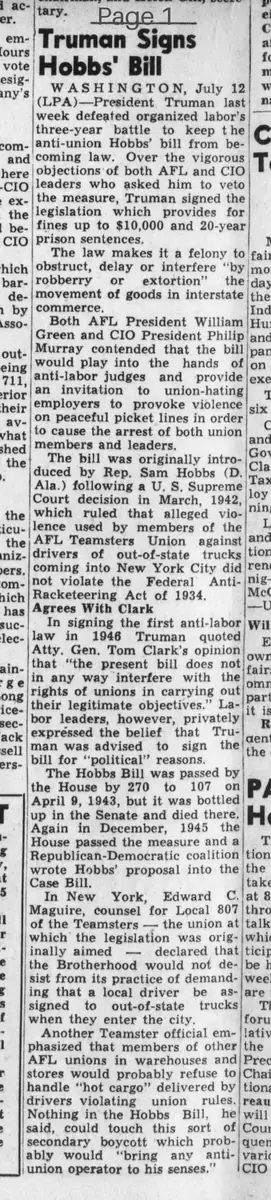
WASHINGTON, July 12 (LPA)-President Truman last week defeated organized labor's three-year battle to keep the anti-union Hobbs' bill from becoming law. Over the vigorous objections of both AFL and CIO leaders who asked him to veto the measure, Truman signed the legislation which provides for fines up to $10,000 and 20-year prison sentences.
The law makes it a felony to obstruct, delay or interfere "by robbery or extortion the movement of goods in interstate commerce.
Both AFL President William Green and CIO President Philip Murray contended that the bill would play into the hands of anti-labor judges and provide an invitation to union-hating employers to provoke violence on peaceful picket lines in order to cause the arrest of both union members and leaders.
The bill was originally introduced by Rep. Sam Hobbs (D, Ala.) following a U. S. Supreme Court decision in March. 1942, which ruled that alleged violence used by members of the AFL Teamsters Union against drivers of out-of-state trucks coming into New York City did not violate the Federal Anti-Racketeering Act of 1934.
Agrees With Clark
In signing the first anti-labor law in 1946 Truman quoted Atty. Gen. Tom Clark's opinion that "the present bill does not in any way interfere with the rights of unions in carrying out their legitimate objectives." Labor leaders, however, privately expressed the belief that Truman was advised to sign the bill for "political" reasons.
The Hobbs Bill was passed by the House by 270 to 107 on April 9, 1943, but it was bottled up in the Senate and died there. Again in December, 1945 the House passed the measure and a Republican-Democratic coalition wrote Hobbs' proposal into the Case Bill.
In New York, Edward C. Maguire, counsel for Local 807 of the Teamsters — the union at which the legislation was originally aimed — declared that the Brotherhood would not desist from its practice of demanding that a local driver be assigned to out-of-state trucks when they enter the city.
Another Teamster official emphasized that members of other AFL unions in warehouses and stores would probably refuse to handle "hot cargo" delivered by drivers violating union rules. Nothing in the Hobbs Bill, he said, could touch this sort of secondary boycott which probably would "bring any anti-union operator to his senses."
What sub-type of article is it?
What keywords are associated?
What entities or persons were involved?
Where did it happen?
Domestic News Details
Primary Location
Washington
Event Date
July 12
Key Persons
Outcome
the bill provides for fines up to $10,000 and 20-year prison sentences for obstructing interstate commerce by robbery or extortion; signed into law despite labor objections.
Event Details
President Truman signed the Hobbs' Bill, making it a felony to obstruct interstate commerce through robbery or extortion, aimed at union practices following a 1942 Supreme Court decision on Teamsters in New York; labor leaders objected, fearing misuse against peaceful pickets.