Thank you for visiting SNEWPapers!
Sign up free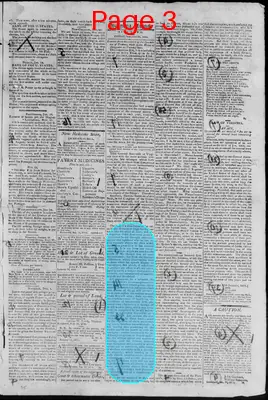
Editorial
January 25, 1811
Virginia Argus
Richmond, Virginia
What is this article about?
Editorial vehemently opposes any idea of dissolving the American Union, criticizing Mr. Quincy's speech for promoting discord and ambition centered on Massachusetts. Warns of resulting anarchy, wars, foreign subjugation, and loss of liberty, drawing on historical examples from ancient Greece, the Germanic Empire, and France.
Clipping
OCR Quality
98%
Excellent
Full Text
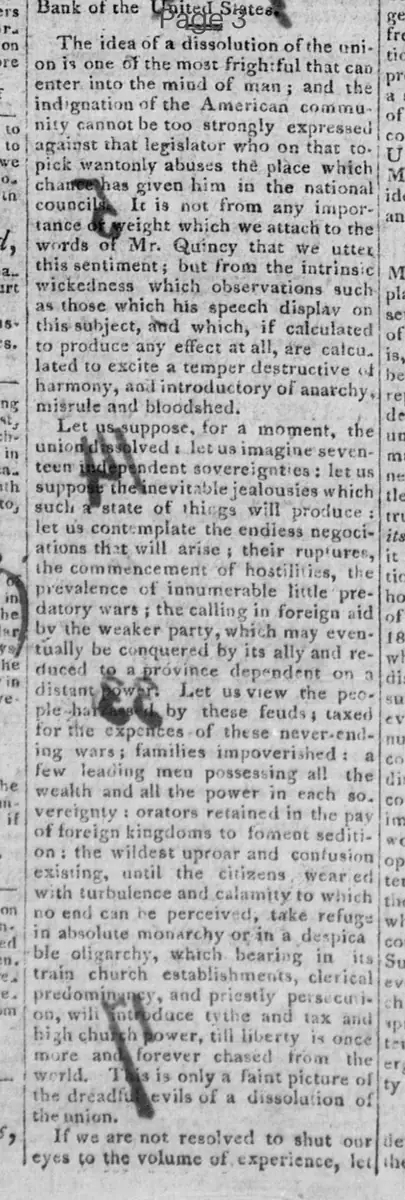
The idea of a dissolution of the union is one of the most frightful that can enter into the mind of man; and the indignation of the American community cannot be too strongly expressed against that legislator who on that topic wantonly abuses the place which chance has given him in the national councils. It is not from any importance or weight which we attach to the words of Mr. Quincy that we utter this sentiment; but from the intrinsic wickedness which observations such as those which his speech displays on this subject, and which, if calculated to produce any effect at all, are calculated to excite a temper destructive of harmony, and introductory of anarchy, misrule and bloodshed.
Let us suppose, for a moment, the union dissolved : let us imagine seventeen independent sovereignties : let us suppose the inevitable jealousies which such a state of things will produce : let us contemplate the endless negociations that will arise ; their ruptures, the commencement of hostilities, the prevalence of innumerable little predatory wars ; the calling in foreign aid by the weaker party, which may eventually be conquered by its ally and reduced to a province dependent on a distant power.
Let us view the people--harassed by these feuds; taxed for the expences of these never-ending wars; families impoverished: a few leading men possessing all the wealth and all the power in each sovereignty : orators retained in the pay of foreign kingdoms to foment sedition : the wildest uproar and confusion existing, until the citizens, wearied with turbulence and calamity to which no end can be perceived, take refuge in absolute monarchy or in a despicable oligarchy, which bearing in its train church establishments, clerical predominancy, and priestly persecution, will introduce tithes and tax and high church power, till liberty is once more and forever chased from the world. This is only a faint picture of the dreadful evils of a dissolution of the union.
If we are not resolved to shut our eyes to the volume of experience, let us look to Greece, whose ruin was brought on by state jealousies and a dissolution of their league. Or, if that example be thought too musty for modern politicians, let us pay some attention to the revolutionary events of our own times. The Germanic constitution, wisely organized to preserve the integrity and duration of the empire, has been sacrificed to the ambition of the members of that political body. Prussia would be a kingdom, and accordingly at the commencement of the last century commenced a career which finally, under Frederick the Great, led her to contest the power of the whole empire: Prussia gained her point, and weakened the union of the Germanic confederation. Saxony and Bavaria had also raised their heads from ambitious motives, which farther detracted from the power of the Empire. What has been the consequence? The destruction of all, and their subjugation to France, whose rulers, playing one German state off against another, has completely subjected them to her will. It was not so much the genius of Bonaparte as it was the genius of discord that effected all this. That same genius of discord, which, in the sixteenth century, had nearly reduced France herself to the degraded situation of a vassal to the crown of Spain. The abilities of Henry the fourth, powerfully aided by the marquis of Rosny, drew France by a union of her parts from that dissolution which threatened her monarchy by means of her disjointed and distracted state:
Mr. Quincy avows his motive, and we plainly perceive that it is an ambitious one. It is, he says, a love of Massachusetts that makes him speak--a love which will not permit him to see her power in the Union diminished by the introduction of other states. But how is it diminished? Massachusetts must still retain all the power and consequence that her population and wealth entitle her to. And ought she to have more? We think not. If our fellow-creatures multiply & spread over the wide surface of this vast continent, making it fruitful and blooming, are the ordinations of Heaven to be arrested because Massachusetts cannot influence the councils of the nation? Are her citizens the chosen people of God, destined to rule all the other states? What injustice, what oppression, has Massachusetts sustained from the government of the Union? None. No man can point to any. Has she not, on the contrary, boasted of her power? Has she not set herself up to intimidate the Union? Witness the Embargo and the proceedings of the Essex Junto. And where are Mr. Quincy's principles of freedom? Centered, it would seem, altogether in Massachusetts. So she is free, he seems to regard no other portion of the human race. He would prefer that Orleans should remain in a state of vassalage, or in the hands of a foreign power, either of which conditions would really endanger the Union. In fine, we can discern in Mr. Quincy's speech, nothing but the ideas of a young man, a party man, and an anti federalist.
Let us suppose, for a moment, the union dissolved : let us imagine seventeen independent sovereignties : let us suppose the inevitable jealousies which such a state of things will produce : let us contemplate the endless negociations that will arise ; their ruptures, the commencement of hostilities, the prevalence of innumerable little predatory wars ; the calling in foreign aid by the weaker party, which may eventually be conquered by its ally and reduced to a province dependent on a distant power.
Let us view the people--harassed by these feuds; taxed for the expences of these never-ending wars; families impoverished: a few leading men possessing all the wealth and all the power in each sovereignty : orators retained in the pay of foreign kingdoms to foment sedition : the wildest uproar and confusion existing, until the citizens, wearied with turbulence and calamity to which no end can be perceived, take refuge in absolute monarchy or in a despicable oligarchy, which bearing in its train church establishments, clerical predominancy, and priestly persecution, will introduce tithes and tax and high church power, till liberty is once more and forever chased from the world. This is only a faint picture of the dreadful evils of a dissolution of the union.
If we are not resolved to shut our eyes to the volume of experience, let us look to Greece, whose ruin was brought on by state jealousies and a dissolution of their league. Or, if that example be thought too musty for modern politicians, let us pay some attention to the revolutionary events of our own times. The Germanic constitution, wisely organized to preserve the integrity and duration of the empire, has been sacrificed to the ambition of the members of that political body. Prussia would be a kingdom, and accordingly at the commencement of the last century commenced a career which finally, under Frederick the Great, led her to contest the power of the whole empire: Prussia gained her point, and weakened the union of the Germanic confederation. Saxony and Bavaria had also raised their heads from ambitious motives, which farther detracted from the power of the Empire. What has been the consequence? The destruction of all, and their subjugation to France, whose rulers, playing one German state off against another, has completely subjected them to her will. It was not so much the genius of Bonaparte as it was the genius of discord that effected all this. That same genius of discord, which, in the sixteenth century, had nearly reduced France herself to the degraded situation of a vassal to the crown of Spain. The abilities of Henry the fourth, powerfully aided by the marquis of Rosny, drew France by a union of her parts from that dissolution which threatened her monarchy by means of her disjointed and distracted state:
Mr. Quincy avows his motive, and we plainly perceive that it is an ambitious one. It is, he says, a love of Massachusetts that makes him speak--a love which will not permit him to see her power in the Union diminished by the introduction of other states. But how is it diminished? Massachusetts must still retain all the power and consequence that her population and wealth entitle her to. And ought she to have more? We think not. If our fellow-creatures multiply & spread over the wide surface of this vast continent, making it fruitful and blooming, are the ordinations of Heaven to be arrested because Massachusetts cannot influence the councils of the nation? Are her citizens the chosen people of God, destined to rule all the other states? What injustice, what oppression, has Massachusetts sustained from the government of the Union? None. No man can point to any. Has she not, on the contrary, boasted of her power? Has she not set herself up to intimidate the Union? Witness the Embargo and the proceedings of the Essex Junto. And where are Mr. Quincy's principles of freedom? Centered, it would seem, altogether in Massachusetts. So she is free, he seems to regard no other portion of the human race. He would prefer that Orleans should remain in a state of vassalage, or in the hands of a foreign power, either of which conditions would really endanger the Union. In fine, we can discern in Mr. Quincy's speech, nothing but the ideas of a young man, a party man, and an anti federalist.
What sub-type of article is it?
Constitutional
Partisan Politics
What keywords are associated?
Union Dissolution
Mr Quincy
Massachusetts
Federalism
Anarchy
Historical Examples
Partisan Ambition
Esex Junto
What entities or persons were involved?
Mr. Quincy
Massachusetts
Union
Essex Junto
Prussia
France
Bonaparte
Henry The Fourth
Marquis Of Rosny
Editorial Details
Primary Topic
Opposition To Dissolution Of The Union
Stance / Tone
Strongly Against Dissolution And Critical Of Mr. Quincy
Key Figures
Mr. Quincy
Massachusetts
Union
Essex Junto
Prussia
France
Bonaparte
Henry The Fourth
Marquis Of Rosny
Key Arguments
Dissolution Would Create Seventeen Independent Sovereignties Leading To Jealousies And Endless Wars
Weaker States Would Call In Foreign Aid And Risk Subjugation
People Would Be Harassed, Impoverished, And Driven To Monarchy Or Oligarchy
Historical Example: Greece Ruined By State Jealousies
Germanic Empire Weakened By Ambitions Of Prussia, Saxony, Bavaria, Leading To French Subjugation
France Saved From Dissolution By Union Under Henry Iv
Quincy's Motive Is Ambitious Love For Massachusetts Fearing Loss Of Power
Massachusetts Has Not Suffered Injustice From The Union
Quincy Is A Young Party Man And Anti Federalist