Thank you for visiting SNEWPapers!
Sign up free
Story
November 8, 1867
The Vermont Transcript
Saint Albans, Franklin County, Vermont
What is this article about?
A biographical sketch of the late Senator McDougall, depicting his decline from a promising young man to a ruined alcoholic, observed on the balcony of Congress Hall in Albany during early summer, ending with his death in September.
Clipping
OCR Quality
95%
Excellent
Full Text
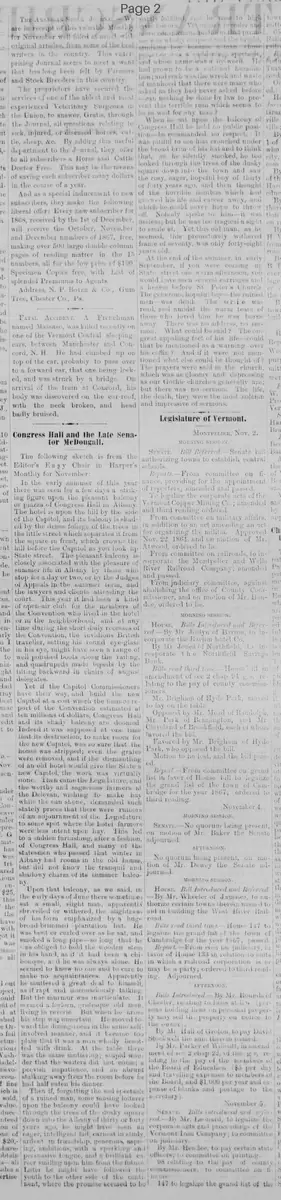
Congress Hall and the Late Senator McDougall.
The following sketch is from the Editor's Easy Chair in Harper's Monthly for November:
In the early summer of this year there was seen for a few days a striking figure upon the pleasant balcony or piazza of Congress Hall in Albany. The hotel is upon the hill by the side of the Capitol, and its balcony is shaded by the dense foliage of the trees in the little street which separates it from the square in front, which crowns the hill before the Capitol as you look up State street. The pleasant balcony is closely associated with the pleasure of summer life in Albany by those who stop for a day or two, or by the Judges of Appeals in the summer term, and the lawyers and clients attending the court. This year it had been a kind of open-air club for the members of the Convention who lived in the hotel or in the neighborhood, and at any time during the short daily recesses of the Convention, the invidious British traveller, setting his round eye-glass in his eye, might have seen a large row of well polished boots along the railing and quadrupeds made bipeds by the tilting backward in chairs of august delegates.
Yet if the Capitol Commissioners have their way, and build the new Capitol at a cost which the finance report of the Convention estimated at ten millions of dollars, Congress Hall and its shady balcony are doomed. Indeed it was supposed at one time that its destruction, to make room for the new Capitol, was so sure that the house was stripped; even the grates were removed, and if the dismantling of an old hotel would give the State a new Capitol, the work was virtually done. Then came the Legislature, and the worthy and sagacious farmers at the Delavan, wishing to make hay while the sun shone, demanded such stately prices that there were rumors of an adjournment of the Legislature to some spot where the hotel farmers were less intent upon hay. This led to a sudden furnishing, after a fashion, of Congress Hall, and many of the statesmen who passed that winter in Albany had rooms in the old house, but did not know the tranquil and shadowy charm of its summer balcony.
Upon that balcony, as we said, in the early days of June there sometimes sat a small, slight man, apparently shrivelled or withered, the slightness of his form emphasized by a huge broad-brimmed plantation hat. He was bent or curled over as he sat, and smoked a long pipe—so long that he was obliged to hold the wooden stem in his hand, as if it had been a chibouque, and he was always alone. He seemed to know no one and to care to make no acquaintances. Apparently he muttered a great deal to himself, as if rapt and unconsciously talking. But the murmur was inarticulate. It seemed a forlorn, grotesque old man, living in reverie. But when he arose his step was uncertain. He moved toward the dining-room in the same self-involved manner, and it became too plain that it was a man wholly besotted with drink. At the table there was the same muttering; stupid wonder that the waiters did not come; a peevish impatience, and an abrupt stalking away from the room before he had half eaten his dinner.
Then if, forgetting the sad spectacle of a ruined man, some musing loiterer upon the balcony could have looked through the trees of the dusky square down into the Albany of thirty or forty years ago, he might have seen an eager, intelligent lad, earnest in study, ardent in friendship, generous, aspiring, ambitious, with a sparkling and persuasive tongue, and a brilliant career smiling upon him from the future. Later he might have followed this youth to the other side of the continent, where the promise seemed to be partly fulfilled, and he rose to high honor. Vermont's proudest son, and wrote his name in characters that plodded patriots patterned. But it was wholly misunderstood. The bright, studious boy became a man whose protectee was a child in speech, and whose name was a by-word. He had grown to be a national humiliation; and such was the wreck and waste of manhood that there were many who asked as they had never asked before—can nothing be done by law to prevent this terrible ruin which seems to wait for any man?
When he sat upon the balcony of Congress Hall he held no public position—he commanded no respect. It was painful to see him crouched under the broad brim of his hat and to think that, as he silently smoked, he too looked through the trees of the dusky square down into the town and saw the rosy, eager, hopeful boy of thirty or forty years ago, and then thought of the horrible monster which had gnawed his life and career away, and which he could never hope to throw off. Nobody spoke to him—it was useless; but he was too tragical a sight to smile at. Yet this old man, as he seemed, this prematurely withered frame of seventy, was only forty-eight years old.
At the end of the summer, in early September, if you were coming up State street one warm afternoon, you would have seen several carriages and a hearse before St. Peter's Church. The generous, hopeful boy—the ruined man was dead. The service was read, and amidst the warm tears of those who loved him he was borne away. There was no address, no sermon. What could be said? The one great appalling fact of his life—could that be mentioned as a warning over his coffin? And if it were not mentioned what else could be thought of? The prayers were said in the church, which was as gloomy and depressing as our Gothic churches generally are; but there was no sermon. The life, the death, they were the most solemn and impressive of sermons.
The following sketch is from the Editor's Easy Chair in Harper's Monthly for November:
In the early summer of this year there was seen for a few days a striking figure upon the pleasant balcony or piazza of Congress Hall in Albany. The hotel is upon the hill by the side of the Capitol, and its balcony is shaded by the dense foliage of the trees in the little street which separates it from the square in front, which crowns the hill before the Capitol as you look up State street. The pleasant balcony is closely associated with the pleasure of summer life in Albany by those who stop for a day or two, or by the Judges of Appeals in the summer term, and the lawyers and clients attending the court. This year it had been a kind of open-air club for the members of the Convention who lived in the hotel or in the neighborhood, and at any time during the short daily recesses of the Convention, the invidious British traveller, setting his round eye-glass in his eye, might have seen a large row of well polished boots along the railing and quadrupeds made bipeds by the tilting backward in chairs of august delegates.
Yet if the Capitol Commissioners have their way, and build the new Capitol at a cost which the finance report of the Convention estimated at ten millions of dollars, Congress Hall and its shady balcony are doomed. Indeed it was supposed at one time that its destruction, to make room for the new Capitol, was so sure that the house was stripped; even the grates were removed, and if the dismantling of an old hotel would give the State a new Capitol, the work was virtually done. Then came the Legislature, and the worthy and sagacious farmers at the Delavan, wishing to make hay while the sun shone, demanded such stately prices that there were rumors of an adjournment of the Legislature to some spot where the hotel farmers were less intent upon hay. This led to a sudden furnishing, after a fashion, of Congress Hall, and many of the statesmen who passed that winter in Albany had rooms in the old house, but did not know the tranquil and shadowy charm of its summer balcony.
Upon that balcony, as we said, in the early days of June there sometimes sat a small, slight man, apparently shrivelled or withered, the slightness of his form emphasized by a huge broad-brimmed plantation hat. He was bent or curled over as he sat, and smoked a long pipe—so long that he was obliged to hold the wooden stem in his hand, as if it had been a chibouque, and he was always alone. He seemed to know no one and to care to make no acquaintances. Apparently he muttered a great deal to himself, as if rapt and unconsciously talking. But the murmur was inarticulate. It seemed a forlorn, grotesque old man, living in reverie. But when he arose his step was uncertain. He moved toward the dining-room in the same self-involved manner, and it became too plain that it was a man wholly besotted with drink. At the table there was the same muttering; stupid wonder that the waiters did not come; a peevish impatience, and an abrupt stalking away from the room before he had half eaten his dinner.
Then if, forgetting the sad spectacle of a ruined man, some musing loiterer upon the balcony could have looked through the trees of the dusky square down into the Albany of thirty or forty years ago, he might have seen an eager, intelligent lad, earnest in study, ardent in friendship, generous, aspiring, ambitious, with a sparkling and persuasive tongue, and a brilliant career smiling upon him from the future. Later he might have followed this youth to the other side of the continent, where the promise seemed to be partly fulfilled, and he rose to high honor. Vermont's proudest son, and wrote his name in characters that plodded patriots patterned. But it was wholly misunderstood. The bright, studious boy became a man whose protectee was a child in speech, and whose name was a by-word. He had grown to be a national humiliation; and such was the wreck and waste of manhood that there were many who asked as they had never asked before—can nothing be done by law to prevent this terrible ruin which seems to wait for any man?
When he sat upon the balcony of Congress Hall he held no public position—he commanded no respect. It was painful to see him crouched under the broad brim of his hat and to think that, as he silently smoked, he too looked through the trees of the dusky square down into the town and saw the rosy, eager, hopeful boy of thirty or forty years ago, and then thought of the horrible monster which had gnawed his life and career away, and which he could never hope to throw off. Nobody spoke to him—it was useless; but he was too tragical a sight to smile at. Yet this old man, as he seemed, this prematurely withered frame of seventy, was only forty-eight years old.
At the end of the summer, in early September, if you were coming up State street one warm afternoon, you would have seen several carriages and a hearse before St. Peter's Church. The generous, hopeful boy—the ruined man was dead. The service was read, and amidst the warm tears of those who loved him he was borne away. There was no address, no sermon. What could be said? The one great appalling fact of his life—could that be mentioned as a warning over his coffin? And if it were not mentioned what else could be thought of? The prayers were said in the church, which was as gloomy and depressing as our Gothic churches generally are; but there was no sermon. The life, the death, they were the most solemn and impressive of sermons.
What sub-type of article is it?
Biography
Tragedy
What themes does it cover?
Misfortune
Tragedy
Moral Virtue
What keywords are associated?
Senator Mcdougall
Alcoholism
Congress Hall
Albany
Tragic Decline
Vermont Senator
Ruined Career
What entities or persons were involved?
Senator Mcdougall
Where did it happen?
Congress Hall, Albany
Story Details
Key Persons
Senator Mcdougall
Location
Congress Hall, Albany
Event Date
Early Summer This Year; Thirty Or Forty Years Ago; Early September
Story Details
A promising young man from Albany rises to high honor as Vermont's proudest son but descends into alcoholism, becoming a national humiliation. Observed as a ruined figure on the balcony of Congress Hall at age 48, he dies in early September, his funeral a silent sermon on his tragic life.