Thank you for visiting SNEWPapers!
Sign up free
The Midland Journal
Rising Sun, Cecil County, Maryland
What is this article about?
Poultry experts praise insulated laying houses for maintaining egg production in cold fall and winter months when prices peak, and in summer heat. R. E. Cray of Ohio State University notes benefits like reduced feed waste and better hen comfort, based on scientific research.
Clipping
OCR Quality
Full Text
INSULATED LAYING HOUSES
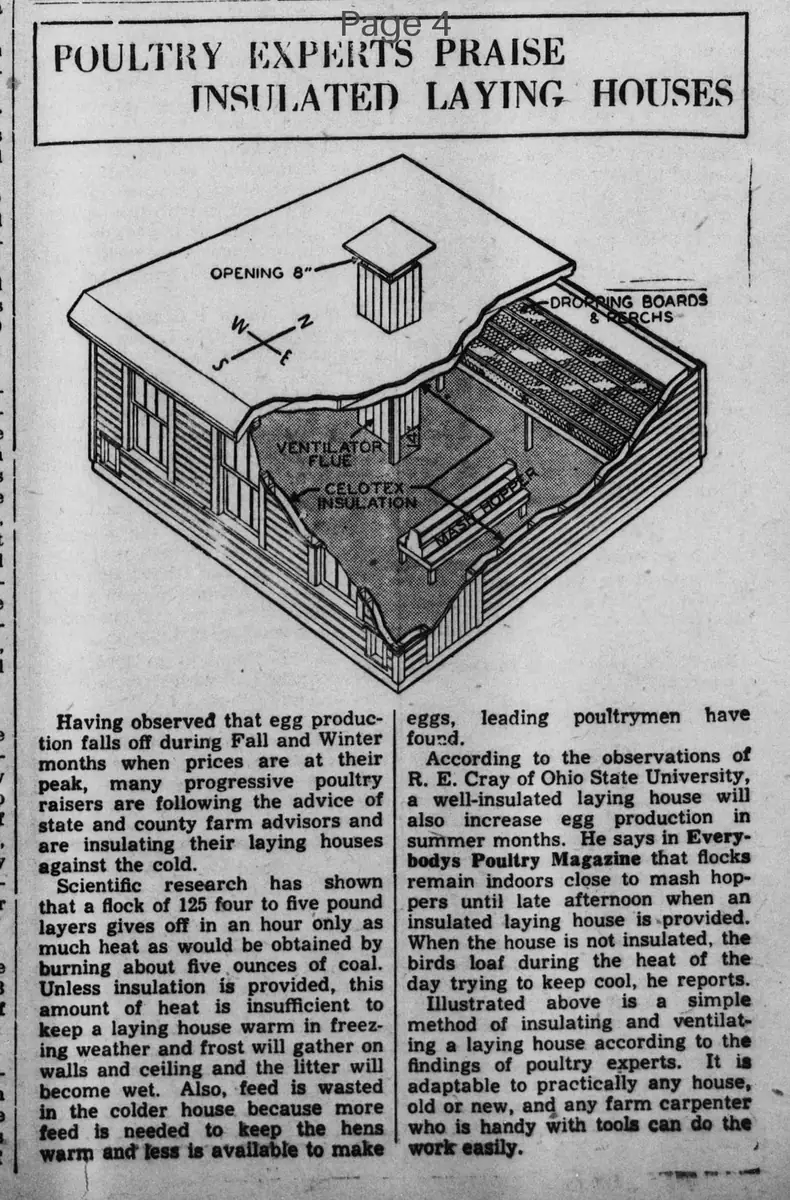
Having observed that egg production falls off during Fall and Winter months when prices are at their peak, many progressive poultry raisers are following the advice of state and county farm advisors and are insulating their laying houses against the cold.
Scientific research has shown that a flock of 125 four to five pound layers gives off in an hour only as much heat as would be obtained by burning about five ounces of coal. Unless insulation is provided, this amount of heat is insufficient to keep a laying house warm in freezing weather and frost will gather on walls and ceiling and the litter will become wet. Also, feed is wasted in the colder house because more feed is needed to keep the hens warm and less is available to make eggs, leading poultrymen have found.
According to the observations of R. E. Cray of Ohio State University, a well-insulated laying house will also increase egg production in summer months. He says in Everybodys Poultry Magazine that flocks remain indoors close to mash hoppers until late afternoon when an insulated laying house is provided. When the house is not insulated, the birds loaf during the heat of the day trying to keep cool, he reports.
Illustrated above is a simple method of insulating and ventilating a laying house according to the findings of poultry experts. It is adaptable to practically any house, old or new, and any farm carpenter who is handy with tools can do the work easily.
What sub-type of article is it?
What keywords are associated?
What entities or persons were involved?
Domestic News Details
Key Persons
Outcome
increased egg production in fall, winter, and summer; reduced feed waste; improved hen comfort in insulated houses.
Event Details
Progressive poultry raisers insulate laying houses on advice from state and county farm advisors to counter reduced egg production in cold months. Scientific research shows hens' body heat is insufficient without insulation, leading to frost, wet litter, and wasted feed. R. E. Cray observes insulated houses keep flocks productive in summer heat too. Simple insulation method adaptable to any house by farm carpenters.