Thank you for visiting SNEWPapers!
Sign up free
The Fairfield News And Herald
Winnsboro, Fairfield County, South Carolina
What is this article about?
Report on Fairfield County Court of General Sessions: Judge Pressley charges grand jury on duties and societal issues like lynching and concealed weapons. Bills for adultery, larceny, assault, murder presented. Cases include nol. pros. for murders and assaults, not guilty verdicts for larceny and assault, guilty for one, others pending.
Clipping
OCR Quality
Full Text
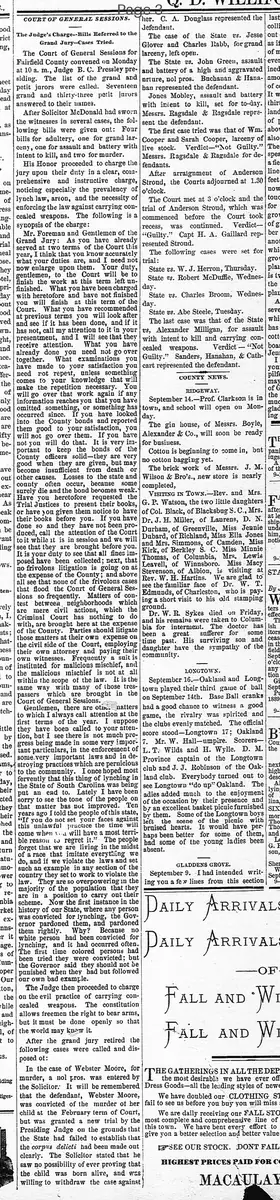
The Judge's Charge--Bills Referred to the Grand Jury--Cases Tried.
The Court of General Sessions for Fairfield County convened on Monday at 10 a. m., Judge B. C. Pressley presiding. The list of the grand and petit jurors were called. Seventeen grand and thirty-three petit jurors answered to their names.
After Solicitor McDonald had sworn the witnesses in several cases, the following bills were given out: Four bills for adultery, one for grand larceny, one for assault and battery with intent to kill, and two for murder.
His Honor proceeded to charge the jury upon their duty in a clear, comprehensive and instructive charge, noticing especially the prevalency of lynch law, arson, and the necessity of enforcing the law against carrying concealed weapons. The following is a synopsis of the charge:
Mr. Foreman and Gentlemen of the Grand Jury: As you have already served at two terms of the Court this year, I think that you know accurately what your duties are, and I need not now enlarge upon them. Your duty, gentlemen, to the Court will be to finish the work at this term left unfinished. What you have been charged with heretofore and have not finished you will finish at this term of the Court. What you have recommended at previous terms you will look after and see if it has been done, and if it has not, call my attention to it in your presentment, and I will see that they receive attention. What you have already done you need not go over together. What examinations you have made to your satisfaction you need not repeat, unless something comes to your knowledge that will make the repetition necessary. You will go over that work again if any information reaches you that you have omitted something, or something has occurred since. If you have looked into the County bonds and reported them good to your satisfaction, you will not go over them. If you have not you will do that. It is very important to keep the bonds of the County officers solid-they are very good when they are given, but may become insufficient from death or other causes. Losses to the state and county often occur, because some surety dies and the bond becomes weak.
Have you heretofore requested the Trial Justices to present their books, or have you given them notice to have their books before you. If you have done so and they have not been produced, call the attention of the Court to it while it is in session and we will see that they are brought before you.
It is your duty to see that all fines imposed have been collected; next, that no frivolous litigation is going on at the expense of the County; and above all see that none of the frivolous cases that flood the Court of General Sessions so frequently. Matters of contest between neighborhoods which are mere civil actions, which the Criminal Court has nothing to do with, are brought here at the expense of the County. Parties should litigate those matters at their own expense on the civil side of the Court, employing their own attorney and paying their own witnesses. Frequently a suit is instituted for malicious mischief, and the malicious mischief is not at all within the scope of the law. It is the same way with many of those trespassers which are brought in the Court of General Sessions.
Gentlemen, there are other matters to which I always call attention at the first terms of the year. I suppose they have been called to your attention, but I see there is not much progress being made in some very important particulars, in the enforcement of some very important laws and in destroying practices which are pernicious to the community. I once hoped most fervently that this thing of lynching in the State of South Carolina was being put an end to. Lately I have been sorry to see the tone of the people on that matter has not improved. Ten years ago I told the people of this state, "If you do not set your faces against this unlawful practice the time will come when it will have a most terrible reason to regret it." The people forget that we are living in the midst of a race that imitate everything we do, and if we violate the laws and set such an example in any section of the country they set to work to violate the law. They are so overpowering in the majority of the population that they are in a position to carry out their scheme. Now the first instance in the history of our State, where any person was convicted for lynching, the Governor pardoned them, and pardoned them rightly. Why? Because no white person had been convicted for lynching, and it had occurred often. The first time colored persons had been tried they were convicted; but the Governor said they should not be punished when they had but followed our own bad example.
The Judge then proceeded to charge on the evil practice of carrying concealed weapons. The constitution allows freemen the right to bear arms, but it must be done openly so that the world may know it.
After the grand jury retired the following cases were called and disposed of:
In the case of Webster Moore, for murder, a nol. pros. was entered by the Solicitor: It will be remembered that the defendant, Webster Moore, was convicted of the murder of her child at the February term of Court, but was granted a new trial by the Presiding Judge on the grounds that the State had failed to establish that the corpus delicti had been made out clearly. The Solicitor stated that he saw no possibility of ever proving that the child was born alive, and was willing to withdraw the case against her. C. A. Douglass represented the defendant.
The case of the State vs. Jesse Glover and Charles Rabb, for grand larceny, left open.
The State vs. John Green, assault and battery of a high and aggravated nature, nol. pros. Buchanan & Hanahan represented the defendant.
Jones Mobley, assault and battery with intent to kill, set for to-day. Messrs. Ragsdale & Ragsdale represent the defendant.
The first case tried was that of Wm. Cooper and Sarah Cooper, larceny of live stock. Verdict-"Not Guilty." Messrs. Ragsdale & Ragsdale for defendants.
After arraignment of Anderson Stroud, the Court adjourned at 1:30 o'clock.
The Court met at 3 o'clock and the trial of Anderson Stroud, which was commenced before the Court took recess, was continued. Verdict "Guilty." Capt H. A. Gaillard represented Stroud.
The following cases were set for trial:
State vs. W. J. Herron, Thursday.
State vs. Robert McDuffie, Wednesday.
State vs. Charles Broom, Wednesday.
State vs. Abe Steele, Tuesday.
The last case was that of the State vs. Alexander Milligan, for assault with intent to kill and carrying concealed weapons. Verdict-"Not Guilty." Sanders, Hanahan, & Cathcart represented the defendant.
What sub-type of article is it?
What themes does it cover?
What keywords are associated?
What entities or persons were involved?
Where did it happen?
Story Details
Key Persons
Location
Fairfield County, South Carolina
Event Date
Monday
Story Details
The Court of General Sessions convened with Judge Pressley presiding. Grand jury received bills for adultery, grand larceny, assault with intent to kill, and murder. Judge charged jury on duties, lynching, arson, and concealed weapons. Cases disposed: Webster Moore murder nol. pros.; Jesse Glover and Charles Rabb grand larceny left open; John Green assault nol. pros.; Jones Mobley assault set for trial; Wm. and Sarah Cooper larceny not guilty; Anderson Stroud guilty; others set for trial; Alexander Milligan assault and weapons not guilty.