Thank you for visiting SNEWPapers!
Sign up free
Letter to Editor
November 29, 1797
Gazette Of The United States, & Philadelphia Daily Advertiser
Philadelphia, Philadelphia County, Pennsylvania
What is this article about?
An anonymous letter from Dedham, Mass., on November 16 critiques a prior article on British allegiance via the Ship America case, questions expatriation rights, and contrasts the 1797 French revolution's authoritarianism with American liberty's checks and balances, favoring the latter.
Clipping
OCR Quality
98%
Excellent
Full Text
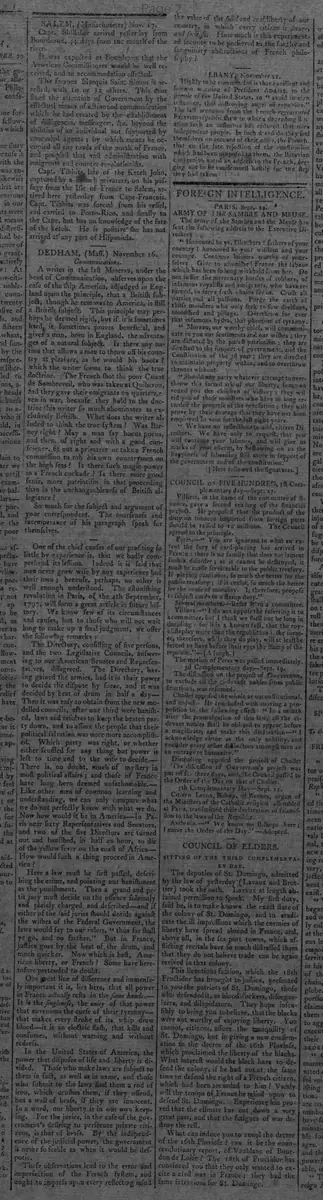
DEDHAM, (Mass.) November 16.
Communications.
A writer in the last Minerva, under the head of Communication, observes upon the case of the Ship America, adjudged in England upon the principle, that a British subject, though he removes to America, is still a British subject. This principle may perhaps be deemed rigid, but if it is sometimes hard, it sometimes proves beneficial, and gives a man, born in England, the advantages of a natural subject. Is there any nation that allows a man to throw off his country at pleasure, as he would his boots? which the writer seems to think the true doctrine. The French shot the poor Count de Sombreuil, who was taken at Quiberon, and they gave their emigrants no quarters, even in war, because they hold to the doctrine this writer so much abominates as exclusively British. What does the writer alluded to think the true system? Was Barney right? May a man say hocus pocus, and then, of right and with a good conscience, fit out a privateer or take a French commission to rob his own countrymen on the high seas? Is there such magic power in a French cockade? Is there more good sense, more patriotism in that proceeding than in the unchangeableness of British allegiance?
So much for the subject and argument of your correspondent. The coarseness and intemperance of his paragraph speak for themselves.
One of the chief causes of our profiting so little by experience is, that we badly comprehend its lessons. Indeed it is said that men never grow wise by any experience but their own; because, perhaps, no other is well enough understood. The astonishing revolution in Paris, of the 4th September, 1797, will form a great article in future history. We know few of its circumstances and causes, but to those who will not wait long to make up a final judgment, we offer the following remarks:
The Directory, consisting of five persons, and the two Legislative Councils, answering to our American Senates and Representatives, disagreed. The Directory, having gained the armies, had it in their power to decide the dispute by force, and it was decided by beat of drum in half a day—
Then it was easy to obtain from the new modelled councils, after one third were banished, laws and resolves to keep the beaten party down, and to assure the people that their political salvation was once more accomplished. Which party was right, or whether either consulted for any thing but power is left to time and to the wise to decide.—
There is, no doubt, much of mystery in most political affairs; and those of France have long been deemed unfathomable.—
Like other men of common learning and understanding, we can only compare what we do not perfectly know with what we do. Now how would it be in America—In Paris near sixty Representatives and Senators, and two of the five Directors are turned out and banished, in half an hour, to die of the yellow fever on the coast of Africa—
How would such a thing proceed in America?
Here a law must be first passed, describing the crime, and pointing out banishment as the punishment. Then a grand and petit jury must decide on the offence solemnly and plainly charged and described—and if either of the said juries should decide against the wishes of the Federal Government, the laws would say to our rulers, "thus far shall ye go, and no farther," But in France, justice goes by the beat of the drum, and much quicker. Now which is best, American liberty, or French? Some have heretofore pretended to doubt.
One great line of difference and immensely important it is, lies here, that all power in France actually rests in the same hands.—
It is the singleness, the unity of that power that envenoms the curse of their tyranny— that makes every stroke of its whip draw blood—it is an electric fish, that kills and consumes, without warning and without redress.
In the United States of America, the power that disposes of life and liberty is divided. Those who make laws are subject to them in fact, as well as in name, and those who submit to the laws find them a rod of iron, which crushes them, if they offend, but a wall of brass, if they are innocent.
In a word, our liberty is in our own keeping. For the juries, in the case of the government's desiring to persecute private citizens, is that of brass. By the independence of the judicial power, the government is never so forcible as when it would be despotic.
These observations lead to the error and imperfection of the French system, and ought to impress upon every reflecting mind the value of the solid and real liberty of our country, in which every citizen is secure, and feels so. How much is this experienced security to be preferred to the false and sanguinary abstractions of French philosophy?
Communications.
A writer in the last Minerva, under the head of Communication, observes upon the case of the Ship America, adjudged in England upon the principle, that a British subject, though he removes to America, is still a British subject. This principle may perhaps be deemed rigid, but if it is sometimes hard, it sometimes proves beneficial, and gives a man, born in England, the advantages of a natural subject. Is there any nation that allows a man to throw off his country at pleasure, as he would his boots? which the writer seems to think the true doctrine. The French shot the poor Count de Sombreuil, who was taken at Quiberon, and they gave their emigrants no quarters, even in war, because they hold to the doctrine this writer so much abominates as exclusively British. What does the writer alluded to think the true system? Was Barney right? May a man say hocus pocus, and then, of right and with a good conscience, fit out a privateer or take a French commission to rob his own countrymen on the high seas? Is there such magic power in a French cockade? Is there more good sense, more patriotism in that proceeding than in the unchangeableness of British allegiance?
So much for the subject and argument of your correspondent. The coarseness and intemperance of his paragraph speak for themselves.
One of the chief causes of our profiting so little by experience is, that we badly comprehend its lessons. Indeed it is said that men never grow wise by any experience but their own; because, perhaps, no other is well enough understood. The astonishing revolution in Paris, of the 4th September, 1797, will form a great article in future history. We know few of its circumstances and causes, but to those who will not wait long to make up a final judgment, we offer the following remarks:
The Directory, consisting of five persons, and the two Legislative Councils, answering to our American Senates and Representatives, disagreed. The Directory, having gained the armies, had it in their power to decide the dispute by force, and it was decided by beat of drum in half a day—
Then it was easy to obtain from the new modelled councils, after one third were banished, laws and resolves to keep the beaten party down, and to assure the people that their political salvation was once more accomplished. Which party was right, or whether either consulted for any thing but power is left to time and to the wise to decide.—
There is, no doubt, much of mystery in most political affairs; and those of France have long been deemed unfathomable.—
Like other men of common learning and understanding, we can only compare what we do not perfectly know with what we do. Now how would it be in America—In Paris near sixty Representatives and Senators, and two of the five Directors are turned out and banished, in half an hour, to die of the yellow fever on the coast of Africa—
How would such a thing proceed in America?
Here a law must be first passed, describing the crime, and pointing out banishment as the punishment. Then a grand and petit jury must decide on the offence solemnly and plainly charged and described—and if either of the said juries should decide against the wishes of the Federal Government, the laws would say to our rulers, "thus far shall ye go, and no farther," But in France, justice goes by the beat of the drum, and much quicker. Now which is best, American liberty, or French? Some have heretofore pretended to doubt.
One great line of difference and immensely important it is, lies here, that all power in France actually rests in the same hands.—
It is the singleness, the unity of that power that envenoms the curse of their tyranny— that makes every stroke of its whip draw blood—it is an electric fish, that kills and consumes, without warning and without redress.
In the United States of America, the power that disposes of life and liberty is divided. Those who make laws are subject to them in fact, as well as in name, and those who submit to the laws find them a rod of iron, which crushes them, if they offend, but a wall of brass, if they are innocent.
In a word, our liberty is in our own keeping. For the juries, in the case of the government's desiring to persecute private citizens, is that of brass. By the independence of the judicial power, the government is never so forcible as when it would be despotic.
These observations lead to the error and imperfection of the French system, and ought to impress upon every reflecting mind the value of the solid and real liberty of our country, in which every citizen is secure, and feels so. How much is this experienced security to be preferred to the false and sanguinary abstractions of French philosophy?
What sub-type of article is it?
Persuasive
Political
Reflective
What themes does it cover?
Politics
Constitutional Rights
What keywords are associated?
British Allegiance
Ship America
French Revolution
American Liberty
French Directory
Constitutional Checks
Expatriation
Letter to Editor Details
Main Argument
the principle of perpetual british allegiance, though rigid, offers benefits and contrasts with french expatriation policies; the 1797 french revolution exemplifies authoritarianism, while american liberty's divided powers and juries provide true security over french abstractions.
Notable Details
Ship America Case
Count De Sombreuil At Quiberon
Joshua Barney Reference
French Revolution September 4, 1797
French Directory And Councils
Comparison Of French Beat Of Drum Justice To American Jury Trials