Thank you for visiting SNEWPapers!
Sign up free
Watertown Republican
Watertown, Jefferson County, Dodge County, Wisconsin
What is this article about?
Union forces under Gen. Thomas decisively defeat Confederate army at Somerset on January 20, capturing artillery, wagons, and supplies. Rebel Gen. Zollicoffer is killed attempting to assassinate Col. Fry. Rebels flee, abandoning camp and fortifications.
Clipping
OCR Quality
Full Text
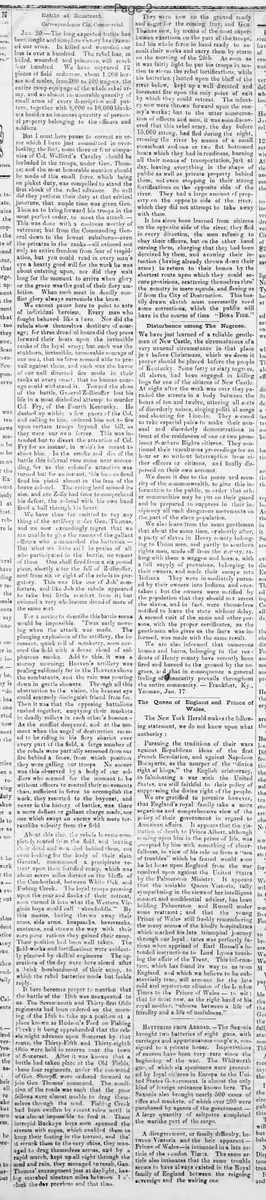
Correspondence Cin. Commercial.
Jan. 20.—The long expected battle has been fought and complete victory has crowned our arms. In killed and wounded our loss is over a hundred. The rebel loss, in killed, wounded and prisoners, will reach four hundred. We have captured 12 pieces of field ordnance, about 1,200 horses and mules, from 300 to 400 wagons, the entire camp equipage of the whole rebel army, and an almost innumerable quantity of small arms of every description and pattern, together with 5,000 to 10,000 blankets besides an immense quantity of personal property belonging to the officers and soldiers.
But I must here pause to correct an error which I have just committed in overlooking the fact, some three or four companies of Col. Wolford's Cavalry should be included in the troops under Gen. Thomas: and the most honorable mention should be made of this small force, which being on picket duty, was compelled to stand the first shock of the rebel advance. So well did they perform their duty at that critical juncture, that ample time was given Gen. Thomas to bring forward his troops in the most perfect order, to meet the attack. This was done with a coolness worthy of veterans; but from the Commanding General down to the lowest subaltern—even the privates in the ranks—all evinced not only an entire freedom from fear or trepidation, but you could read in every man's eye a hearty good will for the work he was about entering upon, nor did they wait long for the moment to arrive when glory or the grave was the goal of their fiery ambition. When such meet in deadly conflict glory always surrounds the brow.
We cannot pause here to point to acts of individual heroism. Every man who fought behaved like a hero. Nor did the rebels show themselves destitute of courage; for three dreadful hours did they press forward their hosts upon the invincible ranks of the loyal army; but such was the stubborn, invincible, immovable courage of our men, that no force seemed able to prevail against them, and such was the havoc of our well directed fire made in their ranks at every onset, that no human courage could withstand it. Toward the close of the battle, General Zollicoffer lost his life in a most diabolical attempt to murder Col. Fry, of the Fourth Kentucky. He dashed up within a few paces of the Col. and calling to him, ordered him not to fire upon certain troops beyond the hill, as they were our own forces. This was intended but to divert the attention of Col. Fry for an instant, in which he meant to shoot him. In the smoke and din of the battle this infernal ruse came near succeeding, for as the colonel's attention was turned but for an instant, his brutal foe fired his pistol almost in the face of the brave colonel. The erring lead missed its aim, and ere Zollicoffer had time to comprehend his defeat, the colonel with his own hand fired a ball through his heart.
We have thus far omitted to say anything of the artillery under Gen. Thomas, and we now exceedingly regret that we are unable to give the names of the gallant officers who commanded the batteries. But what we have said in praise of all who participated in the battle, we repeat of them. One shell fired from a six pound piece, shortly after the fall of Zollicoffer, sent from six or eight of the rebels to purgatory. This was like one of Job's comforters, and like Job the rebels appeared to take but little comfort from it; but evinced a very wholesome dread of more of the same sort.
For a novice to describe this battle scene would be impossible. 'Twas early morning when the attack was made. The plunging explosions of the artillery, the incessant, quick roll of musketry, soon covered the field with a dense cloud of sulphurous smoke. Add to this, it was a stormy morning; Heaven's artillery was pealing sublimely far in the Heavens above the combatants, and the rain was pouring down in gentle showers. Through all this obstruction to the vision, the keenest eye could scarcely distinguish friend from foe. Then it was that the opposing battalions rushed together, emptying their muskets in deadly volleys in each other's bosoms. As the conflict deepened, and at the moment when the angel of destruction seemed to be riding in his fiery chariot over every part of the field, a large number of the rebels were partially screened from our fire behind a fence, from which position they were galling our troops. No sooner was this observed by a body of our soldiers who seemed for the moment to be without officers to control their movements than, sufficient in force to accomplish the work, they resorted to the bayonet, and never in the history of battles, was there a more defiant or gallant charge made, nor one which swept an enemy with more torrent-like velocity from the field.
About this time the rebels became completely routed from the field, and leaving their dead and wounded behind them, not even looking for the body of their slain General, commenced a precipitate retreat upon their fortified camp, which was about seven miles distant on the bluffs of the Cumberland, between White Oak and Fishing Creek. The loyal troops pressing upon the rear and flanks of their retreat, soon turned it into what the Western Virginia boys would call "skeedaddle." By this means, having thrown away their arms, side arms, knapsacks, haversacks, canteens, and strewn the way with their corn pone rations they gained their camp.
Their position had been well taken. The field-works and fortifications were evidently planned by skillful engineers. The operations of the day were here closed after a brisk bombardment of their camp, to which the rebel batteries made but feeble reply.
It here becomes proper to mention that the battle of the 19th was unexpected to us. The Seventeenth and Thirty-first Ohio regiments had been ordered on the morning of the 18th to take up a position at a place known as Hudson's Ford on Fishing Creek: it being apprehended that the rebels might advance upon Somerset by that route. The Thirty-Fifth and Thirty-eighth Ohio were held in reserve near the town of Somerset. After it was known that a battle had taken place at the Old Fields, these four regiments, under the command of Gen. Schoepff, were ordered forward to join Gen. Thomas' command. The condition of the roads was such that the poor fellows were almost unable to drag themselves through the mud. Fishing Creek had been swollen by recent rains until it was almost impossible to ford it. These intrepid Buckeye boys soon spanned the stream with ropes, which enabled them to keep their footing in the torrent, and though it struck them to the very chine, they managed to drag themselves across, and by a rapid march, kept up all night through the mud and rain, they managed to reach Gen. Thomas' encampment just at daylight, having marched nineteen miles between 10 o'clock the day previous and that time.
They were now on the ground ready and eager for the coming fray, and Gen. Thomas now, by means of the most superhuman exertions on the part of the troops, had his whole force in hand ready to assault their works and carry them by storm on the morning of the 20th. As soon as it was fairly light he put his troops in motion to storm the rebel fortifications, while his batteries, planted upon the bluff of the river below, kept up a well directed and incessant fire upon the only point of exit by which they could retreat. The infantry now were thrown forward upon the enemy's works; but to the utter consternation of officers and men, it was soon discovered that this rebel army, the day before 15,000 strong, had fled during the night, crossing the river by means of a small steamboat and one or two flat bottomed boats which they had in readiness, burning all their means of transportation, just at day, leaving everything in the shape of public as well as private property behind them, not even stopping in their strong fortifications on the opposite side of the river. They had a large amount of property on the opposite side of the river, which they did not attempt to take away with them.
It has since been learned from citizens on the opposite side of the river, they fled in every direction, the men refusing to obey their officers, but on the other hand cursing them, charging that they had been deceived by them, and avowing their intention (having already thrown down their arms) to return to their homes by the shortest route upon which they could secure provisions, scattering themselves through the country in mere squads, and fleeing as if from the City of Destruction. This hastily drawn sketch must necessarily need some corrections, which the public will have in the course of time "Bona Fide."
What sub-type of article is it?
What themes does it cover?
What keywords are associated?
What entities or persons were involved?
Where did it happen?
Story Details
Key Persons
Location
Somerset, Cumberland Bluffs, Fishing Creek
Event Date
Jan. 20
Story Details
Union troops under Gen. Thomas repel Confederate attack at Somerset, capture extensive supplies and artillery after three hours of fighting. Gen. Zollicoffer killed by Col. Fry after failed assassination attempt. Rebels retreat in disarray, abandoning camp; Union forces find fortifications empty on January 20.