Thank you for visiting SNEWPapers!
Sign up free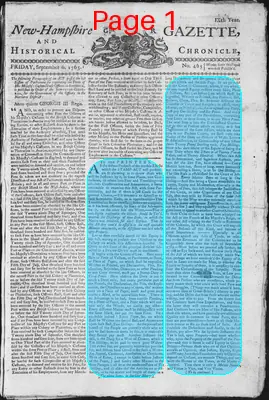
Letter to Editor
September 6, 1765
The New Hampshire Gazette And Historical Chronicle
Portsmouth, Greenland, Rockingham County, New Hampshire
What is this article about?
A colonial correspondent examines the Stamp Act's duties on legal documents in various courts, arguing they lack equity and disproportionately tax the poor, refuting claims of fair property assessment.
Clipping
OCR Quality
98%
Excellent
Full Text
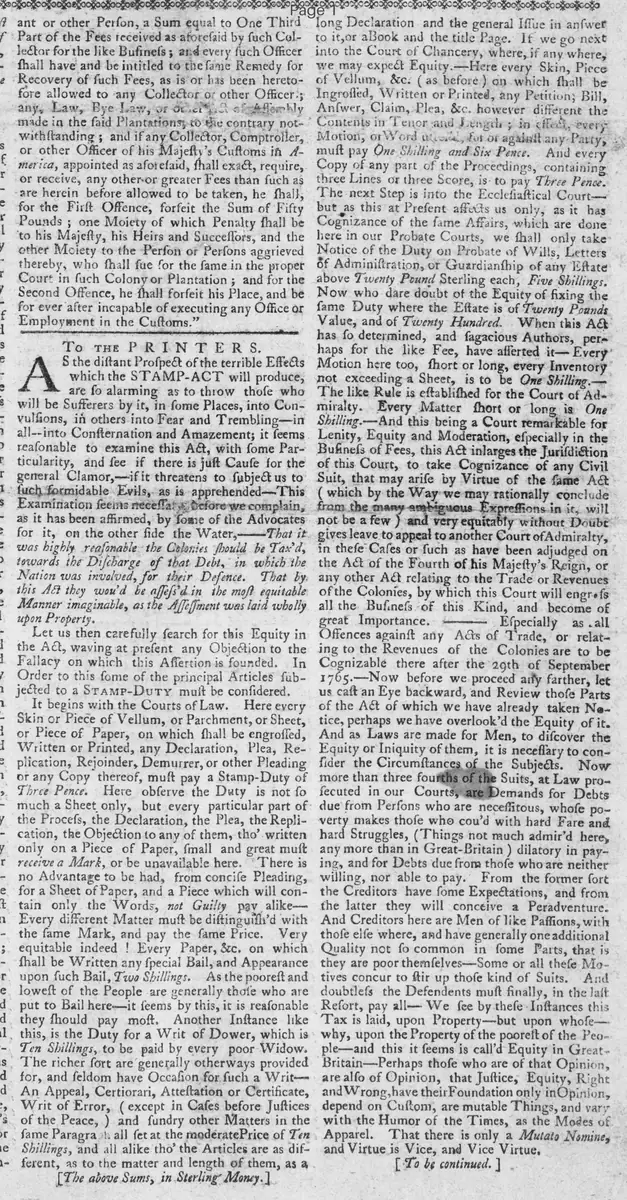
TO THE PRINTERS.
As the distant Prospect of the terrible Effects
which the STAMP-ACT will produce,
are so alarming as to throw those who
will be Sufferers by it, in some Places, into Con-
vulsions, in others into Fear and Trembling--in
all--into Consternation and Amazement; it seems
reasonable to examine this Act, with some Par-
ticularity, and see if there is just Cause for the
general Clamor,--if it threatens to subject us to
such formidable Evils, as is apprehended-- This
Examination seems necessary Before we complain,
as it has been affirmed, by one of the Advocates
for it, on the other side the Water,--That it
was highly reasonable the Colonies should be Tax'd,
towards the Discharge of that Debt, in which the
Nation was involved for their Defence. That by
this Act they wou'd be assessed in the most equitable
Manner imaginable, as the Assessment was laid wholly
upon Property.
Let us then carefully search for this Equity in
the Act, waving at present any Objection to the
Fallacy on which this Assertion is founded. In
Order to this some of the principal Articles sub-
jected to a Stamp-Duty must be considered.
It begins with the Courts of Law. Here every
Skin or Piece of Vellum, or Parchment, or Sheet,
or Piece of Paper, on which shall be engrossed,
Written or Printed, any Declaration, Plea, Re-
plication, Rejoinder, Demurrer, or other Pleading
or any Copy thereof, must pay a Stamp-Duty of
Three Pence. Here observe the Duty is not on
much a Sheet only, but every particular part of
the Process, the Declaration, the Plea, the Repli-
cation, the Objection to any of them, tho' written
only on a Piece of Paper, small and great must
receive a Mark, or be unavailable here. There is
no Advantage to be had, from concise Pleading,
for a Sheet of Paper, and a Piece which will con-
tain only the Words, not Guilty pay alike--
Every different Matter must be distinguished with
the same Mark, and pay the same Price. Very
equitable indeed! Every Paper, &c. on which
shall be Written any special Bail, and Appearance
upon such Bail, Two Shillings. As the poorest and
lowest of the People are generally those who are
put to Bail here--it seems by this, it is reasonable
they should pay most. Another Instance like
this, is the Duty for a Writ of Dower, which is
Ten Shillings, to be paid by every poor Widow.
The richer sort are generally otherwise provided
for, and seldom have Occasion for such a Writ--
An Appeal, Certiorari, Attestation or Certificate,
Writ of Error, (except in Cases before Justices
of the Peace,) and sundry other Matters in the
same Paragraph all set at the moderate Price of Ten
Shillings, and all alike tho' the Articles are as different,
as to the matter and length of them, as a
Long Declaration and the general Issue in answer
to it, or a Book and the title Page. If we go next
into the Court of Chancery, where, if any where,
we may expect Equity.--Here every Skin, Piece
of Vellum, &c. (as before) on which shall be
Ingrossed, Written or Printed, any Petition; Bill,
Answer, Claim, Plea, &c. however different the
Contents in Tenor and Length; in effect, every
Motion, or Word used, for or against any Party,
must pay One Shilling and Six Pence. And every
Copy of any part of the Proceedings, containing
three Lines or three Score, is to pay Three Pence.
The next Step is into the Ecclesiastical Court--
but as this at Present affects us only, as it has
Cognizance of the same Affairs, which are done
here in our Probate Courts, we shall only take
Notice of the Duty on Probate of Wills, Letters
Of Administration, or Guardianship of any Estate
above Twenty Pounds Sterling each, Five Shillings.
Now who dare doubt of the Equity of fixing the
same Duty where the Estate is of Twenty Pounds
Value, and of Twenty Hundred. When this Act
has so determined, and sagacious Authors, per-
haps for the like Fee, have asserted it-- Every
Motion here too, short or long, every Inventory
not exceeding a Sheet, is to be One Shilling.--
The like Rule is established for the Court of Ad-
miralty. Every Matter short or long is One
Shilling.--And this being a Court remarkable for
Lenity, Equity and Moderation, especially in the
Business of Fees, this Act enlarges the Jurisdiction
of this Court, to take Cognizance of any Civil
Suit, that may arise by Virtue of the same Act
(which by the Way we may rationally conclude
from the many ambiguous Expressions in it, will
not be a few) and very equitably without Doubt
gives leave to appeal to another Court of Admiralty,
in these Cases or such as have been adjudged on
the Act of the Fourth of his Majesty's Reign, or
any other Act relating to the Trade or Revenues
of the Colonies. by which this Court will engross
all the Business of this Kind, and become of
great Importance.
Especially as all
Offences against any Acts of Trade, or relating
to the Revenues of the Colonies are to be
Cognizable there after the 29th of September
1765.--Now before we proceed any farther, let
us cast an Eye backward, and Review those Parts
of the Act of which we have already taken No-
tice, perhaps we have overlooked the Equity of it.
And as Laws are made for Men, to discover the
Equity or Iniquity of them, it is necessary to con-
sider the Circumstances of the Subjects. Now
more than three fourths of the Suits, at Law pro-
secuted in our Courts, are Demands for Debts
due from Persons who are necessitous, whose po-
verty makes those who cou'd with hard Fare and
hard Struggles, (Things not much admired here,
any more than in Great-Britain) dilatory in pay-
ing, and for Debts due from those who are neither
willing, nor able to pay. From the former sort
the Creditors have some Expectations, and from
the latter they will conceive a Peradventure.
And Creditors here are Men of like Passions, with
those elsewhere, and have generally one additional
Quality not so common in some Parts, that is
they are poor themselves--Some or all these Mo-
tives concur to stir up those kind of Suits. And
doubtless the Defendants must finally, in the last
Resort, pay all-- We see by these Instances this
Tax is laid, upon Property--but upon whose
why, upon the Property of the poorest of the Peo-
ple--and this it seems is call'd Equity in Great-
Britain--Perhaps those who are of that Opinion,
are also of Opinion, that Justice, Equity, Right
and Wrong, have their Foundation only in Opinion,
depend on Custom, are mutable Things, and vary
with the Humor of the Times, as the Modes of
Apparel. That there is only a Mutato Nomine,
and Virtue is Vice, and Vice Virtue.
[To be continued.]
As the distant Prospect of the terrible Effects
which the STAMP-ACT will produce,
are so alarming as to throw those who
will be Sufferers by it, in some Places, into Con-
vulsions, in others into Fear and Trembling--in
all--into Consternation and Amazement; it seems
reasonable to examine this Act, with some Par-
ticularity, and see if there is just Cause for the
general Clamor,--if it threatens to subject us to
such formidable Evils, as is apprehended-- This
Examination seems necessary Before we complain,
as it has been affirmed, by one of the Advocates
for it, on the other side the Water,--That it
was highly reasonable the Colonies should be Tax'd,
towards the Discharge of that Debt, in which the
Nation was involved for their Defence. That by
this Act they wou'd be assessed in the most equitable
Manner imaginable, as the Assessment was laid wholly
upon Property.
Let us then carefully search for this Equity in
the Act, waving at present any Objection to the
Fallacy on which this Assertion is founded. In
Order to this some of the principal Articles sub-
jected to a Stamp-Duty must be considered.
It begins with the Courts of Law. Here every
Skin or Piece of Vellum, or Parchment, or Sheet,
or Piece of Paper, on which shall be engrossed,
Written or Printed, any Declaration, Plea, Re-
plication, Rejoinder, Demurrer, or other Pleading
or any Copy thereof, must pay a Stamp-Duty of
Three Pence. Here observe the Duty is not on
much a Sheet only, but every particular part of
the Process, the Declaration, the Plea, the Repli-
cation, the Objection to any of them, tho' written
only on a Piece of Paper, small and great must
receive a Mark, or be unavailable here. There is
no Advantage to be had, from concise Pleading,
for a Sheet of Paper, and a Piece which will con-
tain only the Words, not Guilty pay alike--
Every different Matter must be distinguished with
the same Mark, and pay the same Price. Very
equitable indeed! Every Paper, &c. on which
shall be Written any special Bail, and Appearance
upon such Bail, Two Shillings. As the poorest and
lowest of the People are generally those who are
put to Bail here--it seems by this, it is reasonable
they should pay most. Another Instance like
this, is the Duty for a Writ of Dower, which is
Ten Shillings, to be paid by every poor Widow.
The richer sort are generally otherwise provided
for, and seldom have Occasion for such a Writ--
An Appeal, Certiorari, Attestation or Certificate,
Writ of Error, (except in Cases before Justices
of the Peace,) and sundry other Matters in the
same Paragraph all set at the moderate Price of Ten
Shillings, and all alike tho' the Articles are as different,
as to the matter and length of them, as a
Long Declaration and the general Issue in answer
to it, or a Book and the title Page. If we go next
into the Court of Chancery, where, if any where,
we may expect Equity.--Here every Skin, Piece
of Vellum, &c. (as before) on which shall be
Ingrossed, Written or Printed, any Petition; Bill,
Answer, Claim, Plea, &c. however different the
Contents in Tenor and Length; in effect, every
Motion, or Word used, for or against any Party,
must pay One Shilling and Six Pence. And every
Copy of any part of the Proceedings, containing
three Lines or three Score, is to pay Three Pence.
The next Step is into the Ecclesiastical Court--
but as this at Present affects us only, as it has
Cognizance of the same Affairs, which are done
here in our Probate Courts, we shall only take
Notice of the Duty on Probate of Wills, Letters
Of Administration, or Guardianship of any Estate
above Twenty Pounds Sterling each, Five Shillings.
Now who dare doubt of the Equity of fixing the
same Duty where the Estate is of Twenty Pounds
Value, and of Twenty Hundred. When this Act
has so determined, and sagacious Authors, per-
haps for the like Fee, have asserted it-- Every
Motion here too, short or long, every Inventory
not exceeding a Sheet, is to be One Shilling.--
The like Rule is established for the Court of Ad-
miralty. Every Matter short or long is One
Shilling.--And this being a Court remarkable for
Lenity, Equity and Moderation, especially in the
Business of Fees, this Act enlarges the Jurisdiction
of this Court, to take Cognizance of any Civil
Suit, that may arise by Virtue of the same Act
(which by the Way we may rationally conclude
from the many ambiguous Expressions in it, will
not be a few) and very equitably without Doubt
gives leave to appeal to another Court of Admiralty,
in these Cases or such as have been adjudged on
the Act of the Fourth of his Majesty's Reign, or
any other Act relating to the Trade or Revenues
of the Colonies. by which this Court will engross
all the Business of this Kind, and become of
great Importance.
Especially as all
Offences against any Acts of Trade, or relating
to the Revenues of the Colonies are to be
Cognizable there after the 29th of September
1765.--Now before we proceed any farther, let
us cast an Eye backward, and Review those Parts
of the Act of which we have already taken No-
tice, perhaps we have overlooked the Equity of it.
And as Laws are made for Men, to discover the
Equity or Iniquity of them, it is necessary to con-
sider the Circumstances of the Subjects. Now
more than three fourths of the Suits, at Law pro-
secuted in our Courts, are Demands for Debts
due from Persons who are necessitous, whose po-
verty makes those who cou'd with hard Fare and
hard Struggles, (Things not much admired here,
any more than in Great-Britain) dilatory in pay-
ing, and for Debts due from those who are neither
willing, nor able to pay. From the former sort
the Creditors have some Expectations, and from
the latter they will conceive a Peradventure.
And Creditors here are Men of like Passions, with
those elsewhere, and have generally one additional
Quality not so common in some Parts, that is
they are poor themselves--Some or all these Mo-
tives concur to stir up those kind of Suits. And
doubtless the Defendants must finally, in the last
Resort, pay all-- We see by these Instances this
Tax is laid, upon Property--but upon whose
why, upon the Property of the poorest of the Peo-
ple--and this it seems is call'd Equity in Great-
Britain--Perhaps those who are of that Opinion,
are also of Opinion, that Justice, Equity, Right
and Wrong, have their Foundation only in Opinion,
depend on Custom, are mutable Things, and vary
with the Humor of the Times, as the Modes of
Apparel. That there is only a Mutato Nomine,
and Virtue is Vice, and Vice Virtue.
[To be continued.]
What sub-type of article is it?
Persuasive
Political
Informative
What themes does it cover?
Taxation
Economic Policy
Constitutional Rights
What keywords are associated?
Stamp Act
Colonial Taxation
Legal Duties
Equity Critique
Poor Burden
Court Fees
Debt Suits
What entities or persons were involved?
The Printers
Letter to Editor Details
Recipient
The Printers
Main Argument
the stamp act imposes inequitable stamp duties on legal documents that disproportionately burden the poor and fail to tax property fairly, contrary to advocates' claims.
Notable Details
Duties On Pleadings: 3 Pence Per Document
Special Bail: 2 Shillings
Writ Of Dower: 10 Shillings For Poor Widows
Chancery Proceedings: 1 Shilling 6 Pence Per Skin
Probate Of Wills: 5 Shillings Regardless Of Estate Size
Critique Of Court Of Admiralty Expansion
Most Suits Involve Poor Debtors