Thank you for visiting SNEWPapers!
Sign up free
Wilmington Journal
Wilmington, New Hanover County, North Carolina
What is this article about?
Proceedings of the North Carolina House of Commons on February 8th, including bills introduced for landlord relief and fish passage, resolutions on Cherokee bonds and artificial limbs, and a heated committee debate on allowing negroes to testify in court, with speeches by Messrs. Dargan, Hyman, and Everett opposing or supporting the measure amid post-war racial tensions.
Clipping
OCR Quality
Full Text
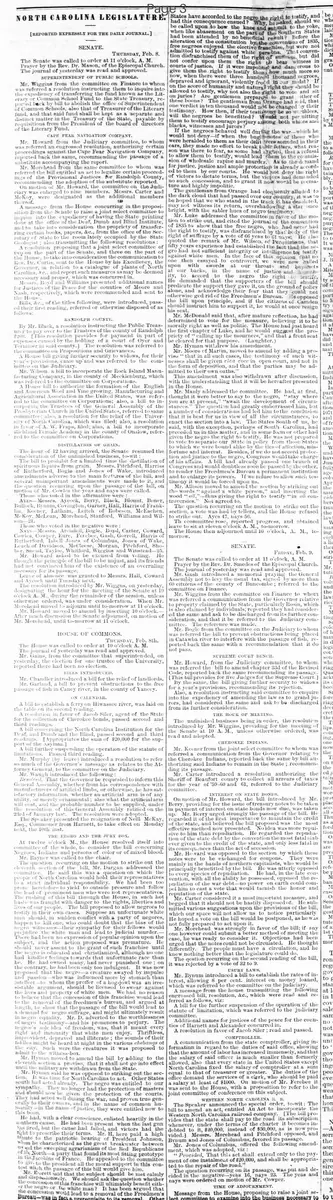
THURSDAY, Feb. 8th.
The House was called to order at 10 o'clock A. M. The journal of yesterday was read and approved.
Mr. Gains, from the committee that superintended, on yesterday, the election for one trustee of the University reported there had been no election.
BILLS INTRODUCED.
Mr. Chandler introduced a bill for the relief of landlords. Mr. Garland, a bill to prevent obstructions to the free passage of fish in Caney river, in the county of Yancey.
ON CALENDAR.
A bill to establish a ferry on Hiwassee river, was laid on the table on its second reading.
A resolution in favor of Jacob Siler, agent of the State for the collection of Cherokee bonds, passed second and third readings.
A bill concerning the North Carolina Institution for the Deaf, Dumb and the Blind, passed second and third readings. [Appropriates the sum of $20,000 for the support of the Asylum.]
A bill further suspending the operation of the statute of limitations. Passed third reading.
Mr. Murphy (by leave) introduced a resolution to refer so much of the Governor's message as relates to the Attorney General, to the committee on the Judiciary.
Mr. Waugh introduced the following :
Resolved, That the Governor be requested to inform this General Assembly, whether from his correspondence with manufacturers of artificial limbs, or otherwise, he has satisfactory information whether an artificial arm is of any utility, or merely ornamental: also what the artificial arm will cost, and the probable number to be supplied, under the resolution of this General Assembly ratified on the 23rd of January last. The resolutions were adopted.
The Speaker presented the resignation of Neill McKay, Esq., Commoner from Harnett, to take effect on Monday next, the 10th inst.
THE NEGRO AND THE JURY BOX.
At twelve o'clock M., the House resolved itself into committee of the whole, to consider the bill concerning Negroes, Indians and persons of color or of mixed blood.
Mr. Rayner was called to the chair.
The question recurring on the motion to strike out the eleventh section of the bill, Mr. Dargan addressed the committee. He said this was a question on which the people of North Carolina would hold their representatives to a strict individual responsibility. We had been too prone heretofore to yield to outside pressure and follow the lead of prominent men who were not representatives. The rushing of this bill through the House, in such hot haste was fraught with danger to the rights, liberties and lives of our people. The bill proposed to allow negroes to testify in their own cases. Suppose an unfortunate white man should, in sudden conflict with a party of negroes, happen to kill one, who could doubt that the bias of the negro witnesses—their sympathy for their fellows would prejudice the white man and lead to judicial murder. There had been no expression of popular opinion upon the subject, and the action proposed was premature. He should never assent to the grant of such franchise until the negro is educated and christianized, although no one had kindlier feelings towards that unfortunate race than he. He had owned many, had never punished one: on the contrary, he had been only too indulgent. It was now proposed that the negro—a creature swayed by impulse and passion—who was influenced more by stomach than intellect—to whom the proffer of a hog-jowl was an irresistible argument, should be licensed to swear against the lives and property of white men. We had no reason to believe that the concession of this franchise would lead to the removal of the freedmen's bureau, and argued at length, to show that the passage of the bill would lead to a demand for negro suffrage, and might ultimately result in negro equality. Mr. D. adverted to the worthlessness of negro testimony—and his proneness to perjury. The negro's sole idea of freedom, was, that it meant every right and immunity that white men enjoy. Thriftless, improvident, depraved and illiterate; the sounds of their fiddles might be heard at night in the various shebangs of the city. Such were the creatures it was proposed to admit to the witness-box.
Mr. Hyman moved to amend the bill by adding to the eleventh section a proviso, that it shall not go into effect until the military are withdrawn from the State.
Mr. Hyman said he was opposed to striking out the section. It was time for North Carolina to act. Other States south had acted already. The negro was entitled to our sympathy. They no longer had the protection of masters and should now be given the protection of the courts. They had acted well during the war, and proven true generally to their owners, and in the name of common humanity—in the name of justice, they were entitled now to this boon.
He had, with a clear conscience, enlisted heartily in the southern cause. He had been present when the last gun was fired, but the cause had failed, and victors had the right to prescribe their terms. Mr. H. here paid a high tribute to the patriotic bearing of President Johnson, whom he characterized as the great breakwater between us and the sweeping agrarianism of the Red Republicans of the North—a party that found its most fitting prototype in the Jacobins of France. He appealed to the committee to give to the president all the moral support in this contest which the passage of this bill would give him.
Mr. Everett said that the subject should be met calmly and dispassionately. We should ask the question whether the concession of this franchise will ultimately benefit either the negro or the white man the concession would lead to removal of the Freedmen's Bureau—was in fact a prerequisite to its removal. Other
What sub-type of article is it?
What keywords are associated?
What entities or persons were involved?
Where did it happen?
Domestic News Details
Primary Location
North Carolina
Event Date
Thursday, Feb. 8th.
Key Persons
Event Details
The House of Commons convened at 10 A.M., approved the journal, reported no election for university trustee. Bills introduced: relief for landlords by Mr. Chandler, preventing fish obstructions in Caney river by Mr. Garland. On calendar: ferry bill on Hiwassee river tabled; resolution for Jacob Siler passed; bill for North Carolina Institution for the Deaf, Dumb and Blind passed with $20,000 appropriation; statute of limitations suspension passed. Resolutions introduced on Attorney General referral and Governor's information on artificial limbs adopted. Resignation of Neill McKay presented. Committee of the whole debated bill on Negroes, Indians, and persons of color; motion to strike eleventh section allowing negro testimony discussed by Mr. Dargan opposing due to risks and biases, Mr. Hyman proposing amendment tying to military withdrawal and supporting for sympathy and support of President Johnson, Mr. Everett advocating calm consideration for benefits and Freedmen's Bureau removal.