Thank you for visiting SNEWPapers!
Sign up free
The Madison Journal
Tallulah, Madison County, Louisiana
What is this article about?
USDA article promotes cowpeas as key legume for Southern cotton belt, enhancing soil nitrogen, providing hay and feed for livestock, and suggesting rotations with cotton, corn, and grains to boost farm productivity.
Clipping
OCR Quality
Full Text
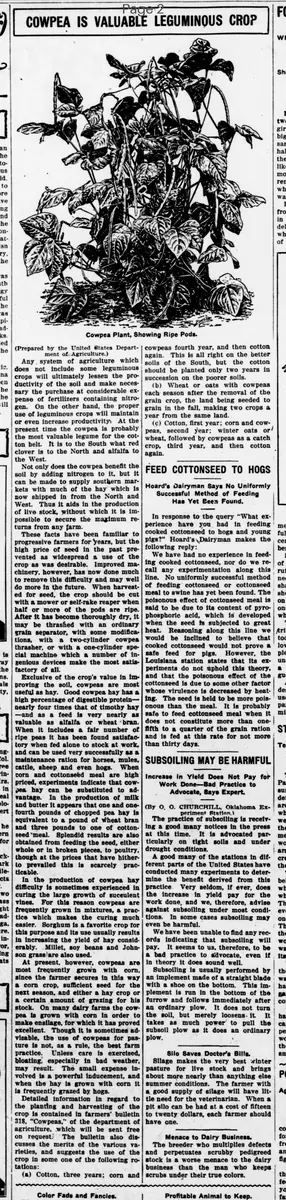
Cowpea Plant, Showing Ripe Pods.
(Prepared by the United States Department of Agriculture.)
Any system of agriculture which does not include some leguminous crops will ultimately lessen the productivity of the soil and make necessary the purchase at considerable expense of fertilizers containing nitrogen. On the other hand, the proper use of leguminous crops will maintain or even increase productivity. At the present time the cowpea is probably the most valuable legume for the cotton belt. It is to the South what red clover is to the North and alfalfa to the West.
Not only does the cowpea benefit the soil by adding nitrogen to it, but it can be made to supply southern markets with much of the hay which is now shipped in from the North and West. Thus it aids in the production of live stock, without which it is impossible to secure the maximum returns from any farm.
These facts have been familiar to progressive farmers for years, but the high price of seed in the past prevented as widespread a use of the crop as was desirable. Improved machinery, however, has now done much to remove this difficulty and may well do more in the future. When harvested for seed, the crop should be cut with a mower or self-rake reaper when half or more of the pods are ripe. After it has become thoroughly dry, it may be thrashed with an ordinary grain separator, with some modifications, with a two-cylinder cowpea thrasher, or with a one-cylinder special machine which a number of ingenious devices make the most satisfactory of all.
Exclusive of the crop's value in improving the soil, cowpeas are most useful as hay. Good cowpea hay has a high percentage of digestible protein—nearly four times that of timothy hay—and as a feed is very nearly as valuable as alfalfa or wheat bran. When it includes a fair number of ripe peas it has been found satisfactory when fed alone to stock at work, and can be used very successfully as a maintenance ration for horses, mules, cattle, sheep and even hogs. When corn and cottonseed meal are high priced, experiments indicate that cowpea hay can be substituted to advantage. In the production of milk and butter it appears that one and one-fourth pounds of chopped pea hay is equivalent to a pound of wheat bran and three pounds to one of cottonseed meal. Splendid results are also obtained from feeding the seed, either whole or in broken pieces, to poultry, though at the prices that have hitherto prevailed this is scarcely practicable.
In the production of cowpea hay difficulty is sometimes experienced in curing the large growth of succulent vines. For this reason cowpeas are frequently grown in mixtures, a practice which makes the curing much easier. Sorghum is a favorite crop for this purpose and its use usually results in increasing the yield of hay considerably. Millet, soy beans and Johnson grass are also used.
At present, however, cowpeas are most frequently grown with corn, since the farmer secures in this way a corn crop, sufficient seed for the next season, and either a hay crop or a certain amount of grazing for his stock. On many dairy farms the cowpea is grown with corn in order to make ensilage, for which it has proved excellent. Though it is sometimes advisable, the use of cowpeas for pasture is not, as a rule, the best farm practice. Unless care is exercised, bloating, especially in bad weather, may result. The small expense involved is a powerful inducement, and when the hay is grown with corn it is frequently grazed by hogs.
Detailed information in regard to the planting and harvesting of the crop is contained in farmers' bulletin 318, "Cowpeas," of the department of agriculture, which will be sent free on request. The bulletin also discusses the merits of the various varieties, and suggests the use of the crop in some one of the following rotations:
(a) Cotton, three years; corn and cowpeas fourth year, and then cotton again. This is all right on the better soils of the South, but the cotton should be planted only two years in succession on the poorer soils.
(b) Wheat or oats with cowpeas each season after the removal of the grain crop, the land being seeded to grain in the fall, making two crops a year from the same land.
(c) Cotton, first year; corn and cowpeas, second year; winter oats or wheat, followed by cowpeas as a catch crop, third year, and then cotton again.
What sub-type of article is it?
What keywords are associated?
Where did it happen?
Domestic News Details
Primary Location
Cotton Belt
Event Details
The cowpea is described as the most valuable legume for the cotton belt, benefiting soil by adding nitrogen, supplying hay for markets, aiding livestock production, and serving as feed with high digestible protein. It is grown for seed, hay, in mixtures with other crops like sorghum or corn, for ensilage, or grazing. Farmers' bulletin 318 provides details on planting, harvesting, varieties, and rotations including cotton, corn, cowpeas, wheat, or oats.