Thank you for visiting SNEWPapers!
Sign up free
The Enquirer
Richmond, Henrico County, Virginia
What is this article about?
This editorial presents a visionary analysis of Europe's geopolitical landscape post-French Revolution, advocating for a diplomatic reconfiguration of boundaries to establish a new, permanent balance of power. It proposes unifying Spain-Portugal, creating a unified Italy, dismembering the Ottoman Empire, consolidating German states under Austria and Prussia, and adjusting Swedish and Russian territories, while accepting French expansions. It urges Bonaparte and other leaders to pursue peace over war for Europe's happiness. Signed 'PACIFICATOR.'
Clipping
OCR Quality
Full Text
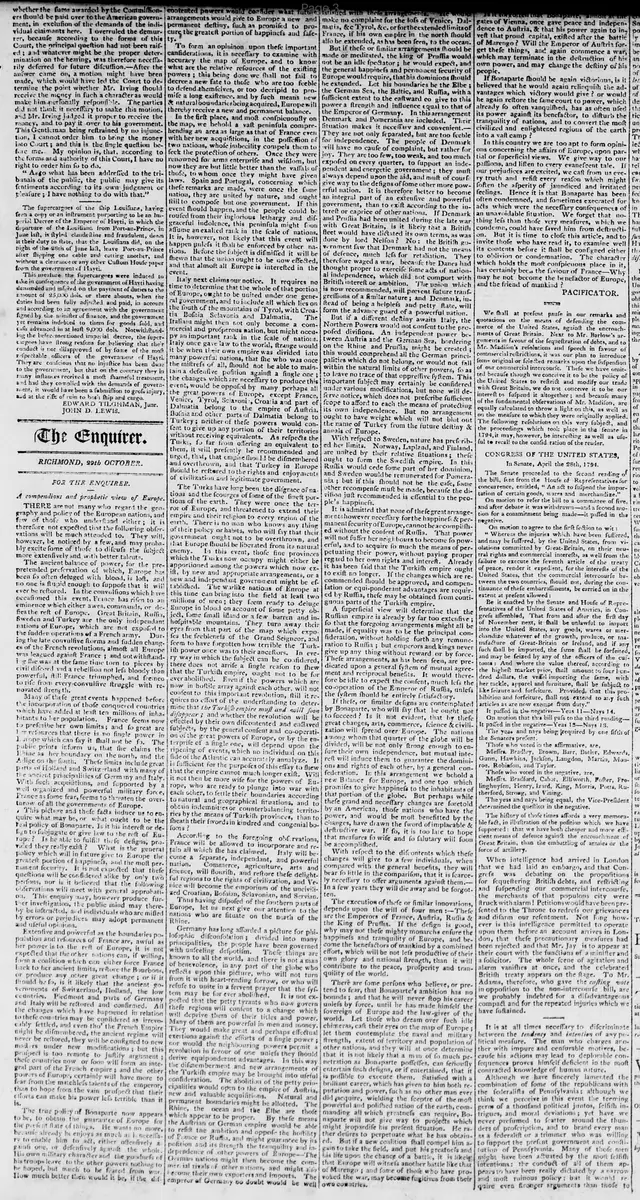
There are not many who regard the geography and policy of the European nations, and few of those who understand either; it is therefore not expected that the following observations will be much attended to. They will, however, be noticed by a few, and may probably excite some of those to discuss the subject more extensively and with better talents.
The ancient balance of power, for the pretended preservation of which, Europe has been so often deluged with blood, is lost, and no one is stupid enough to suppose that it will ever be restored. In the convulsions which have occasioned this event, France has risen to an eminence which either awes, commands, or degrades the rest of Europe. Great Britain, Russia, Sweden and Turkey are the only independent nations of Europe, which are not exposed to the sudden operations of a French army. During the late convulsive storms and sudden changes of the French revolutions, almost all Europe was leagued against France; and notwithstanding she was at the same time torn to pieces by civil discord and a rebellion not less bloody than powerful, still France triumphed, and seems to rise from every convulsive struggle with renovated strength.
Many of these great events happened before the incorporation of those conquered countries which have added at least ten millions of inhabitants to her population. France seems now to prescribe her own limits; and so great are her resources that there is no single power in Europe which can say it shall not be so. The public prints inform us, that she claims the Rhine as her boundary on the north, and the Adige on the south. These limits include great parts of Holland and Switzerland with many of the ancient principalities of Germany and Italy. With such acquisitions, and supported by a well organized and powerful military force, France as some fear, seems to threaten the overthrow of all the governments of Europe.
This picture and these facts induce us to enquire what may be, or what ought to be the real policy of Bonaparte. Is it his interest or design to subjugate or give law to the rest of Europe? Is he able to fulfill these designs, provided they really exist? What is the general policy which will in future give to Europe the greatest portion of happiness, and the most permanent security. It is not expected that these questions will be considered alike by any two persons, nor is it believed that the following observations will meet with general approbation. This enquiry may, however produce further investigation, the public mind may thereby be instructed, and individuals who are misled by errors or prejudices may adopt permanent and useful opinions.
Extensive and powerful as the boundaries population and resources of France are, awful as her power is to the rest of Europe, it is not expected that the other nations can, if willing, form a coalition which can either force France back to her ancient limits, restore the Bourbons, or produce any other great change; or if it should be so, is it likely that the ancient governments of Switzerland, Holland, the low countries, Piedmont and parts of Germany and Italy will be restored and confirmed. All the changes which have happened in relation to these countries may be considered as irrevocably settled, and even tho' the French Empire might be dismembered, the ancient regime will never be restored, they will be consigned to new masters under new modifications; but this prospect is too remote to justify argument; these countries now or soon will form an integral part of the French empire; and the other powers of Europe, certainly will have more to fear from the matchless talents of the emperor, than to hope from the vain prospect that their efforts can make his power less terrible than it is.
The true policy of Bonaparte now appears to be, to obtain the guarantee of Europe for the present state of things. He wants no more, because already he enjoys as much as is necessary to enable him to act, either offensively against one, or defensively against the whole. His own military character and the goodness of his troops leave to the other powers nothing to be hoped, but much to be feared from war. How much better then would it be, if the discontented powers would consider what future arrangements would give to Europe a new and permanent destiny, such as promised to procure the greatest portion of happiness and safety.
To form an opinion upon these important considerations, it is necessary to examine with accuracy the map of Europe, and to know what are the relative resources of the existing powers; this being done we shall not fail to decree a new fate to those who are too feeble to defend themselves, or too decrepid to promise a long existence, and by such means new & natural boundaries being acquired, Europe will thereby receive a new and permanent balance.
In the first place, and most conspicuously on the map, we behold a vast peninsula comprehending an area as large as that of France even with her new acquisitions, in the possession of two nations, whose imbecility compels them to seek the protection of others. Once they were renowned for arms enterprise and wisdom, but now they are but little better than the vassals of those, to whom once they might have given laws. Spain and Portugal, concerning which these remarks are made, were once the same nation, they are united by nature, and ought still to compose but one government. If this event should happen, and the people could be roused from their inglorious lethargy and disgraceful indolence, this peninsula might soon assume an exalted rank in the scale of nations.
It is, however, not likely that this event will happen unless it shall be enforced by other nations. Before the subject is dismissed it will be shewn that the union ought to be now effected, and that almost all Europe is interested in the event.
Italy next claims our notice. It requires no time to determine that the whole of that portion of Europe, ought to be united under one general government, and to include all which lies on the south of the mountains of Tyrol, with Croatia Bosnia Selavonia and Dalmatia.
The Italians might then not only become a commercial and prosperous nation, but might occupy an important rank in the scale of nations. Italy once gave law to the world, strange would it be when their own empire was divided into many powerful nations, that she who was once the mistress of all, should not be able to maintain a defensive position against a single one; the changes which are necessary to produce this event, would be opposed by many perhaps all the great powers of Europe, except France, Venice, Tyrol, Sclavoni, Croatia and part of Dalmatia belong to the empire of Austria. Bosnia and other parts of Dalmatia belong to Turkey; neither of these powers would consent to give up any portion of their territories without receiving equivalents. As respects the Turk, so far from offering an equivalent to them, it will presently be recommended and urged, that, that empire should be dismembered and overthrown, and that Turkey in Europe should be restored to the rights and enjoyments of civilization and legitimate government.
The Turks have long been the disgrace of nations and the scourges of some of the finest portions of the earth. They were once the terror of Europe, and threatened to extend their empire and their religion to every region of the earth. There is no man who knows anything of their policy or habits, who will say that their government ought not to be overthrown, and that Europe should be liberated from its natural enemy.
In this event, those fine provinces which the Turks now occupy might either be apportioned among the powers which now exist, by new and appropriate arrangements, or a new and independent government might be established. The warlike nations of Europe at this time can bring into the field at least two millions of men; they seem ready to deluge Europe in blood on account of some petty object, some small island or a few barren and inhospitable mountains. They turn away their eyes from that part of the map which exposes the feebleness of the Grand Seignior, and seem to have forgotten how terrible the Turkish power once was to their ancestors. In every way in which the subject can be considered, there does not arise a single reason to shew that the Turkish empire, ought not to be forever abolished. Even if the powers which are now in hostile array against each other, will not consent to this important revolution, till it requires no effort of the understanding to determine that the Turkish empire must and will soon disappear; and whether the revolution will be effected by their own discontented and enslaved subjects, by the general consent and co-operation of the great powers of Europe, or by the enterprise of a single one, will depend upon the ripening of events, which no individual on this side of the Atlantic can accurately analyze. It is sufficient for the purposes of this essay to shew that the empire cannot much longer exist. Will it not then be more wise for the powers of Europe, who are ready to plunge into war with each other, to settle their boundaries according to natural and geographical situations, and to obtain indemnities or counterbalancing territories by the means of Turkish provinces, than to sheath their swords in kindred and congenial bosoms?
According to the foregoing observations, France will be allowed to incorporate and retain all which she has claimed. Italy will become a separate, independent, and powerful nation. Commerce, agriculture, arts and science, will flourish, and restore these delightful regions to the rights of civilization, and Venice will become the emporium of the uncivilized Croatian, Bosnian, Sclavonian, and Servian.
Thus having disposed of the southern parts of Europe, let us next give our attention to the nations who are situate on the north of the Rhine.
Germany has long afforded a picture for philosophic disconsolation; divided into many principalities, the people have been governed with unfeeling despotism. These things are known to all the world, and there is not a man of benevolence, in any part of the globe who reflects upon this picture, who will not turn from it with heart-rending sorrow, or who will refuse to unite in a fervent prayer that the system may be forever abolished. It is not expected that the petty tyrants who now govern these regions will consent to a change which will deprive them of their titles and power. Many of them are powerful in men and money. They would make great and perhaps effectual exertions against the efforts of a single power; nor would the neighbouring powers permit a revolution in favour of one unless they should derive equiponderant advantages. In this way the dismemberment and new arrangements of the Turkish empire may be brought into useful consideration. The abolition of the petty principalities would open to the empire of Austria, new and valuable acquisitions. Natural and permanent boundaries might be allotted. The Rhine, the ocean and the Elbe are those which appear to be proper. By these means the Austrian or German empire would be able to resist the ambition and oppose the hostility of France or Russia, and might guarantee by its position and its strength the tranquility and independence of other powers of Europe--The German nations might then become the commercial rivals of other nations, and might also become their own exporters and importers. The emperor of Germany no doubt would be well
make no complaint for the loss of Venice, Dalmatia, &c. Tyrol, &c. or for the extended limits of France, if his own empire in the north should also be extended, as has been seen, to the ocean. But if these or similar arrangements should be made or meditated, the king of Prussia would not be an idle spectator; he would expect, and the general happiness and permanent security of Europe would require, that his dominions should be extended. Let his boundaries be the Elbe; the German Sea, the Baltic, and Russia, with a sufficient extent to the eastward to give to this power a strength and influence equal to that of the Emperor of Germany. In this arrangement Denmark and Pomerania are included. Their situation makes it necessary and convenient.- They are not only separated, but are too feeble for independence. The people of Denmark will have no cause of complaint, but rather for joy. They are too few, too weak, and too much exposed on every quarter, to support an independent and energetic government; they must always depend upon the aid, and must of course give way to the designs of some other more powerful nation. It is therefore better to become an integral part of an extensive and powerful government, than to exist according to the interest or caprice of other nations. If Denmark and Prussia had been united during the late war with Great Britain, is it likely that a British fleet would have dictated its own terms, as was done by lord Nelson? No: the British government saw that Denmark had not the means of defence, much less for retaliation. They therefore waged a war, because the Danes had thought proper to exercise some acts of national independence, which did not comport with British interest or ambition. The union which is now recommended, will prevent future transgressions of a similar nature; and Denmark, instead of being a helpless and petty state, will form the advance guard of a powerful nation.
But if a different destiny awaits Italy, the Northern Powers would not consent to the proposed divisions. An independent power between Austria and the German Sea, bordering on the Rhine and Prussia, might be created; this would comprehend all the German principalities which do not belong, or would not fall within the natural limits of other powers, so as to leave no trace of that oppressive system. This important subject may certainly be considered under various modifications, but none will deserve notice, which does not prescribe sufficient scope to afford to each the means of protecting its own independence. But no arrangement ought to have weight which will not blot out the name of Turkey from the future destiny & annals of Europe.
With respect to Sweden, nature has prescribed her limits. Norway, Lapland, and Finland, are united by their relative situations; these ought to form the Swedish empire. In this Russia would cede some part of her dominion, and Sweden would be remunerated for Pomerania; but if this should not be the case, some other recompense must be made, because the division just recommended is essential to the people's happiness.
It is admitted that none of these great arrangements however necessary for the happiness & permanent security of Europe, cannot be accomplished without the consent of Russia. That power will not suffer her neighbours to become so powerful, and to acquire so much the means of perpetuating their power, without paying proper regard to her own rights and interest. Already it has been said that the Turkish empire ought to exist no longer. If the changes which are recommended should be approved, and compensation or equi-ponderant advantages are required by Russia, these may be obtained from contiguous parts of the Turkish empire.
A superficial view will determine that the Russian empire is already by far too extensive: so that the foregoing arrangements might all be made, if equality was to be the principal consideration, without holding forth any remuneration to Russia; but emperors and kings never give up anything without reward or by force. These arrangements, as has been seen, are predicated upon a general system of mutual agreement and reciprocal benefits. It would therefore be idle to expect the consent, much less the co-operation of the Emperor of Russia, unless the system should be entirely satisfactory.
If these, or similar designs are contemplated by Bonaparte, who will say that he ought not to succeed? Is it not evident, that by these great changes, arts, commerce, science & civilization will spread over Europe. The nations among whom that quarter of the globe will be divided, will be not only strong enough to ensure their own independence, but mutual interest will induce them to guarantee the dominions and rights of each other, by a general confederation. In this arrangement we behold a new Balance for Europe, and one too which promises to give happiness to the inhabitants of that portion of the globe. But perhaps while these grand and necessary changes are foretold by an American, those nations who have the power, and would be most benefitted by the changes, have drawn the sword of implacable & destructive war. If so, it is too late to hope that measures so wise and so salutary will soon be accomplished.
With respect to the discontents which these changes will give to a few individuals, when compared with the general benefits, they will bear so little in the comparison, that it is scarcely necessary to offer arguments against them.-- In a few years they will die away and be forgotten.
The execution of these or similar innovations, depends upon the will of four men :--These are the Emperors of France, Austria, Russia & the King of Prussia. If the design is good, why may not these mighty monarchs ensure the happiness and tranquility of Europe, and become the benefactors of mankind by a combined effort, which will be not less productive of their own glory and national strength, than it will contribute to the peace, prosperity and tranquility of the world.
There are some persons who believe, or pretend to fear, that Bonaparte's ambition has no bounds; and that he will never stop his career unless by force, until he has made himself the sovereign of Europe and the law-giver of the world. Let those who dream over such idle chimeras, cast their eyes on the map of Europe; let them contemplate the naval and military strength, extent of territory and population of other nations, and they will at once determine that it is not likely that a man of so much penetration as Bonaparte possesses, can seriously entertain such designs, or if entertained, that it is possible to execute them. Satisfied with a brilliant career, which has given to him both reputation and power, such as no other man ever did acquire, wielding the sceptre of the most powerful and polished nation of the earth, commanding all which greatness can require, Bonaparte will not give way to projects which might jeopardise his present situation. He rather desires to perpetuate what he has obtained. But if a new coalition shall compel him again to take the field, and put his greatness and his life upon the chance of a battle, it is likely that Europe will witness another battle like that of Marengo; and some of those who have provoked the war, may become fugitives from their own countries.
gates of Vienna, once gave peace and independence to Austria, & that his power again to invest that proud capital, existed after the battle of Marengo? Will the Emperor of Austria forget these things, and again commence a war, which may terminate in the destruction of his own power, and may change the destiny of his people.
If Bonaparte should be again victorious, is it believed that he would again relinquish the advantages which victory would give? or would he again restore the same court to power, which already so often vanquished, has as often used its power against its benefactor, to disturb the tranquility of nations, and to convert the most civilized and enlightened regions of the earth into a vast camp ?
In this country we are too apt to form opinions concerning the affairs of Europe, upon partial or superficial views. We give way to our passions, and listen to every evanescent tale. If our prejudices are excited, we cast from us every truth and resist every reason which might soften the asperity of jaundiced and irritated feelings. Hence it is that Bonaparte has been often condemned, and sometimes execrated for acts which were the necessary consequences of an unavoidable situation. We forget that nothing less than those very measures, which we condemn, could have saved him from destruction. But it is time to close this article, and to invite those who have read it, to examine well its contents before it shall be consigned either to oblivion or condemnation. The character which holds the most conspicuous place in it, has certainly been the saviour of France--Why may he not become the benefactor of Europe, and the friend of mankind ?
PACIFICATOR.
What sub-type of article is it?
What keywords are associated?
What entities or persons were involved?
Editorial Details
Primary Topic
Proposed Reconfiguration Of European Boundaries For Permanent Peace And Balance Of Power
Stance / Tone
Advocatory And Prophetic, Supportive Of Diplomatic Territorial Rearrangements And Bonaparte's Stabilizing Role
Key Figures
Key Arguments