Thank you for visiting SNEWPapers!
Sign up free
Literary
January 5, 1871
The Republican Journal
Belfast, Waldo County, Maine
What is this article about?
Instructional essay advising gentle, patient methods to handle balky horses, emphasizing calming them rather than punishment, with steps to retrain spoiled ones. Attributed to American Farmer.
Clipping
OCR Quality
95%
Excellent
Full Text
HOW TO TREAT BALKY HORSES
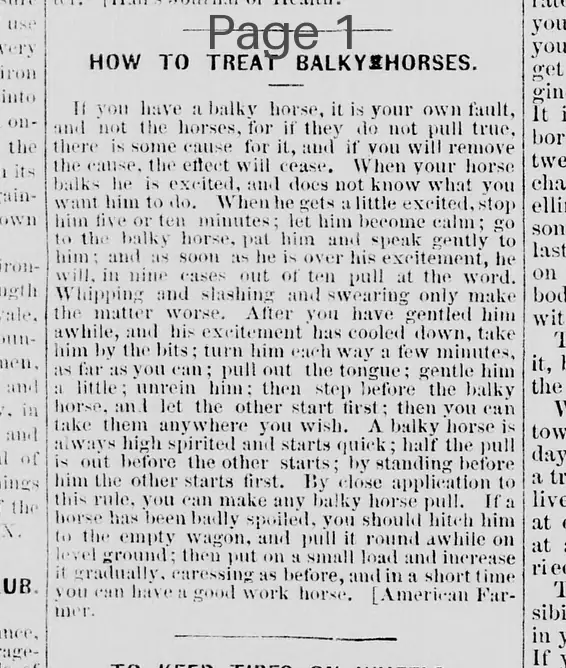
If you have a balky horse, it is your own fault, and not the horse's, for if they do not pull true, there is some cause for it, and if you will remove the cause, the effect will cease. When your horse balks he is excited, and does not know what you want him to do. When he gets a little excited, stop him five or ten minutes; let him become calm; go to the balky horse, pat him and speak gently to him; and as soon as he is over his excitement, he will, in nine cases out of ten pull at the word. Whipping and slashing and swearing only make the matter worse. After you have gentled him awhile, and his excitement has cooled down, take him by the bits; turn him each way a few minutes, as far as you can; pull out the tongue; gentle him a little; unrein him; then step before the balky horse, and let the other start first; then you can take them anywhere you wish. A balky horse is always high spirited and starts quick: half the pull is out before the other starts; by standing before him the other starts first. By close application to this rule, you can make any balky horse pull. If a horse has been badly spoiled, you should hitch him to the empty wagon, and pull it round awhile on level ground; then put on a small load and increase it gradually, caressing as before, and in a short time you can have a good work horse. [American Farmer.
If you have a balky horse, it is your own fault, and not the horse's, for if they do not pull true, there is some cause for it, and if you will remove the cause, the effect will cease. When your horse balks he is excited, and does not know what you want him to do. When he gets a little excited, stop him five or ten minutes; let him become calm; go to the balky horse, pat him and speak gently to him; and as soon as he is over his excitement, he will, in nine cases out of ten pull at the word. Whipping and slashing and swearing only make the matter worse. After you have gentled him awhile, and his excitement has cooled down, take him by the bits; turn him each way a few minutes, as far as you can; pull out the tongue; gentle him a little; unrein him; then step before the balky horse, and let the other start first; then you can take them anywhere you wish. A balky horse is always high spirited and starts quick: half the pull is out before the other starts; by standing before him the other starts first. By close application to this rule, you can make any balky horse pull. If a horse has been badly spoiled, you should hitch him to the empty wagon, and pull it round awhile on level ground; then put on a small load and increase it gradually, caressing as before, and in a short time you can have a good work horse. [American Farmer.
What sub-type of article is it?
Essay
What themes does it cover?
Agriculture Rural
Moral Virtue
What keywords are associated?
Balky Horses
Horse Training
Gentle Handling
Agricultural Advice
What entities or persons were involved?
American Farmer
Literary Details
Title
How To Treat Balky Horses
Author
American Farmer
Key Lines
If You Have A Balky Horse, It Is Your Own Fault, And Not The Horse's, For If They Do Not Pull True, There Is Some Cause For It, And If You Will Remove The Cause, The Effect Will Cease.
Whipping And Slashing And Swearing Only Make The Matter Worse.
By Close Application To This Rule, You Can Make Any Balky Horse Pull.